
Preventing Corruption in Energy Transition Mineral Supply Chains

Experts have issued an urgent call for reforms to tackle the pressing issue of corruption in transition mineral supply chains.
Corruption undermines key safeguards that protect local communities and the environment, redirects public money into private hands, and disrupts and delays production just when responsibly produced minerals are urgently needed to meet climate goals.
Corruption in mineral supply chains threatens a just energy transition and risks derailing global efforts to fight climate change. The global fight against climate change relies on our ability to scale up low-carbon infrastructure, which requires more minerals than fossil-fuel-based systems.
Governments, businesses, international organizations and the climate community need to take decisive action now to tackle corruption in transition mineral supply chains.
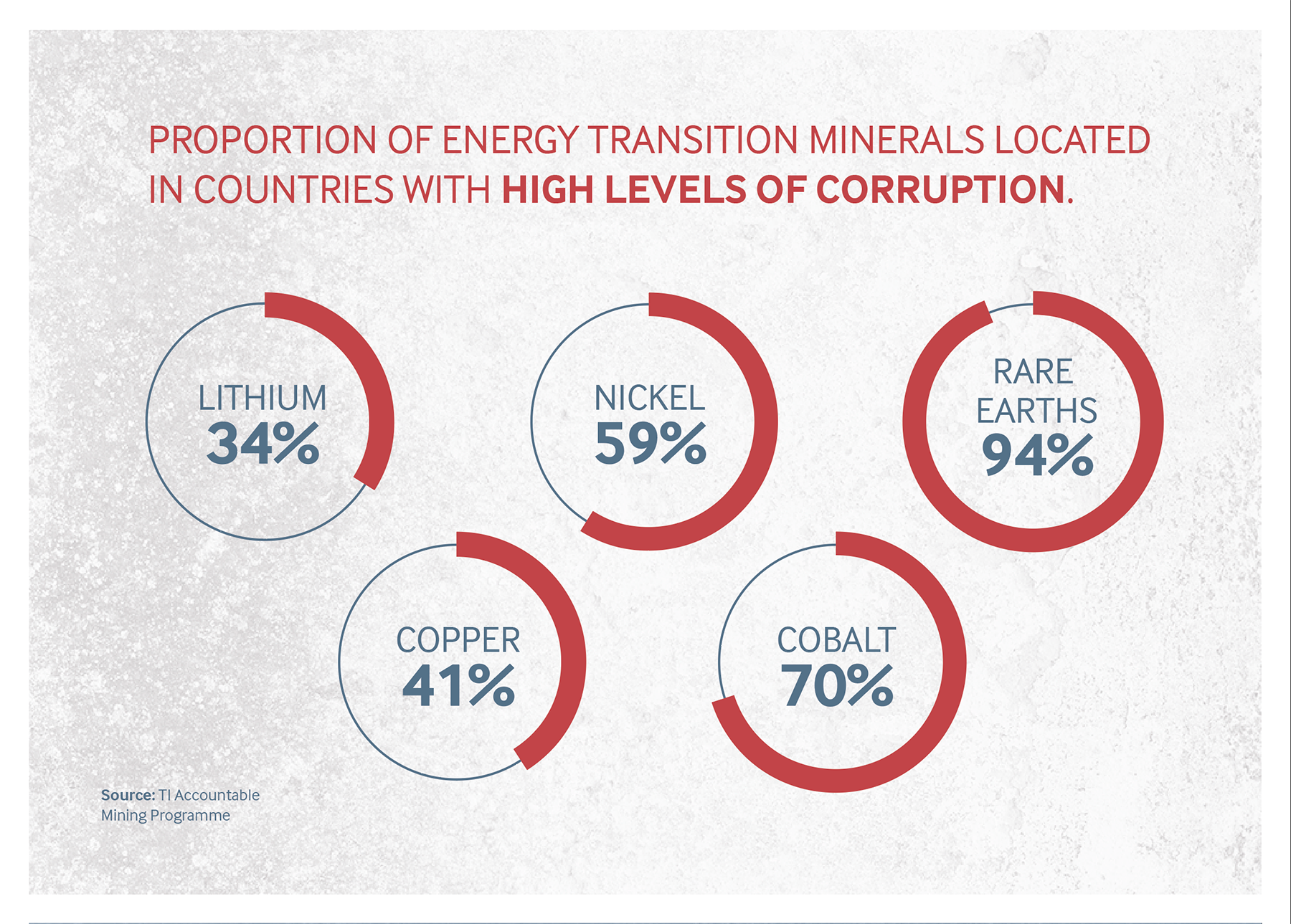
The Expert Group on Preventing Corruption in Transition Minerals, which brings together perspectives from civil society, governments, academia and international organizations, has developed a set of key recommendations to tackle corruption in mineral supply chains. The development process was led by the Natural Resource Governance Institute (NRGI), with advice from the OECD Centre for Responsible Business Conduct and the Extractive Industries Transparency Initiative (EITI).
Expert Group on Preventing Corruption in Transition Minerals
These recommendations were developed by the Expert Group on Preventing Corruption in Transition Minerals, bringing together perspectives from civil society, governments, academia and international organizations. The development process was led by NRGI with advice from the OECD Centre for Responsible Business Conduct and the EITI. The recommendations are supported by AFREWATCH, Business and Human Rights Resource Centre (BHRRC), Global Witness, Oxfam America, Publish What You Pay, RAID, Resource Matters, Transparency International Accountable Mining Programme, Dr Kathryn Sturman (Sustainable Minerals Institute, University of Queensland), and Dr Ana Bastida (University of Dundee).