
National Mining Companies: Growing Ambitions, Limited Visibility
Demand for many minerals is growing rapidly, driven by AI, military technologies, and the energy transition, creating opportunities to transform economies and societies in mineral-rich countries. But while many of these issues are making headlines, an important group of companies shaping the sector—National Mining Companies (NMCs)—remains poorly understood.
Governments in mineral-producing countries have significant ambitions for these state-owned or state-controlled companies. They want them to generate revenue, secure access to strategic minerals, support domestic processing and help develop the wider mining sector.
These companies are already important actors, and government interest is increasing. Analysis from a forthcoming Natural Resource Governance Institute (NRGI) report finds that NMCs accounted for at least 21 percent of the combined value of mine production across six critical minerals—copper, cobalt, graphite, lithium, nickel and rare earths—between 2020 and 2024. Meanwhile, at least nine new NMCs have been established in the last three years. While the role and governance of state-owned enterprises remains a key topic of discussion in many spaces, we need a deeper, more specific understanding of NMCs and the different roles they play.
NMCs established during the last three years
| Country | Name | Year established |
|---|---|---|
| Guinea | Nimba Mining Company | 2025 |
| Malawi | Malawi Mining Investment Company (MAMICO) | 2024 |
| Mali | Société de Patrimoine Minier du Mali (SOPAMIM) | 2026 |
| Mozambique | Empresa Nacional de Minas (ENM) | 2026 |
| Niger | Mazoumawa National Gold Company | 2024 |
| Niger | Timersoi National Uranium Company | 2024 |
| Niger | Teloua Safeguarding Uranium Mining Company (TSUMCO) | 2026 |
| Nigeria* | Nigeria Solid Minerals Company | 2024 |
| Uganda | Uganda National Mining Company | 2024 |
Efforts to address this gap in understanding are growing. NRGI is contributing by developing a global NMC database and an associated report that examines the diversity of these companies, examples of effective practice and cautionary experiences. This research builds on our work on national oil companies and wider SOE governance, as well as country-specific NMC guidance.
We will publish these resources in the coming months. In the database, we have compiled publicly available information on 100 NMCs, covering their mandates and activities, ownership and corporate structures, financing arrangements, governance and financial performance. We define NMCs as state-controlled companies with upstream mining as one of their main focuses. They include large, vertically integrated companies comparable in scale to major private mining companies, as well as small exploration companies and managers of minority state interests.
Together, these resources aim to improve understanding of NMCs among key stakeholders and inform decision-making by governments and the companies themselves: supporting producer-country governments to use the wealth below the ground to drive inclusive development for the people who live above it.
Countries covered by NRGI's research on 100 NMCs
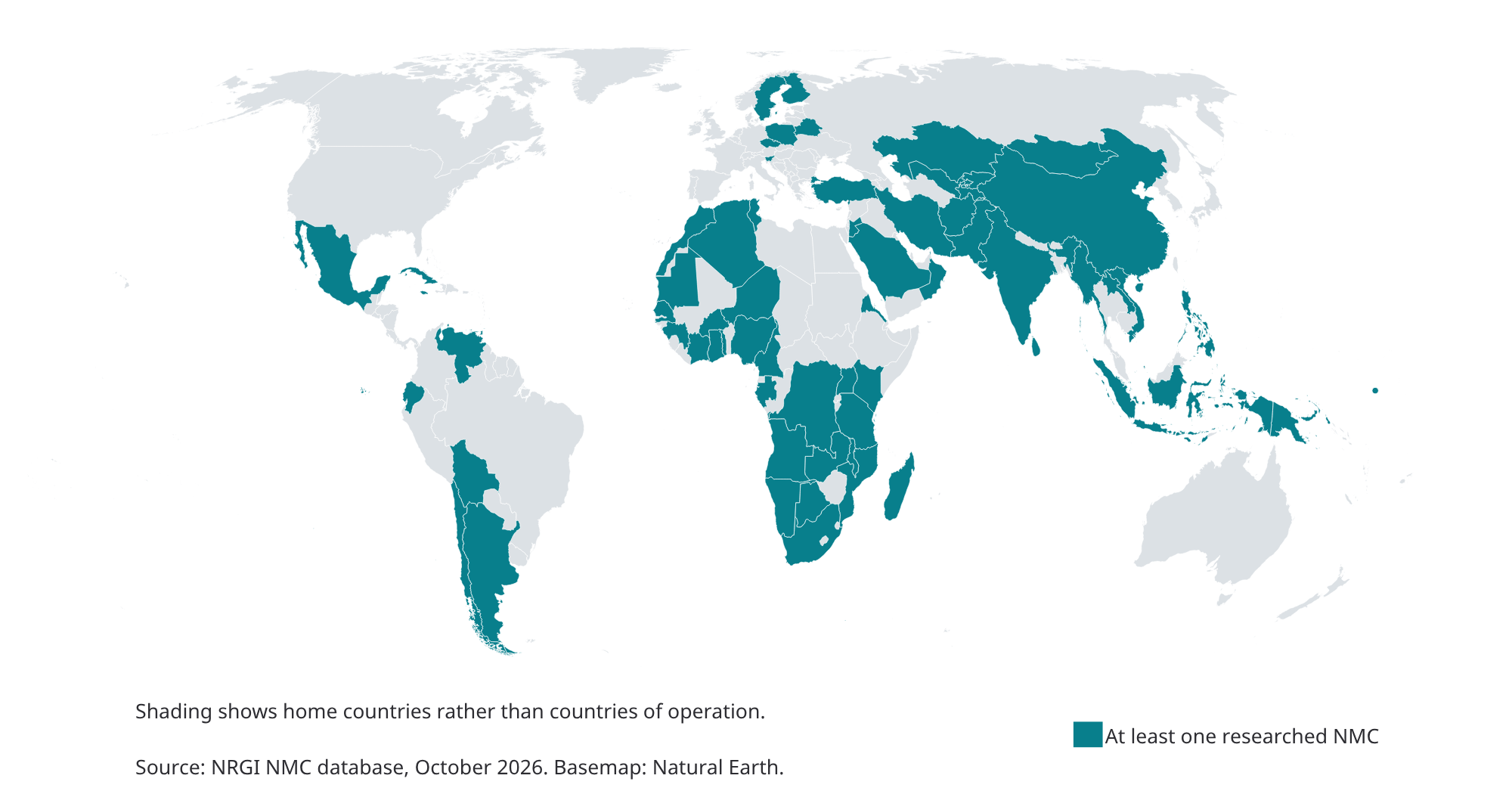
Here is a preview of some key findings:
Role in supply chains. NMCs’ contribution of at least one-fifth of mine production value across the six critical minerals illustrates their importance for global supply chains. Their significance is even greater in some mineral-producing countries, including major global producers, where they account for most or all production of particular minerals. For example, OCP is the sole producer of Morocco’s phosphate. Société Nationale Industrielle et Minière (SNIM) produced 97 percent of Mauritania’s iron ore between 2020 and 2024, and Coal India and other Indian NMCs produced 85 percent of India’s coal during the same period.
Finances. Financial performance varies widely. Some NMCs appear highly profitable. Others make large losses and risk diverting scarce public resources from other government priorities. For example, following two years of substantial losses, Poland’s JSW recently announced plans to reduce its workforce by 21 percent as part of a financial recovery plan.
Transparency. Despite this importance, public disclosure remains weak. As of October 2026, we found no recent publicly available annual report for 63 percent of the 94 researched companies more than three years old, and no recent publicly available audited financial statements for 57 percent. These gaps limit the ability of governments, oversight bodies and citizens to assess commercial performance, delivery of public-policy objectives and exposure to fiscal risks.
We look forward to sharing the fuller findings and engaging with governments, NMCs, civil society and other researchers in the coming months. If you are working on these issues, or would like to discuss the research, please get in touch. And, if you’d like to register to receive the report and database when available, please fill in the form below.
Authors

Thomas Scurfield
Senior Economic Analyst

Amir Shafaie
Legal and Economic Programs Director