National Oil Company Profile: Petroecuador
Highlights
- Oil production in Ecuador, including Petroecuador’s, has remained stable since 2005, averaging between 3.5 and 4 mmboe/day. At current production rates and without further discoveries, Petroecuador’s oil reserves will be depleted by 2032. The company does not produce substantial amounts of gas.
- Because of Petroecuador’s extremely low production costs, 100 percent of its investment pipeline is likely to break even in a moderately paced energy transition scenario.
- Ecuador depends heavily on oil revenues for its fiscal sustainability, resulting in substantial economic transition risks. Despite this risk context, Petroecuador has not made commitments towards emission reductions leading to net zero.
See the accompanying guide for definitions of all variables and explanations of the terms used. Sources are referenced with a number in parentheses, e.g., (1), and listed at the end of the profile together with the reference year. An explanation of the energy transition scenarios used is also at the end of the profile, preceding the references.
This profile was last updated in August 2024.
Key statistics
| Potential emissions from reserves (proved, 1P) (1) | 183 Mt CO₂e |
| Home country income level (2) | Upper-middle income |
| Equitable phase-out responsibility (11) | By 2046 |
| Company transition risk: share of investment that does not break even in a moderate transition scenario (1, 19) | 0% |
| Government revenues from oil and gas at risk in a moderate transition scenario, as share of current oil and gas government revenue (8) | 82% |
| Current share of total government revenue from oil and gas (8) | 17% |
Company governance
Petroecuador was founded in 1989, evolving from the Corporación Estatal Petrolera Ecuatoriana (previously established in 1972), as a company with more modern management practices and a renewed corporate structure.
Petroecuador is an integrated group engaged in oil and gas exploration, production, refining and transport. It is fully owned by the Ecuadorian government and operates in its home market.
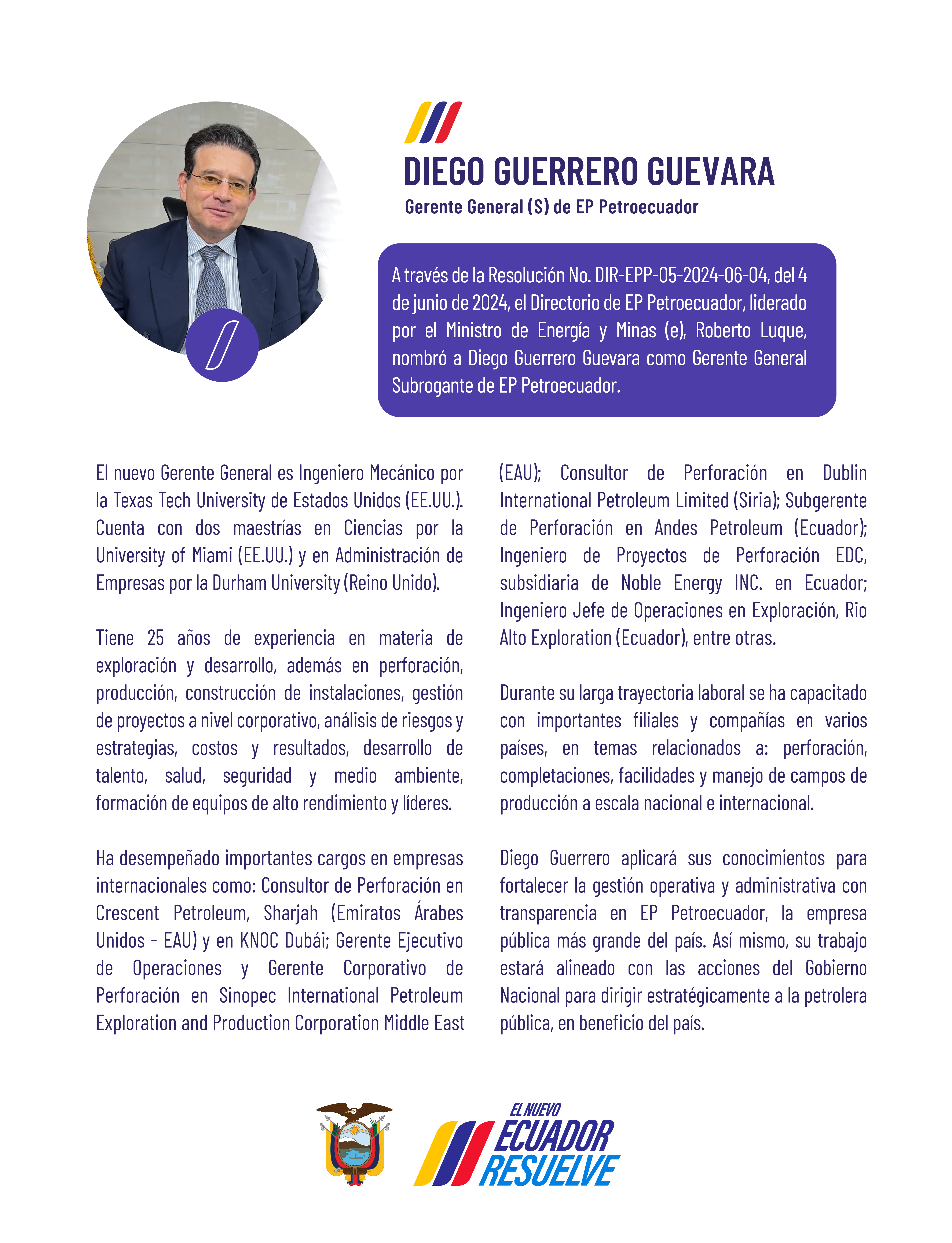
Since June 2024, Petroecuador’s general manager has been Diego Guerrero Guevara. The national oil company (NOC) provides limited information on its corporate governance and on its board of directors, operating instead with the practices of an Ecuadorian state-owned enterprise.
Petroecuador has the structure of a state-owned enterprise and is therefore not listed on stock exchanges. The government is the sole owner of the company.
| Founded (20) | 1989 |
| Listed on exchange (5) | No |
| NOC share in the country’s total oil production (3) | 39% |
| NOC share in the country’s total gas production (3) | 50% |
| NOC ownership share of the country’s oil reserves (3) | 78% |
| Employment (3) | 10,114 |
| OPEC member country (15) | No |
| International exploration and production operations (1, 5) | No |
| Subsidiaries (5) | 6 subsidiaries in 1 country |
Ownership
| Government of Ecuador | 100% |
Source: (5)
Environmental, social and governance performance
Petroecuador does not regularly publish information on its performance against environmental, social and governance (ESG) indicators, or regular sustainability reports. Its Resource Governance Index score (which measures the transparency and accountability of fossil fuel revenue management, value realization, and the quality of the wider enabling governance environment) does not significantly differ from regional and global averages.
| Company | Country | ESG score (5) | Environmental score (5) | Social score (5) | Governance score (5) | Resource Governance Index score (15) |
| Petroecuador | Ecuador | N/A | N/A | N/A | N/A | 54 |
| Ecopetrol | Colombia | 69 | 59 | 75 | 72 | 71 |
| Petrobras | Brazil | 75 | 62 | 90 | 68 | 71 |
| YPF | Argentina | 71 | 63 | 67 | 89 | 57 |
| Regional median | 72 | 61 | 77 | 76 | 59 | |
Reserves and production
Petroecuador’s oil production has been somewhat stable since 2005. However, Rystad Energy expects its production to start to decline from 2024, even in scenarios assuming the highest oil price (e.g., the Expansion scenario). At current production rates and without new discoveries, the oil reserves will last for only eight years, and gas reserves for 11 years.
Sources: (1, 3, NRGI visualization)
| Refining capacity (bpd) (14) | 175,000 |
| Pipeline capacity (bpd) (14) | 360,000 |
| Oil reserves of NOC (proved, 1P) (million boe) (1) | 1,022 |
| Oil reserves of NOC as a share of reserves of country (1) | 78% |
| Years of oil reserves left at current production (1) | 8 |
| Gas reserves of NOC (million boe) (1) | 10 |
| Gas reserves of NOC as a share of reserves of country (1) | 74% |
| Years of gas reserves left at current production (1) | 11 |
Transition and other economic risks
Ecuador’s public finances are dependent on oil and gas for 17 percent of revenues, and 82 percent of these oil and gas revenues are at risk in the moderate transition scenario. This entails risks to Ecuador’s fiscal sustainability in the context of the energy transition. Ecuador’s exports are also highly dependent on oil.
Petroecuador has yet to adopt the reporting and corporate governance practices typical of the most efficient NOCs. While Petroecuador has a very low level of indebtedness, Ecuador faces strong fiscal transition risks which put further pressure on its low credit rating.
Economic dependence on fossil fuel revenues and exports
| Indicator | 2013–2017 | 2018–2022 |
| NOC transfers to government as a share of total fiscal revenue (3, 1) | N/A | N/A |
| Crude oil export revenues as a share of country’s export revenues (17, 19) | 40% | 30% |
| Gas export revenues as a share of country’s export revenues (17, 19) | 0% | 0% |
Government revenues at risk in the transition
| Share of oil and gas revenue in total government revenue (8) | Government revenues from oil and gas at risk in the moderate transition scenario, as share of current oil and gas government revenue (8) | |
| Ecuador | 17% | 82% |
| Suriname | 11% | 1% |
| Colombia | 5% | 83% |
| Regional average | 27% | 70% |
| Global average | 44% | 56% |
Credit ratings
| Fitch (5) | Moody’s (5) | S&P (5) | |
| Ecuador | CCC+ | Caa3 | B– |
| Petroecuador | N/A | N/A | N/A |
Petroecuador financial performance
| Company | Country | Liquidity: current ratio (1, 3) | Efficiency and profits: return on capital employed (1, 3) | Indebtedness: leverage (1, 3) |
| Petroecuador | Ecuador | N/A | N/A | 8% |
| Petrobras | Brazil | 39% | 13% | 51% |
| Pemex | Mexico | 10% | 17% | 161% |
| Regional median | 22% | 19% | 44% | |
| Global median | 30% | 15% | 30% | |
| Global average | 42% | 20% | 36% | |
Investment at risk in different energy transition scenarios
Source: (19)
In the moderate transition scenario, almost 100 percent of Ecopetrol’s 2023 to 2032 investment pipeline breaks even.
Energy security
Despite being self-sufficient in crude oil, and even an exporter of crude oil, Ecuador does not have sufficient refining capacity. It therefore must import substantial quantities of refined oil products, more than USD 4.8 billion in 2022 (23). However, it has only eight years left of reserves at current rates of production. The country’s power system relies heavily on renewables, particularly on hydropower, for 80 percent of its electricity generation (4).
The NOC has not set any targets to reduce its emissions and has not significantly diversified its portfolio beyond oil and gas. Petroecuador has not actively engaged with most transition performance indicators. Petroecuador’s scope 1, 2 and 3 emissions intensity decreased marginally between 2017 and 2022; however, its emissions intensity is still among the highest in the sector at 177 kg CO₂e/boe (22).
| Refining throughput of NOC as a share of final country consumption of oil products (6) | N/A |
| Years of oil reserves left at current production (1) | 8 |
| Years of gas reserves left at current production (1) | 11 |
| Crude oil and refined oil products imports as a share of national consumption of oil products (4) | N/A |
| Share of oil and gas in primary energy consumption of country (4) | 78% |
| Gas imports as a share of country supply of gas (4) | 0% |
| Share of electricity production of country from renewables (4) | 80% |
Climate impacts and greenhouse gas emissions
Petroecuador has high scope 1 and 2 emissions per barrel, and the company has yet to provide solutions to improve upon this. To align with a 1.5°C pathway, Petroecuador needs to decrease its scope 1, 2 and 3 emissions intensity by nearly 4 percent annually.
Ecuador’s President Daniel Noboa aims to pause or reverse the results of a referendum in which 54 percent of Ecuadorians voted to ban drilling in the block 43 field in Yasuní National Park, which is part of the Amazon.
| NOC emissions reduction target, scope 3 emissions (14) | N/A |
| Annual scope 1 and 2 emissions of NOC (3) | N/A |
| Average GHG emitted before combustion per barrel of oil produced by companies in country (9) | 177 kg CO₂e/boe |
| Average GHG emitted before combustion per boe of gas produced by companies in country (9) | 201 kg CO₂e/boe |
| OGDC member company (10) | No |
| NOC net zero target, scope 1 and 2 emissions (5) | N/A |
| Equitable phase-out responsibility of the country (11) | 2046 |
Energy transition scenarios
We use four energy transition scenarios:
Fast. We based this scenario on the oil and gas demand estimated in the International Energy Agency’s (IEA) Net Zero Emissions by 2050 Scenario, which maps out a transition pathway that would limit global warming to 1.5° C. This assumes large-scale negative emissions enabled by technologies such as carbon capture and storage.
Moderate. We based this scenario on the IEA’s Announced Pledges Scenario which assumes the full and timely implementation of national energy and climate goals, including net zero emissions targets.
Slow. We based this scenario on the IEA’s Stated Policies Scenario which assume governments follow their current set of energy and climate policies.
Expansion. We based this scenario on the Organization of Petroleum Exporting Countries’ (OPEC) scenario which assumes a continued expansion in demand up to 2045.
Sources
All data are from the latest year available as referenced in the relevant source as of August 2024. For most data this is 2024. Data related to emissions and NOC finances are from 2023 or in some cases 2022. Data on country-level oil reserves and production, the ownership of oil reserves, employment and energy security are from 2022. The Resource Governance Index score is from 2021. If you find an error in this profile, please email noc_profiles@resourcegovernance.org.
- Rystad Energy UCube, 2024 (proprietary data)
- World Bank, 2024
- NOC Database, 2023
- International Energy Agency (IEA), 2023
- S&P Global IQ, 2024 (proprietary data)
- Statistical Review of World Energy, 2024
- Euromonitor, 2023
- Carbon Tracker, 2023
- Fossil Fuel Registry, 2023
- Oil & Gas Decarbonization Charter (OGDC), 2024
- An Equitable Phase Out of Fossil Fuel Extraction (Equity Review), 2023
- Facing the Future (NRGI), 2023
- Petroecuador announcement, 2024
- U.S. Energy Information Administration, 2024
- Resource Governance Index (NRGI), 2021
- OPEC, 2024
- UN Comtrade, 2024
- Global Oil & Gas Exit List, 2024
- Riskier Bets, Smaller Pockets (NRGI), 2023
- Petroecuador website, 2015
- World Benchmarking Alliance, 2023
- Observatory of Economic Complexity, 2024
Explore how national oil companies are navigating the energy transition
NRGI’s national oil company profiles provide detailed insights into each company’s structure, strategy and role in the energy transition.