
Facing the Future: What National Oil Companies Say About the Energy Transition

-
National oil companies (NOCs) should publicly acknowledge the risk of the energy transition, assess this risk, and act by implementing mitigation plans.
-
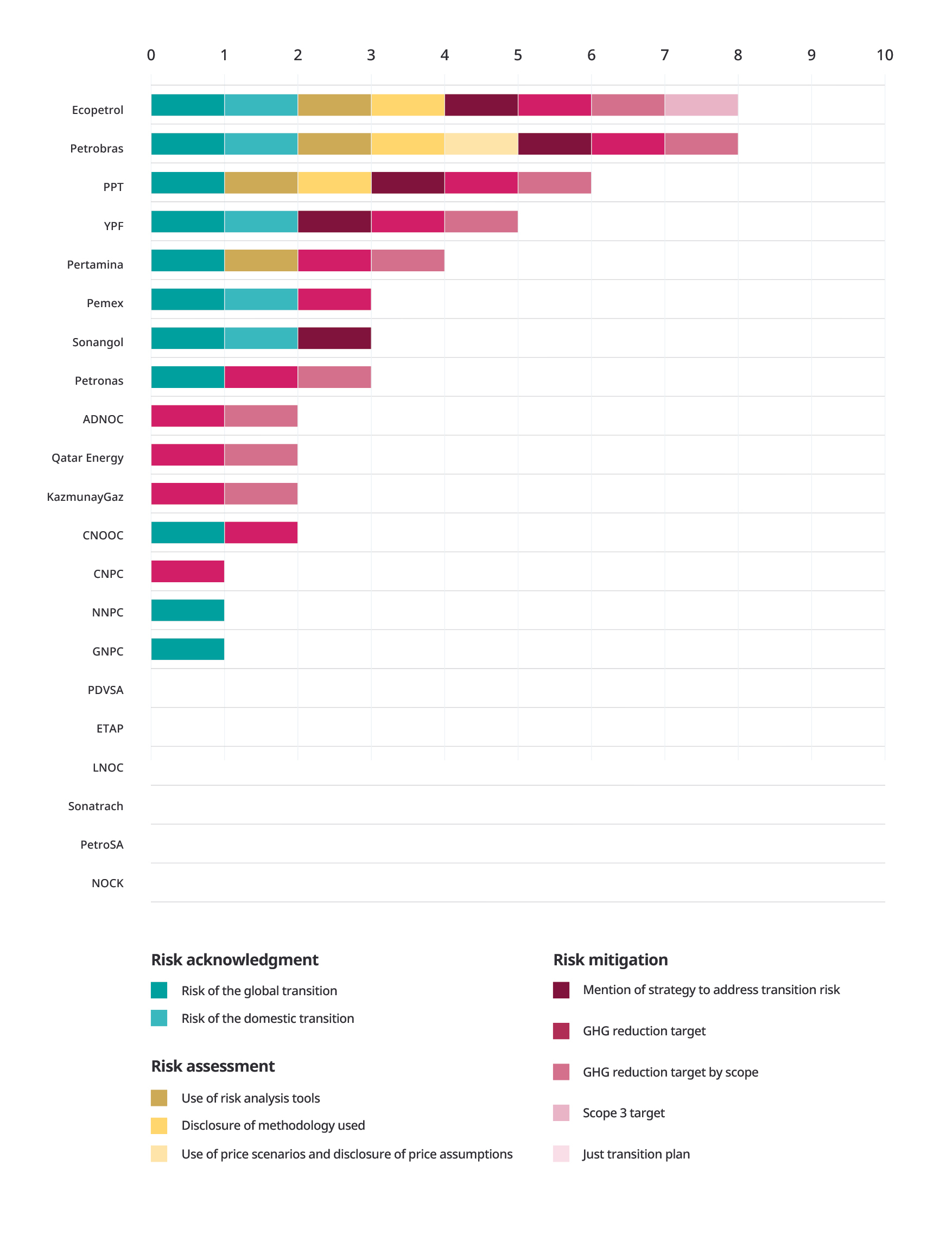
Only 9 out of 21 NOCs analyzed acknowledge the risk of the energy transition, 4 have mentioned the use of transition risk assessments, and 5 have explicitly mentioned strategies to mitigate the risk.
-
None of the NOCs have published “just transition plans” detailing how they will help workers and communities.
-
NOCs do not plan to decrease investments in risky oil and gas assets. Petrobras (Brazil), Petronas (Malaysia) and Sonangol (Angola) are divesting from less valuable assets, but not necessarily to mitigate transition risk or downsize operations.
-
Some NOCs, such as NNPC (Nigeria) and GNPC (Ghana), want to expedite drilling before oil and gas demand falls and acquire assets divested by other companies.
-
At least six NOCs intend to increase oil and gas investment to secure energy supplies.
-
Most NOCs intend to diversify, especially into gas, oil refineries, petrochemicals and renewable energy. However, it is unclear how much NOCs are spending on diversification or whether these are effective mitigation strategies.
-
NOCs can learn from each other. Two NOCs—Ecopetrol (Colombia) and Petrobras—are clear leaders in terms of recognition of energy transition risk. However, NOCs disclosing more transition risk information are not necessarily also those reducing higher-risk investments.
NOCs’ readiness to manage energy transition risk (based on public statements)
National oil companies (NOCs) produce half of the world’s oil, yet only recently have climate organizations considered NOCs a worthwhile area for advocacy.


Riskier Bets, Smaller Pockets: How National Oil Companies Are Spending Public Money Amid the Energy Transition

-
Expecting a slow energy transition away from fossil fuels, national oil companies (NOCs) will likely invest USD 1.8 trillion in upstream oil and gas developments and expansions over the next 10 years.
-
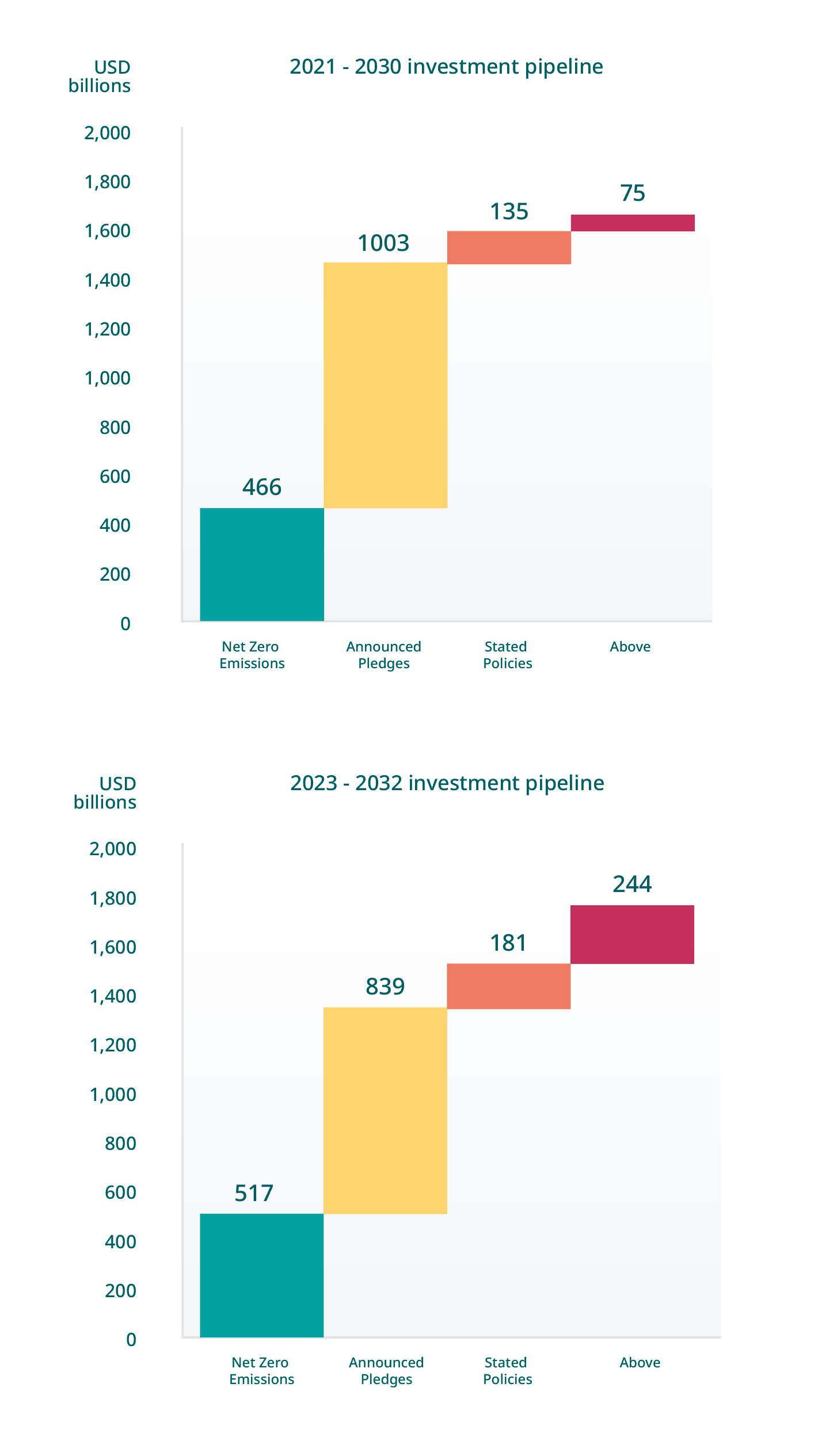
But $425 billion—a quarter of the NOCs’ planned investment—will be unprofitable if oil demand falls to 55 million barrels a day, in line with the International Energy Agency’s Announced Pledges Scenario. This is the highest risk portion of the portfolio and has doubled since the Russian invasion of Ukraine.
-
NOCs will only profit from around $1.2 trillion of investment (71 percent of the total NOC investment) if humanity fails to contain global temperature rise to below 1.5°C, pushing the world toward climate catastrophe.
-
While NOCs are making riskier bets, their debt is rising in some regions. Between 2011 and 2022, the average debt to total asset value of NOCs in sub-Saharan Africa, the Middle East and North Africa, and Latin America rose by a third.
-
Governments’ financial pockets are shrinking. Between 2011 and 2021, the average government debt as a proportion of gross domestic product doubled.
-
Yet many NOCs have not publicly acknowledged the growing risks of the energy transition. They and their governments must examine how they can generate sufficient revenue and energy for citizens without making even riskier bets with public money.
As the energy transition accelerates and government finances deteriorate national oil companies (NOCs) are gambling their countries’ wealth.
As NOCs, along with the rest of the oil industry, expect oil demand to stay high, they will likely invest USD 1.8 trillion in new upstream developments and project expansions over the next 10 years. However, $425 billion of this investment is unlikely to be profitable if global oil demand falls from the current 100 million barrels a day to 55 million barrels a day by 2050, in line with the International Energy Agency’s Announced Pledges Scenario. This is twice the investment NOCs were planning in 2021 before the Russian invasion of Ukraine. In addition, NOCs will likely invest $1.2 trillion in projects that will only break even if humanity fails to keep the global rise in temperatures below 1.5°C, pushing the world toward climate catastrophe.
Even if demand persists, the future is not business-as-usual for NOCs and their governments. Continued burning of fossil fuels will result in further climate damage to nature, societies and economies: a 13 to 29 percent fall in gross domestic product (GDP) for non- OECD countries by mid-century. Nine out of the ten most affected economies have NOCs. Governments should examine how this radically increases uncertainty and challenges the roles of NOCs and the public capital they are investing.
NOCs in China, Saudi Arabia, Russia and Brazil are set to spend the most. In particular, Chinese and other Asia-Pacific NOCs are increasing their investments significantly compared to their plans two years ago. Conversely, NOCs in Latin America, Eurasia and sub-Saharan Africa are reducing their investments.
NOCs in Sub-Saharan Africa, Asia-Pacific and Eurasia are generally the most exposed to risk. A third of all NOCs—including Indonesia’s Pertamina, Nigeria’s NNPC and Mexico’s Pemex—are due to invest more than a third of their investment pipeline in projects that would not break even under the IEA’s Announced Pledges Scenario (APS). A scenario in which governments meet their climate pledges to reduce oil and gas demand. Some smaller NOCs are highly exposed: four-fifths of Uganda’s UNOC and Cameroon’s SNH investment pipelines fail to break even in the APS.
NOC debt is rising in some regions. Between 2011 and 2022, the average debt to total asset value of NOCs in sub-Saharan Africa, the Middle East and North Africa, and Latin America rose by a third.
NOCs’ investment in risky assets represents a large portion of state budgets—with significant consequences for governments’ ability to fund public services in the future. UNOC and NNPC are due to invest an amount equivalent to more than 30 percent of their governments’ annual expenditure in projects that do not break even in the APS. QatarEnergy and Mozambique’s ENH are also betting large amounts relative to their governments’ budgets, but their focus on gas may reduce their risk exposure.
Value of all NOCs’ aggregate “investment pipelines” measured in 2021 and 2023, by scenarios in which they break even


Civic Space is Crucial for Resource Governance and the Energy Transition—But It’s Endangered

On 23 July 2023 Azerbaijani security forces violently detained scholar and political activist Gubad Ibadoghlu on fabricated charges of financial impropriety. Since then, authorities have attempted to connect him with an extremist religious group, charges that could carry a sentence of 12 years in jail. The likely reason for this persecution is Ibadoghlu’s work as an advocate for responsible natural resource governance and accountability in the Azerbaijani extractive industries.

Despite winning hosting rights for this year’s COP29 UN climate summit, Azerbaijan is no stranger to human rights abuses and censorship. The oil and gas industry dominates the country’s economy, bringing in around 90 percent of export revenues and 60 percent of the government’s budget, supporting a governing elite linked with corruption and authoritarianism. In this context, authorities have routinely quashed citizens’ efforts to bring meaningful public accountability to oil, gas and mining revenues, with the country notably withdrawing from the Extractive Industries Transparency Initiative (EITI) in 2017 after it failed to meet the initiative’s requirements on civil society engagement.
Civic space in danger
Unfortunately, Azerbaijan is not the only oil, gas or mineral producer where civic space—the environment that enables civil society to play a role in the political, economic and social life of a country—is under threat. Over the last 12 months, NRGI has tracked threats to civic space in the 57 countries that implement the EITI using reporting from the Business & Human Rights Resource Center, CIVICUS and the RSF Barometer. In the last year alone abuses against human rights defenders and journalists, or strategic lawsuits against public participation (SLAPPs), were recorded in 67 percent of EITI implementing countries (38 countries), with abuses directly linked to the extractive industries in 13 countries.

In Niger, authorities arbitrarily detained Abdoulaye Seydou and Adamou Idrissa, both members of the ROTAB/Publish What You Pay-Niger coalition, for their peaceful and legitimate defense of human rights. In the Philippines, radio broadcaster Cresenciano Bunduqui was shot dead outside his home after he had spoken out about a recent oil spill, illegal gambling and local political issues on his radio show. In Kazakhstan, community members reported that residents protesting a gold project were brutally dispersed by company security following environmental protests over a failed public hearing concerning the environmental impacts of the plant. In Mexico, human rights defenders Antonio Díaz Valencia and Ricardo Arturo Lagunes Gasca disappeared after engaging in community negotiations over the operations of the Las Encinas iron mine.

These incidents illustrate a broader trend. The 2023 CIVICUS Monitor scoring shows that the percentage of the world’s population living in countries with closed civic space is the highest since 2018 when CIVICUS started tracking civic space conditions, rising from 26 to 31 percent during this period.
Fertile ground for corruption
The ramifications of this kind of violence for public accountability are particularly troubling. Where citizens and journalists are afraid of what might happen if they speak out, they hold back from analyzing the extractive industries and publishing the facts. This provides cover for some elites and other unscrupulous actors to engage in corruption. It also means that mistakes and mismanagement in day-to-day extractive operations go unreported, increasing the likelihood of serious environmental and social impacts, and undermining the optimization of revenues and other benefits that extractive projects might bring.
Moreover, oppression that takes place alongside actual improvements in transparency (such as the data produced by EITI processes) adds the specter of “zombie transparency”—disclosures that produce a veneer of good governance but upon which no one takes action. In its most severe form, zombie transparency can undermine confidence in data and disclosure more broadly, playing into the hands of those who seek to divert financial flows from the extractive industries to suit their own personal agendas.
EITI fights back
For these reasons the EITI board established a civil society protocol in 2015. The protocol protects civic space by specifying criteria by which the EITI Board can assess whether civil society is able to adequately participate in a country’s EITI processes and express views related to natural resource governance. These include tests relating to the abilities of civil society actors: to express opinions without restraint or reprisal; to operate freely; to communicate and cooperate with each other; to be fully, actively and effectively engaged in all stages of the EITI process; and to access and contribute to public decision-making. These safeguards have sharp teeth, and the EITI board has suspended several countries from the initiative and rejected others’ applications to join in cases where countries’ civic space is closed.

Further, in the latest update to the EITI standard in 2023, EITI members agreed that multistakeholder groups that govern national EITI processes should monitor adherence to the protocol. Speaking at the EITI global conference in Dakar last year, NRGI president and CEO Suneeta Kaimal welcomed this development, noting that “the EITI community can use this requirement to support multistakeholder groups to actively monitor civic space, amplify and address threats.”
The work ahead
Despite these advances within EITI, the situation remains bleak. In 2022 colleagues from NRGI, Publish What You Pay, Oxfam America, the International Center for Not-for-Profit Law and the Institute for Development Studies gathered to explore new strategies for protecting civic space. Unfortunately, two years later, many of the recommendations from that work still require implementation:
- The new EITI board, in place since June, should commit to more efficiently translating EITI standards into implementation; and to enforcing the standards it sets—even in tough cases.
- Bilateral and philanthropic funders should reinforce existing mechanisms for dialogue and participation where possible. Recent changes in donor priorities linked to the energy transition have resulted in an underfunding of efforts to ensure robust governance and good decision making. But these are more needed than ever as governments and companies make important strategic shifts based on changing global energy patterns.
- Extractive and energy companies should speak up and support the protection of civic space, which is key to positive economic outcomes.Investors should strengthen criteria related to civic space protection in their business decisions, and encourage companies and governments to ensure the protection of civic space as essential to environmental, social and governance (ESG) considerations and a positive investment climate.
- International financial institutions should make greater use of their lending power to call for action to support civic space.
Civic space is a necessary ingredient for public scrutiny and effective resource governance. If the citizens of producer countries are to benefit from their natural resources amid the energy transition, civic space must be protected.
Mexico’s energy and climate contradictions are laid bare at COP28
COP28 puts spotlight on state oil giants
Not all Arab states backing Saudi Arabia in COP28 talks
Net-Zero Targets and the Energy Transition
Inside the oil kingdom's climate summit
Reading the COP28 Tea Leaves on Gas

You’ve seen the headlines: the final agreement from COP28 includes some long-overdue if limited commitments to move away from fossil fuels. But then there is this sentence, tucked away in paragraph 29: “Transitional fuels can play a role in facilitating the energy transition while ensuring energy security.” It reads almost like a throwaway line, yet some commentators and state parties see it as the biggest of a “litany of loopholes” that could entrench fossil fuel use for decades.
What exactly is a “transitional fuel”? The agreement doesn’t say, but the term has been used in the past to refer to fossil gas. Fossil fuel lobbyists were out in force in Dubai, as were climate negotiators from some of the world’s biggest, wealthiest and most influential gas exporters like the U.S., Australia and Qatar.
This comes as less wealthy governments across Africa, Asia and Latin America are making plans to produce and burn more gas in the name of energy security. The list includes Colombia, Ghana, Lebanon, Mexico, Nigeria and Senegal. Their leaders argue that this will give them sufficient, uninterrupted electricity service; lower, more stable energy costs and prices; and the ability to make decisions about energy free from foreign interests, rules and norms.
Some of these countries will need gas to achieve these goals, at least for a while. But perversely, depending too much on gas for energy security can make economies and energy systems—and ultimately, the lives of people—less stable.
The challenges start with predicting how much gas a country will need for its own energy. It is simply hard to know how many new users of gas a country will have, how long it will take to build new gas infrastructure, or how quickly the country will transition to cleaner energy sources. The costs of a bad guess can be high, from electricity shortages to wasted public revenues, as countries like Ghana, Thailand or Egypt have learned.
And governments of some lower- and middle-income countries aren’t being realistic about where future gas supplies will come from, rolling out big plans that will not materialize for several reasons. The extraction of gas for domestic use rather than exports is becoming especially tough to finance: investors see it as not only bad for the climate but also unprofitable. If a country’s remaining gas reserves cost too much to produce, the state will probably have to spend more on subsidies or make consumers pay higher prices for electricity and other goods and services made with gas.
And what happens when a country cannot extract enough of its own gas to fuel the power plants and other domestic gas infrastructure it has built? Its main choice will be to buy imported gas, either through pipelines or aboard ships, as liquified natural gas (LNG). Deals to import gas can play a role in boosting energy security, yet governments should approach them with caution. They can tie a country’s energy system to many forces and events outside its control, sometimes with disastrous results.
In the worst cases, dependence on imported LNG can send shock waves through an economy, as middle-income South Asian gas producers like Pakistan and Bangladesh learned after Russia invaded Ukraine in 2022. Sudden LNG shortages and record prices led to closed power plants and factories; skyrocketing electricity costs; weaker local currencies and foreign exchange shortages; costly public debt; high inflation; millions of lost jobs; and a return to even dirtier, dangerous fuel sources like coal and private generators.
Faced with such risks, governments need to find right-sized, time-bound roles for gas. Otherwise, they could lock their people into using an unsustainable, expensive, polluting fuel with a very uncertain future. They also need to fully consider renewables as an alternative to gas.
Gas advocates rightly claim that solar and wind power cannot yet provide everything gas can: they are not ingredients in fertilizer or plastics, for instance, nor can they make heat for manufacturing cement, steel or other metals that countries need. Renewables also come with their own challenges, like intermittent power supply and high up-front costs, which can make them a tough choice for lower-income countries. Compared to gas power plants, though, solar and wind farms can be easier to plan for, quicker to build, less dependent on foreign energy prices and market trends, and more attractive to a wider pool of investors. All these advantages are likely to increase with time.
As part of NRGI’s work on domestic energy transition, we aim to help decisionmakers and oversight actors in the countries where we work, from Senegal and Nigeria to Mexico and Colombia, interrogate whether further investments in gas truly will make them more secure. The second part of our gas-to-power framework, coming in January, will focus on this question. The framework helps non-experts in government, civil society, research and the media weigh the competing claims around gas, laying out the latest thinking in a balanced way.
In the current debate around gas extraction and use, buzzwords like energy security can obscure the risks countries can face if they invest too much in gas, as well as the challenges of leaving fossil fuels behind. A different kind of debate is needed, one that focuses more on which energy sources can best meet a country’s needs at the least cost to its economy, people’s lives and the planet. COP28’s nebulous nod to “transitional fuels” shows there is still work to be done.
State Oil Companies Betting Billions Against the UAE Consensus

After the COP28 UN climate conference in Dubai unprecedented attention has finally landed on the hidden half of the world’s oil and gas industry: national oil companies (NOCs). These state companies produce half the world’s oil and gas, yet their finances and operations are often hidden from the view of their countries’ own citizens.
Bringing to light and engaging with the operations of NOCs is now crucial and urgent. The landmark agreement by 195 countries in Dubai—the “UAE Consensus”— calls for a “transition away from fossil fuels.” Having slow-walked climate action for decades, the richest and most polluting countries have left the global carbon budget so tight that even NOCs in the poorest countries have little time to transition.
(Meanwhile NOCs’ efforts to reduce carbon and methane pollution from the production of oil and gas are insufficient. The Oil and Gas Decarbonization Charter announced in the early days of COP28 falls well short of what is needed to reach the Paris Agreement goals.)
The COP decision sends a clear message to national oil companies and their governments: look to a greener future. Instead NOCs are on course to spend $1.8 trillion in the coming decade to produce fossil fuels. This is mostly public money funding oil and gas in amounts far beyond levels consistent with a 1.5C upper temperature increase limit.
In essence, this money is a big bet that energy transition fails. More than two-thirds—$1.2 trillion—of this spending will only break even if the world consumes oil and gas at a rate that will cause catastrophic climate change. Not only does the UAE Consensus make this bet look riskier but governments with shrinking pockets will be less able to bail out NOCs whose bets turn bad. Across countries with NOCs, the average government debt as a proportion of gross domestic product doubled between 2011 and 2021.
How might NOCs and their governments respond? They must first recognize that there can be no more business as usual. Either the global transition fails to meet the UAE Consensus and the resulting climate crisis hits hard, or the transition erodes fossil fuel demand on which these countries depend.
From there, they should assess how their strategies will fare in a range of energy transition scenarios. How would revenue shortfalls affect the economic health of their countries? Saudi Aramco and ADNOC enjoy plentiful, low-cost oil that positions them to be among the “last producers standing.” But most NOCs don’t.
Where profit hinges on global climate inaction, NOCs must pursue new pathways or right-size their spending plans; and if they don’t or can’t, their governments should tighten the reins.
Before COP28, we examined the public statements of 21 leading NOCs and found that more than half hadn’t even acknowledged the threat of the global energy transition to their business models and the fiscal well-being of their countries. And fewer than a quarter had articulated plans to mitigate this risk. The global call to transition away from fossil fuels may now change these attitudes.
Amid a largely discouraging picture, some positive examples stand out. Colombia’s Ecopetrol has disclosed a detailed analysis of transition risk and the use of risk assessment tools. This is bold—the company’s portfolio relies heavily on high-cost oil that won’t make economic sense in a greener future—but acknowledging risk and identifying options are the first steps to progress.
Yet with few obvious options for replacing the revenues and energy that oil and gas bring, political leaders and NOC executives in such countries will likely remain hooked on hydrocarbons. They need support to take these steps.
NOCs and their governments—especially the lowest-income producers with the least ability to transition their economies on their own—shouldn’t bear the whole burden of transition. Wealthy, heavily polluting countries should be the first and fastest to phase out their production—and to finance transition in lower-income countries where citizens disproportionately suffer climate impacts and have contributed far less to warming. Without concrete commitments by wealthy countries on this front, the call for a “just and equitable” transition in the UAE Consensus risks falling flat.
The UAE Consensus requires both NOCs and the international community to respond, and to do so in this crucial decade.