
National Oil Companies and the Energy Transition: Looking to COP28 and Beyond
Online and in-person

National oil companies from emerging markets produce about 50 percent of the world’s oil, hold about 50 percent of global refining capacity, and own most of the world’s oil and gas reserves. With oil prices at more than USD 80/barrel, they are also generating significant oil revenues. With COP28 taking place in the United Arab Emirates, a major oil exporting country with a strong national oil company, the role of oil and gas in the energy transition, and that of national oil companies, is going to take center stage in the discussions in Dubai.
What are these companies’ decarbonization goals? What kind of investments are they making in clean energy technologies, if any? The Center on Global Energy Policy (CGEP) at Columbia University’s School of International and Public Affairs (SIPA) hosted a discussion to explore the policy and investment choices of national oil companies in the energy transition.
Moderator
- Patrick Heller, chief program officer, Natural Resource Governance Institute
Speakers
- Erica Downs, senior research scholar, Center on Global Energy Policy at Columbia SIPA
- Tatiana Mitrova, research fellow, Center on Global Energy Policy at Columbia SIPA
- Luisa Palacios, senior research scholar, Center on Global Energy Policy at Columbia SIPA
- Karen E. Young, senior research scholar, Center on Global Energy Policy at Columbia SIPA
This event took place in person in New York City and was live-streamed via Zoom.

Patrick Heller
Chief Program Officer
GNPC urged to deepen energy transition commitment
Anticorruption Guidance for Partners of State-Owned Enterprises

It also recommends measures SOEs can take to strengthen their anticorruption safeguards. The guidance for private-sector companies has five parts:
- Conducting due diligence on SOEs
- Avoiding high-risk agents
- Responding to political exposure
- Safeguarding payments
- Protecting joint ventures from corruption
The final section identifies corresponding recommendations for SOEs in each of these five areas.
By adopting stronger safeguards against corruption, international companies and SOEs can avoid costly scandals that hamper their performance and damage their reputations. These reforms would also help protect the interests of resource-producing countries. Past cases clearly show the kinds of economic, social and political damage corruption can cause.
Countering corruption
NRGI has developed an online tool to support state-owned enterprises and those who partner with them to address corruption risk.
Reforming National Oil Companies: Nine Recommendations
Some national oil companies (NOCs) have contributed heavily to successful efforts to harness benefits from the oil sector and drive broader national development. In other cases, however, NOCs have become inefficient managers of national resources, obstacles to private investment, drains on public coffers, or sources of patronage and corruption. As such, NOC reform—incremental in some cases, fundamental in others—lies at or near the top of the policy agendas of many oil-rich countries.
Building on existing literature, we surveyed 12 NOCs from diverse geographical and operational contexts to distill practical steps that policy-makers can take to make their countries' NOCs more effective and more accountable—to governments and to citizens. Our recommendations can be seen in both the executive summary and the full report.
The report's recommendations are based on the experiences of the following national oil companies:
- GNPC (Ghana)
- KMG (Kazakhstan)
- Petronas (Malaysia)
- Petrobras (Brazil)
- Saudi Aramco (Saudi Arabia)
- Sonangol (Angola)
- NIOC (Iran)
- NNPC (Nigeria)
- Pemex (Mexico)
- Statoil (Norway)
- PetroVietnam (Vietnam)
- SNH (Cameroon)
The nine recommendations for companies and the authorities who oversee them— described in detail in the report—are:
| Recommendation | Core features | |
| Defining and financing a commercial mandate |
1. Carefully define commercial and non-commercial roles. Limit non-commercial activities where sophisticated or expensive commercial activities heighten the risk and cost of conflicts of interest. |
|
|
2. Develop a workable revenue retention model. |
|
|
|
3. Procure external financing by listing some NOC shares on public stock exchanges or issuing external debt where appropriate. |
|
|
| Limiting political interference in technical decisions |
4. Define clear structures and roles for state shareholders. |
|
|
5. Empower professional, independent boards. |
|
|
|
6. Invest in NOC staff integrity and capacity. |
|
|
| Ensuring transparency and oversight |
7. Maximize public reporting of key data. |
|
|
8. Secure independent financial audits, and publish them. |
|
|
|
9. Choose an effective level of legislative oversight. |
|
|
Managing Senegal’s Oil and Gas Revenues

Key messages
- The oil and gas sector it is not expected to transform Senegal’s economy or public finances. Fields that have received a final investment decision are are unlikely to generate revenues over 3 percent of GDP.
- Senegal already possesses some of the institutions needed to promote good revenue management of oil and gas revenues, including: (1) a relatively transparent and comprehensive annual budgeting process; (2) robust compliance with Extractive Industries Transparency Initiative (EITI) standards; (3) a relatively free and vibrant media.
- Given Senegal’s acute domestic investment needs, the government’s new sovereign wealth fund proposal may be ill-timed. Such funds are not the best vehicle for investing natural resource wealth domestically. Instead, the government should consider investing these funds through the budget. It could also be advisable to employ an expenditure rule limiting government spending, or a non-resource current balance rule preventing governments from squandering resource revenues by running a deficit in other areas, combined with a capital expenditure growth rule to mandate investment.
- The national oil company, PETROSEN’s debt accumulation and revenue retention pose significant risks for public finances over the coming years. The government should consider strengthening oversight of PETROSEN, for instance by appointing independent board members, publishing independent audits and clarifying the company’s dividend policy.
- Some fishing communities in Senegal are concerned about the impact of oil and gas projects on their livelihoods. If these negative impacts are confirmed, the authors of this report recommend that the government consider compensation through environmental and social management plans, as opposed to allocating a fixed share of resource revenues to sub-national governments.
Big Spenders: Swiss Trading Companies, African Oil and the Risks of Opacity
The sale of crude oil by governments and their national oil companies (NOCs) is one of the least scrutinized aspects of oil sector governance. This report is the first detailed examination of those sales, and focuses on the top ten oil exporting countries in sub-Saharan Africa. From 2011 to 2013, the governments of these countries sold over 2.3 billion barrels of oil. These sales, worth more than $250 billion, equal a staggering 56 percent of their combined government revenues.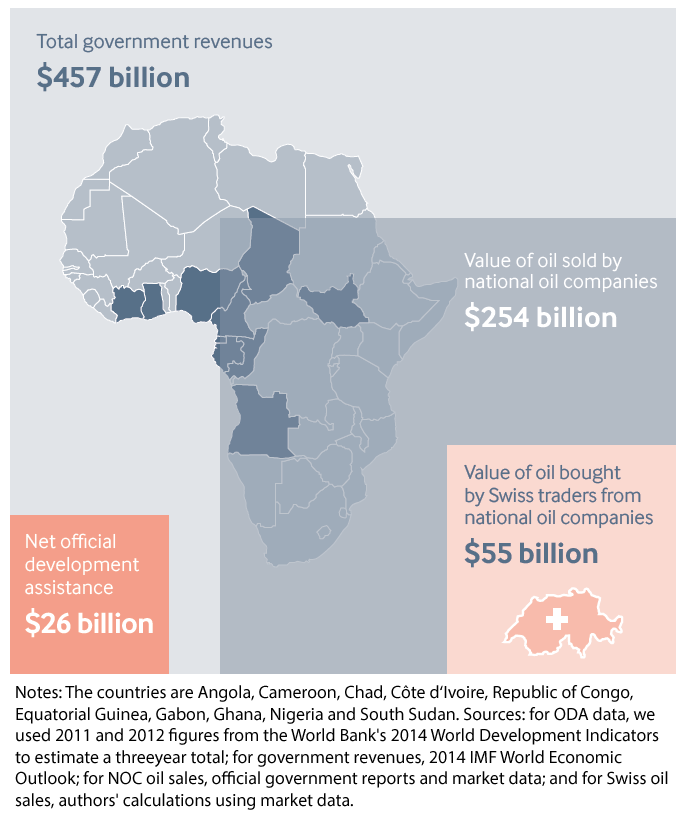
The Resource Governance Index Drives Reform in Uganda

In 2021, NRGI published RGI assessment results for 18 countries including Uganda, where it assessed both the mining and oil and gas sectors.
The challenge
The RGI assessment revealed two significant challenges in Uganda’s extractive sector.
First was the absence of fiscal rules governing revenue withdrawals from the Petroleum Fund. Once Uganda begins oil production, the resulting revenues will be deposited into the Petroleum Fund, held at the Bank of Uganda. Withdrawals from the Petroleum Fund will flow to the Consolidated Fund (to finance infrastructure and development). The remaining balance will be transferred to the Petroleum Revenue Investment Reserve (a sovereign wealth fund) to be invested outside the country. Fiscal rules would set guidelines on how much can be transferred to the Consolidated Fund for budgetary spending and how much should be transferred to the sovereign wealth fund. Resource-rich countries without relevant fiscal rules risk that political pressure results in pro-cyclical budgetary spending, which increases or decreases with volatile oil prices. This in turn risks a scenario in which the government fails to save any revenues in the sovereign wealth fund.
Second, NRGI’s assessment highlighted the absence of laws requiring the disclosure of the identities of beneficial owners of extractive companies. Such laws enhance transparency and accountability and mitigate corruption. Without them, Ugandans cannot know who ultimately owns the companies that benefit from extraction, and some extractives companies may evade taxes payments or hide improper relationships with powerful decisionmakers.
With low scores of 55 and 49 (out of 100) in the mining and oil and gas sectors respectively, the RGI results highlighted the pressing need for reforms in Uganda’s extractive sector and the need for greater transparency and accountability to ensure that resource revenues benefit Ugandans.
NRGI’s role
In response to its findings, NRGI recommended several key reforms to the Ugandan government. Among them, NRGI suggested making the identity of beneficial owners of companies engaging in extractive projects publicly available and implementing robust numerical rules governing deposits to and withdrawals from the Petroleum Fund, as well as firm rules governing the investment of oil revenues.
By providing technical assistance and financial support, NRGI played a critical role in driving engagement for these reforms. Between February and June 2022, NRGI prioritized engagement with the Ugandan government to push for the implementation of these recommendations. NRGI staff also met with key stakeholders, including the Ministry of Finance, civil society organizations and media partners such as CSCO, ACME and CSBAG, to develop capacity on transparency and accountability, petroleum revenue management, beneficial ownership disclosure and fiscal rules.
Impact
NRGI’s engagement with the government of Uganda resulted in significant legal and institutional policy reforms. Following a series of strategic meetings between NRGI and the Ministry of Finance, Planning and Economic Development, and in collaboration with the International Monetary Fund, the government of Uganda adopted fiscal rules for petroleum revenue management. The rule adopted by parliament provided that: “A maximum of oil revenue worth 0.8% of the preceding year’s estimated non-oil GDP outturn shall be transferred to the Consolidated Fund for budget operations. The balance shall be transferred to the Petroleum Revenue Investment Reserve (PRIR) for investment in accordance with the Public Finance Management Act (2015) as amended.” (Objective 3 of the CFR 2021-2025).
NRGI’s engagement with the government of Uganda resulted in significant legal and institutional policy reforms.
In addition, following NRGI’s engagement with the Ministry of Energy and Mineral Development and the Uganda National Oil Company, the parliament amended Uganda’s Companies Act to include a requirement for companies, including those in the extractives sector, to disclose their beneficial owners. The successful implementation of these amendments could serve as a catalyst for addressing potential corruption and elite capture of Uganda’s extractive sector.
These reforms are timely, given that Uganda is undergoing a major extractive sector transition, with the government keen to unlock the sector’s potential while avoiding the “resource curse.” NRGI’s analysis provided policymakers and citizens with a measurable lens through which to understand trends in performance and gaps, enhancing transparency and accountability in the extractives sector.
NRGI will continue to engage civil society organizations and other stakeholders to enhance their understanding of the rationale and importance of fiscal rules to better hold the government to account and ensure that the government adheres to the beneficial ownership provisions in the Companies Act.
Supporting Social Media Debates About Nigeria's Oil Sector
Social media have become important channels for Nigerians to simply and quickly exchange information about the governance of the country’s critically important oil sector. NRGI has provided support to organizations that are pioneering ways to make resource governance content more easily digestible and actionable, including on social media. This support has taken the form of grants to BudgIT (with more than 165,000 Twitter followers) and capacity building for staff of the Nigeria Extractive Industries Transparency Initiative (NEITI).
The Nigeria National Petroleum Corporation (NNPC) regularly publishes reports detailing its finances and operations. Using NRGI funding, BudgIT staff translate NNPC reports and other oil sector-related publications into simple infographics. With NEITI, NRGI’s media development team provided curriculum development support to help create a framework for a social media influencers’ capacity development strategy.
The #FixOurOil hashtag has become a digital forum for debates around the sector, with much of the discussion initiated and informed by BudgIT and NEITI content. Gabriel Okeowo, BudgIT’s principal lead, says that “with NRGI’s support, BudgIT has been able to reach over 5 million Nigerians via digital and physical channels.” And with BudgIT’s support, NEITI trainees acquired skills for developing tools such as short videos and infographics.

Massive and Misunderstood: Data-Driven Insights into National Oil Companies
- National oil companies (NOCs) produce the majority of the world’s oil and gas.They dominate the production landscape in some of the world’s most oil-rich countries, including Saudi Arabia, Mexico, Venezuela and Iran, and play a central role in the oil and gas sector in many emerging producers. In 2017, NOCs that published data on their assets reported combined assets of $3.1 trillion.
- At least 25 countries are “NOC-dependent,” meaning that the national oil company collects revenues equivalent to more than 20 percent of all government revenues. The fiscal health of many countries – and governments’ ability to use oil revenues to finance development – depend heavily on how well the NOC is run, how much revenue it is required to transfer to the state, and the quality of its spending.
- Many NOCs carry big debts, sometimes as much as 10 or even 20 percent of their countries’ GDP. Several NOCs have required multi-billion-dollar government bailouts in recent years, becoming a costly drain on public finances.
- Sixty-two percent of NOCs exhibit “weak,” “poor” or “failing” performance on public transparency, as measured by the Resource Governance Index. International transparency actors should promote better NOC reporting on expenditures, transfers to the government and the breakdown of oil and gas production from different sources. NOCs and their governments should develop key performance indicators based clear goals, and benchmark rigorously.
- NRGI’s National Oil Company Database, available at www.nationaloilcompanydata.org, provides the largest set of open data on NOC production, revenues, spending and transfers to government in the world, with more than 70,000 data points from 71 NOCs worldwide from 2011 to 2017.
National oil companies (NOCs) produce the majority of the world’s oil and gas, pumping out an estimated 85 million barrels of oil equivalent per day. Within their home countries, NOCs influence the degree to which billions of people benefit (or suffer) from their countries’ hydrocarbon assets. Many of these companies manage multi-billion-dollar portfolios of public assets, execute complex projects across their territories and at sea, employ citizens in the tens or hundreds of thousands, and perform a range of public services from providing energy to building infrastructure. Despite their importance, NOCs are poorly understood thanks to weak and uneven reporting, sparse research, and an absence of publicly available comparative data.
Without solid information, governments, oversight bodies and market players struggle to assess NOC performance and develop strategies for how these influential entities can generate greater benefits for citizens.
To help address this gap, Natural Resource Governance Institute (NRGI) assembled a database on NOC production, revenue generation, fiscal transfers to the state, and operational and financial performance that covers 71 companies headquartered in 61 countries worldwide, from 2011 to 2017. The database resides at www.nationaloilcompanydata.org.
This report explores key findings from analysis of the data.
Read the press release. Watch the trailer. Use the database. Access the R code behind the analysis.
Dive into the data
NRGI's National Oil Company Database compiles information crucial to understanding these underanalyzed players in markets and the energy transition.
Improved Contract Transparency Practices in Mexico
The challenge
Mexico’s recent energy reform opened a purely state-run oil and gas sector to private investment. It wasn’t easy: in Mexico, corruption sensitivities are high, and opposition to reform from politicians, civil society and the general public was sometimes fierce.
Now the autonomous National Hydrocarbons Commission (CNH) is charged with guaranteeing accountable, transparent bidding and contract management processes for new private actors in the sector. CNH’s purview also includes Petróleos Mexicanos (Pemex), the state-owned entity that solely ran the oil and gas sector for over 70 years.
It is a difficult, complex mandate, but CNH president-commissioner Juan Carlos Zepeda’s ambitious goal is to go “above and beyond” international transparency practices and to foster public trust in the body.
NRGI's role
Since 2016, NRGI has acted as an informal advisor to CNH, analyzing global best practice and benchmarks in regulatory transparency with the aim of developing a culture of openness and tying together sources of information from across the labyrinthine oil and gas sector. CNH tapped NRGI to help to bring together a civil society coalition to monitor the regulatory agency’s progress in implementing its recommendations.
In January 2017, NRGI delivered a comprehensive report to CNH that provided specific recommendations regarding the disclosure of key commercial, environmental, social and beneficial ownership information, facilitating citizens’ understanding of the sector. The report included advice for ensuring disclosure that applies equally to Pemex and the private sector. Additionally, a multi-stakeholder panel comprised of NRGI experts and CNH leadership presented the report to an overflow crowd at the regulatory body’s headquarters in Mexico City, helping build an information bridge between CNH and the public.
NRGI convened a civil society coalition that is empowered to monitor CNH progress in meeting and exceeding report recommendations. NRGI has committed to work with civil society organizations to hammer out points of collaboration.
Impact
NRGI’s research and guidance has helped CNH take important steps toward improved transparency. CNH now ensures that information on the process of each bidding round is public and online on a recently revamped website—contracts, annexes, the name of companies involved at each stage of the bidding process and all progress in the bids can now be tracked and understood by outside parties. Contracts with foreign oil companies have also been made fully public, as have the investment plans companies are pursuing to bring assets to production.
NRGI experts continue to actively engage with CNH. For example, NGRI pointed out that a draft of a CNH report failed to mention that no information related to entitlements for Pemex was publically available; CNH subsequently incorporated this observation into the final draft of its report and has used it to pressure Pemex to provide more entitlements-related data.