
Road to COP27: Positioning Africa’s Civil Society and Citizens on Climate Change, Energy Transition and Extractives
With COP27 on the horizon, NRGI, Econews Africa, Oxfam, Publish What You Pay (PWYP) and Tax Justice Network Africa convened a series of webinars, "East And Southern Africa Civil Society Organization Energy Transition Joint Capacity-Building and Road To COP27," drawing on various experts and experiences from the continent. The series shared lessons and aimed to build a common voice on what the energy transition means for Africa and its people. The events took place between April and October 2022.
Watch them here:
Climate Change and Energy Transition: What Are They and What are the Issues?
Energy Transition and the Future of Oil, Coal and Gas Extraction
Exploring Sustainable Pathways to Energy Transition: Are Investments in Renewable Energies Sustainable for Africa?
Minerals and the Energy Transition: Key Findings and How Africa Can Leverage Its Potential
Positioning Africa’s Civil Society and Citizens on Climate Change, Energy Transition and Extractives in Readiness for COP27
Two events were also organized as part of the Alternative Mining Indaba:
The Resource Remix: Europe's Gas Crunch, African Supply, and the Energy Transition

The Resource Remix is a podcast from the Natural Resource Governance Institute exploring new futures for commodity-exporting countries in the energy transition.
In this third episode of NRGI's podcast, available on Apple Podcasts, Google Podcasts and Spotify, NRGI’s Silas Olan’g converses with Crystol Energy CEO Carole Nakhle and Theophilus Acheampong, economist and political risk analyst, and senior lecturer at the University of Dundee.
NRGI · The Resource Remix - Episode 3 - Europe's Gas Crunch, African Supply, and The Energy Transition
During their conversation, Nakhle, Acheampong and Olan’g explore the implications of Russia’s war in Ukraine on global energy markets, how it has prompted many countries to reevaluate their dependency on Russian oil and gas, and what Europe’s subsequent demand for gas means for African countries. They discuss whether the current geopolitical climate and market dynamic presents African oil- and gas-producing states with opportunities or risks.
With COP27 on the horizon, the three experts deliberate on whether recent developments will influence African producer countries’ energy transition plans, and to what extent. Acheampong points out how the crisis has exposed how energy security seems to come above all else, including achieving climate goals. With prevailing energy poverty across the African continent, Acheampong argues that African countries shouldn’t have to choose. Concurring, Nakhle affirms that, while domestic energy supply should be the priority for African countries, ensuring the energy transition and safeguarding energy security are not mutually exclusive. But, she adds, this hasn’t happened in practice so far, noting that governance should underpin any efforts to achieve both.
On to the topic of financing the energy transition, Olan’g highlights that the European Union, and other wealthy importers, haven’t yet met their existing climate finance commitments. Acheampong but adds that investment opportunities also exist elsewhere and must be considered.
***
Transcript:
Silsa Olan’g, NRGI: The 27th Conference of the Parties will take place in Egypt this November. The so-called African COP will be the first major climate conference in the wake of Russia's invasion of Ukraine. The war has had implications on global energy markets. Much attention has focused on how African countries from the Cape up to the Mediterranean have reacted to the shockwave. For many years now we have heard that fossil fuels must go. But suddenly European countries are hunting high and low for natural gas, including in Africa. This dash for gas has exposed double standards in energy access and achieving climate goals. What opportunities might resource-rich African states have in these tumultuous times? And how will this affect African governments and citizens’ agenda at COP27?
Welcome to The Resource Remix, a podcast from the Natural Resource Governance Institute. We bring listeners dynamic perspectives on the cutting-edge issues affecting countries rich in commodities in the context of the energy transition. I am Silas Olan’g. I have been with NRGI for more than a decade. And now serve as the organization's Africa energy transition advisor based in Dar es Salaam, Tanzania. Two guests join me today to dive into the prospects for African countries in this new energy market landscape. Our first guest speaking to us from London is Carole Nakhle. Carole is an energy economist, founder and chief executive officer of Crystol Energy, an advisory and research firm, and a member of NRGI’s Governing Board. Carole, welcome to NRGI’s podcast.
Carole Nakhle, Crystol Energy: Hello Silas. I am very happy to join you today.
SO: Thank you. We also welcome Theo Acheampong. Theo is an economist and political risk analyst and a lecturer at the University of Dundee in Scotland where he is speaking to us from today. Theo, you are most welcome to the podcast.
Theo Acheampong, University of Dundee: Thank you very much, a pleasure to be here.
SO: Thank you both so much for joining me in this episode.
Russian invasion has prompted moves by many countries to reassess their reliance on Russian oil and gas and reduce their dependence on its imports. Many articles have sprung up with commentators, discussing how world leaders desperate for energy are turning to Africa for its reserves of oil and gas, considering them as potential beneficiaries of Europe’s supply gap. In May, the EU published its energy strategy, but the strategy leaves many unanswered questions. Carole, now that it has been some months since the initial market shock, what is the clear-eyed view of the coming two to three years? Are some of the countries likely to profit from the current context of increased European demand? If so, which countries and in which way?
CN: Thank you, Silas. Well, first of all, before I answer the question, it is very important to clarify to the listeners and viewers that the crisis we are seeing today in Europe and elsewhere – because the record high gas prices that we are seeing currently are not only in Europe but also in Asia, even North America – it is not caused by Russia's invasion of Ukraine. It is, of course, that factor that the geopolitical development plays a very important role, but it would be naive to blame it all on the war, because some dynamics have been happening in gas markets over decades, including the development of LNG trade, which I think, last year or 2020, but probably last year, if I am not mistaken, for the first time overtakes pipeline trade. So, there is this globalization of gas markets. Of course, we are very far from what we have in oil markets, but the fact that you have more LNG trade happening than originally, markets that were independent of each other – so European would not really care about what was happening to the Asians, the Asians would not care what was happening in North America – this is not the case anymore today. Today if Asia catches a cold, Europe sneezes because of LNG trade, that's very important. I am saying that right up front, because it has implications for existing and potential producers, especially exporters of LNG, whether by pipeline, for example, from North Africa to Europe, or LNG exporters, including in West Africa, but even more so in East Africa, with the likes of Mozambique. They will be facing a completely different market than, for example, what they faced a few years ago.
Now to go back to your question about the outlook for the gas situation in Europe — what that means for African producers, current and future. And I insist on “the future” because we shouldn't underestimate the role that East Africa will play in the next few years. But, first, in the short term, if I focus on this winter, because gas demand increases in winter in Europe, I am more pessimistic because you've got to see usually gas demand increase around this time. If winter is going to be as cold as it was a year ago, then we should expect the most important consequence, which is higher prices. And we're already seeing record prices across Europe, and then in the longer term, after that, things should start to ease up. But I am an economist, so I have to say that high prices may be the solution to high prices, and I say it may be, because it depends also on what governments are doing, and see, as you highlighted, that in your opening remarks about the kind of contradictions and new terms that we are seeing. Because for years, if not decades, the rich countries, the OECD countries, blamed or recommended the developing countries for giving subsidies to their people, energy subsidies for self-use subsidies. Guess what? They are doing exactly the same today and giving subsidies to the rich and poor alike. So that is one aspect. I had to get it off my chest because it really bothers me as an economist.
But if we think about the high price signal, that is pushing consumers to adjust their demand. They are looking for an alternative, they are even thinking about which room to congregate into the winter and avoid using other rooms in the house if they have more than one room, let's say, in a house. We are seeing on the biggest scale the switching from gas to a targeted source of energy. Nuclear is one option, and renewables is another option. But ironically, we are seeing a shift to coal. We are seeing a shift to oil products, such as diesel. So that is another reversal and climate change and energy policies we are seeing in Europe. And they are scrambling to find alternatives for supplies coming from Russia because Russia for decades has been the largest, or was maybe, today's not anymore, the largest supplier of gas to the continent. But that means, maybe on the face of it, you would say, Okay, that's great. That will be an opportunity for African gas producers. But there are two things I want to highlight here.
First, they are not the only ones eyeing the European markets. You have American LNG increased by more than 70 percent compared to last year for the first quarter of this year. They love to send their gas to Europe, and don't forget the American-sanctioned Nord Stream 2, the pipeline coming from Russia to Europe from last year. So, it is not after the war. It was long before the war started. So, for the Americans, the European market is very attractive. So African producers will have to face the reality that there will be greater competition from the Middle East, Qatar, for example, from elsewhere. Everybody wants to send their gas to Europe. But the second thing, and that's a big question. Does Africa have the capacity to increase its exports beyond what they have today?
Let me focus on North Africa, and I leave it there, and then I let Theo elaborate more on sub-Saharan Africa. But look at Algeria, look at Egypt, especially Algeria, its export potential has been declining because its production has not been rising as fast as its consumption. So local consumption has been growing very fast because of different unattractive, irrational policies, economically speaking, and as a result, if they don't keep up with investment, if they don't keep up with increasing production, and they don't slow down the growth in demand, I think we should be realistic about how much more Africa can send to Europe. I'll leave it there, and we can elaborate on the rest later on.
SO: Thank you very much, Carol. From what you're saying, several established producers, Algeria, Angola and Nigeria seem already well positioned to benefit from this demand. As they are already reaping higher revenues from the spike in oil and gas prices. Countries with projects due to start within the next year or so, such as Mauritius and Senegal, I think they will likely also benefit from the higher prices. Others, on the other hand, where investment decisions on key LNG projects are still pending, could end up suffering larger financial risks than benefits. I am thinking of Mozambique, for example, given security challenges, and, of course, my own country, Tanzania, due to ongoing negotiations and outstanding project design processes. Is there a risk of heightened expectations not being made for certain producer countries, especially in sub-Saharan Africa? And what are the risks associated for some countries in attempting to meet European demand? Theo, I would really like to hear your views on this.
TA: Thank you very much, Silas. And again, it is a pleasure to be here. Let me also start with a much broader-level remark, and then we can look at the specifics.
I think what is interesting is that we live in quite extraordinary times. In my relatively short life, I have seen at least three crises, if not maybe four. From the financial crisis of 2008-2009, and then the commodities price lump of 2014-2017, then we had COVID, and, just as the recovery was gaining momentum, now we're dealing with the aftershocks of the Russia-Ukraine war or conflict, and, of course, that has had some major repercussions in terms of the global energy geopolitics or the dynamics. For me, what is kind of interesting, as you already allude to in your opening remarks, is the fact that there seems to be a change in tone.
Only from a year ago, when a lot of the European and Western nations were saying, we're going on net-zero, and the environment is the key consideration, but rather we've seen energy security and issues of access and affordability becoming the dominant theme in the global energy debate going forward. And of course, some have even said that it is quite hypocritical in a sense that some of the developing countries, including those in Africa, haven't been given as much of an opportunity to also develop their own domestic energy resources, which are mostly fossil fuels, by the way. But I think the tone has changed and because Europe especially is looking to fill its energy supplies with alternative sources, Africa, then, of course, comes strongly into the question. As you rightly pointed out, in terms of the gap, or the size that needs to be filled, a couple of numbers may be able to help you put things in a better context.
Then we look at specifically which of sub-Saharan African countries are likely to benefit. If so, when and how? So? We know that Russia has about 17 percent of the world’s production of natural gas. I checked some numbers. It is about 25 Tcf and about 40 percent of the European or EU import historically has come from Russia. If we look at the African context, Africa has just about 7 percent of the world’s production of natural gas, and you're expecting to ramp this up to about 350 billion kilometers or 12.4 Tcf. The earlier production is about 9 Tcf. And if you look at how much the size of the gap is, I don't think that African countries would be able to fill that in the short term.
So there are several issues, but it really comes down, in my view, to about four, some of which Carole talks about. The first one is the availability of spare capacity or how much countries would really be able to ramp up their production even the one year to be able to augment the sort of supply deficit that the Europeans are looking for. And related to that are also issues of logistics and infrastructure. If I take Nigeria, for example, which has the highest gas reserves in Africa at about 207 Tcf. Last year they were only able to produce 2 Tcf. And exported 1 Tcf out of that. Predominantly it comes down to financing issues. It comes down even to issues of theft of petroleum products, including the landscape or the regulatory landscape not being fully harmonized. So, I think it is not really a problem of reserves per se. But how fast African countries can ramp up that production. And this is where given the logistical issues, given that the gas markets are not fully formed, I don't really see any potential beneficiaries in at least the one-year outlook, I think. Of course, we've seen Italy trying to negotiate for more gas from the likes of Algeria and Egypt, and some of the production may go up, but in terms of sub-Saharan Africa, when I look at Nigeria, or Equatorial Guinea, or Mauritania, Senegal, or Mozambique, and Tanzania, or even Republic of Congo, I think, in the one year highly unlikely. Beyond that, in maybe two to three, you can even say four years, there is a possibility of that happening. But again, it takes a lot to develop these gas projects and policy will play a role, regulation will play a role, and ultimately even the direction of the war will play a role in terms of these alternative supplies from the likes of the US and the other Middle Eastern countries who are able to much more quickly ramp up capacity and take market share.
SO: Thank you very much. So yes, capacity is a real issue, and because we’re are looking into one year, two years is okay. But there is a big question as to how long Europe will continue demanding gas, given that they are also developing their own energy transition. So indeed, Europe is looking for gas now and not necessarily in the long term, which may lead to a disconnect somehow, because we're looking at, on the one hand, the capacity gap requires significant investment in Africa, for example, producing countries. On the other hand, Europe is also going for the countries, as you mentioned, the US and others. So I think Europe is looking really for renewables as well, and this is where the disconnect is.
This is a warning to gas-producing countries in Africa when setting their priorities, as you talk about setting up the policies, but if they are setting the policies looking into the European market, while the European market, again, is trying to focus on renewables, what does this mean in terms of a long-term engagement with Europe from African producer countries?
CN: What you're touching on is a very important question that I asked myself recently when I wrote an article on policy confusion that you are seeing across the Western countries, in particular the EU and North America, and the UK as well. In the sense that we see these governments are asking, oil companies are asking oil and gas producers across the world, including Africa, to produce more oil and gas, and send it across to Europe to help them temporarily with the crisis. But, as we all know, oil and gas projects are by their own nature long-term. So by the time you take the investment decision to commit the capital, it will take a couple of years before you start producing, and then you're not going to produce for a year or two. You are hoping to produce for the next 20-30 years, and if the outlook for those 20-30 years is hugely uncertain, then why would you bother and commit today? So this is really the fair position and questioning that existing producers are telling those consumers. Those consumers are telling them we want your gas, but only to help us through the crisis, to help us through this winter, and maybe next, until we beef up our capacity of nuclear and renewable energy.
But let me tell you an example of a country that doesn't often come to my mind. And this is a European country, Norway. So, just to understand the position of African countries. Let's look at a country in Norway, that is the closest to the EU in everything culturally, values, principles, legislations, regulations, you name it.
Norway made it very clear in May. The Minister of Energy said it openly. If Europe commits to buying more gas for the long term, we can help it replace Russian gas. And that's why, a month or two later, if I am not mistaken, there was EU-Norway energy cooperation where the EU openly said that it supports Norway's continuous exploration and production of oil and gas for 2030 and beyond. So that was a clear reassurance that the EU gave to Norway to say, we'll continue buying your oil and gas, continue investing. Why would it be a different position for African countries? So African countries should also get the same commitment from European customers who are desperate for gas that they want to maintain their gas demand for many years to come. if they don't want it., there is China on its own. If you look at the expected increase and the demand for China for the next few years on its own, it can capture all the additional capacity in expansion in liquified natural gas and LNG. So this goes back to the point I said earlier about the globalization of gas markets. It is not any more Europe on its own telling producers, “send me your gas.” If Europe is not going to be more linear and understand the position of oil and gas producers in Africa, Europe will lose it to Asian consumers who are very hungry for natural gas.
SO: Thank you very much. As we approach COP27, it is important to consider the impact of recent developments on the energy transition that we have been speaking about and the implications for African producer countries and their energy transition plans. Theo, you have shared elsewhere how wealthy countries have not delivered on their climate finance promise to sub-Saharan African countries. Some people have suggested that African countries shouldn’t pursue plans to extract gas in a world of crisis and gas supply crisis, balancing the climate crisis and gas supply crisis somewhat competing. And can be tricky. Should issues, such as who gets to extract fossil fuels and which projects are financed, be revisited in the pursuit of a more equitable energy transition? Is Europe’s sudden interest in African gas hypocritical, especially as Europe pressures African country to meet green goals or potential revenues from gas is worth it? Theo, you have spoken a lot about that.
TA: Yeah, very interesting question. And let me piggyback to what Carole said earlier. If Norway can still produce oil and gas in 2030 and beyond, if the UK in their new energy strategy clearly outlined the role of oil and gas, even in the US, again, oil and gas being a mainstay even in 2030 and beyond, then I ask myself, why must it be different for Africa in that sense? Because at the end of the day what this crisis has shown above all else is that energy security comes first. And Africa for that matter must also prioritize meeting its own domestic energy security needs. And then the rest, of course, for export to wherever the market may be. And as Carole actually told us, the market is not necessarily in Europe, and if you do a 30-40-year demand projection, the market is elsewhere outside of Europe, and the technology is also available now to even produce some of these fossil fuel resources and reduce the carbon intensity of that production process.
In my sort of limited world where I sit, I don't really see a disconnect between the climate objectives and energy security in terms of access and affordability, what we typically in literature will call “the energy trilemma,” and more so, for Africa, because, again, what this conflict has shown, and even COVID has also shown is that we have very fragile energy systems, you have deepening or prevailing energy poverty on the continent, and we need all the resources to be able to address those concerns around energy security, and in that regard the fewer choice to plug that gap, I don't think African countries should be forced into the binary whole of having to choose between renewables and/or oil and gas in that matter. When you even talk specifically about the overall emissions, if you take Africa as a whole, it is actually less than 4 percent of the total CO2 emissions cumulatively to date. If you look even specifically within the energy systems of many African countries, I argue, that it is largely already decarbonized except for South Africa, where coal is the most dominant. So I think the issue of the just and equitable transition is very much paramount at the heart of the continent.
But it shouldn't be made to look as though you have to choose one particular technology option and/or the other. When it comes to the financing issues again, this is where you see quite a bit of geopolitics also at play. So we know from some estimates, including a very recent study done by the climate policy initiative that Africa as a whole, needs about 250 billion every year between 2020 and 2030. We are already two years into that. If you look at last year's numbers and the flux, the continent got just a little around 30 billion coming in terms of these financing flows. And, interestingly, most of them actually went into mitigation, less into adaptation, where the research also shows African countries are heavily exposed, and even on the financing flows, many of these are coming in as loans interest-bearing commercial laws, and less as grants. So, in a sense, you see a lot of African countries caught in this quagmire. But I don't think that the solution should be one to force a technology choice on African countries, one even in Europe, the main producers as to exploring their oil and gas deposits and number two, the issue of the financing, I think, is going to be absolutely critical, especially at COP where many of the financing flows would need to be increased, and when it comes to things of the mitigation financing, and of course, the other one, which I forgot to mention, is the issue of loss and damage for historical emissions.
SO: I cannot agree with you more. Indeed, in a recent media appearance, my colleague, Thomas Scurfield also noted that European Union and wealthy countries, in general, must meet their existing climate and finance commitment before new European Union investment commitment and funding pledges can be taken seriously, particularly in Africa, where they have not made those bridges.
Building on sustainable and reliable domestic energy systems is another crucial aspect that's just mentioned. I think in the end, in the EU energy strategy this has not been clearly addressed, and many of the commentators in the Western media also noted that. But today, 600 million people in Africa still lack access to electricity and Europe wants to find as much gas as possible in Africa and other regions. It doesn’t sufficiently support energy access for market references on the need to diversify its own energy sources. I think, Carole, you mentioned this before. What are and should be the priorities for export business domestic consumption in Africa? I would like to hear from both of you.
CN: For long we all believed that in the case of gas, and in particular in the case of Africa especially, I think, the priority should be given to the local market, to the domestic market. Because if you want to really have economic development, you need to give access to energy.
You need to allow that access by developing the local market, by putting the regulations in place, the right pricing systems in place, to build the infrastructure. So if you have gas, and that's why gas by large remains a regional business, and a big chunk of the gas produced is consumed locally, why would it be any different in Africa? I think the main problem in Africa is domestically because of the institutional side, because of the investment climate, and these are things that African countries need to really work on improving the governance of the sector. If they are to seize your portion of the golden opportunity that no other country maybe has in this way, or onahe same scale, not only in terms of oil and gas resources and reserves.
We forget that Africa is very rich in the critical minerals needed for the energy transition. And that's why I will go back to the point that you made. We don't need to choose between oil and gas and green energy, because Africa is blessed with resources that allow the production of both to meet the energy transition while safeguarding energy security. But the experiences show that it is not if you have the resources in the ground you're going to benefit. Look at Venezuela — they have the largest proven reserves in the world, and yet they are not among the largest oil producers in the world because of what was well-known as the resource curse. So let me keep my answer brief to your question, and say, the domestic market should take precedence, but that will not be developed automatically, you need to put in place the right institutional framework to allow that to happen so that everybody benefits from the resources that you have, and the export market can be developed in parallel but should not be given priority over the domestic market.
TA: Just to add a bit to Carole's point, an interesting point, we've been doing some bit of exercise just to see if you doubled Africa's current electricity output to bridge the access deficit, how much more emissions would that contribute if you even had a major chunk of that coming by way of natural gas. And what is quite remarkable is that even if we double the output of power on the continent using the same energy mix as currently pertains, it Is still going to contribute less than 5 percent of the total cumulative greenhouse emissions in that regard. The point here is that seeking to export gas from Africa for me is not necessarily a bad idea, but as Carole said, the important thing is also to develop the regional gas markets.
I have been involved in a few studies, and you can find that there are significant constraints in terms of developing these markets. However, we have an opportunity now with the Africa Continental free trade area to work on some of these issues, such as having harmonized gas pricing, regime, the issues about the investment requirements, and I think some of the sovereign wealth funds on the continent need to think about pulling some of their resources together, because, after all, if the money is not going to be coming from Europe and other places, if they decide to pull out the investment, we still need to develop these gas markets and there are other groups of money even domestically on the continent, with the sovereign world funds, but also some of the pension funds, et cetera, to put into some of these investment. And of course, you need to address all the regulatory and political risk issues and ensure that you are pricing the gas appropriately and doing that based on what must go to industry, and which ones must go for domestic consumption. Because if we don't develop those regional gas markets, and it is all about export, export, export, then, unfortunately, it is still going to be, in my view, the same old colonial extractivist model, which has dominated the geopolitical order for the last 400 years, with very little trickle-down effects for livelihoods on the continent.
SO: Thank you. To what extent do you think COP27 will be a moment for settling some of these questions? Are there many questions still out there?
TA: I think going into COP27, there are three key things: the issue of energy access, the issue of climate financing, and all around the issue of just transition. But I think really what is important here is that historically, Africa has not had a unified strategy on most of these issues. I think, going into COP, we, as a continent, must present a unified strategy, and the strategy should detail, in my view, our unique circumstances, but also highlight the role that oil and gas would play as an important fuel choice for any decarbonization pathway for the continent. I am not talking about other continents. I am only talking specifically about oil in Africa. In that regard, both oil and gas and renewables would for sure play a big part of that agenda.
I am just worried that the attempt to force this different pathway like it is this and not that, is going to push a lot of the already existing assets for reserves and make them potentially even become stranded in the first instance, and that would already have a cascading impact on the worst energy poverty that we were talking about with about half of the continent not having access to electricity, so the strategy is important, highlighting unique circumstances, and also advocating for more of the financing flows on the continent. And lastly, things around the critical minerals for transition where many of the countries on the continent have one form or the other. But to really make an opportunity out of it, it must be developed on a regional basis.
SO: Thank you, Carole and Theo, for joining me today for this episode of the NRGI podcast. This has been a very interesting conversation, leaving us with a lot of food for thought on what really constitutes a just transition.
For our listeners: please check out the first two episodes on your preferred platforms. We are on SoundCloud, YouTube, Spotify, Apple Podcasts and Google Podcasts. Do join us in the next episode. Thank you.
Disclaimer: Views and opinions expressed in this podcast belong to the individuals featured and do not necessarily represent those of the Natural Resource Governance Institute. The recording and transcript have been edited and condensed for clarity.
NRGI's podcast The Resource Remix explores new futures for commodity-exporting countries in the energy transition.
VIDEO: Europe's Hypocrisy Over Africa's Gas?

Examining which countries in Africa can increase gas production in the next few years, Scurfield highlights Nigeria's and Angola's liquefied natural gas (LNG) plants' spare capacity to extract more gas and supply gas to Europe if appropriate investment are made.
Projects that can’t come online until 2030 probably won’t have much of a market in Europe to supply at that point.
He adds: “But there are other countries where production is a lot further off. A country like Tanzania, that has had an LNG project plan for over a decade, hasn’t yet reach an investment decision and is unlikely to do so before 2025, meaning production won’t start until 2030. It seems like those sort of projects won’t be able to meet Europe’s needs and make the most of this opportunity from this supply crunch, given that Europe is looking to find other sources of gas right now, but actually in the longer term its main response to the Russian invasion of Ukraine is to accelerate its energy transition. And it is looking to reduce its gas consumption by 40 percent by 2030. So projects that can’t come online until then probably won’t have much of a market in Europe to supply at that point."
Scurfield also stresses that the European Union and wealthy countries in general must meet their existing climate finance commitments before new European Union investment commitments and funding pledges can be taken seriously: "It [the European Union] still isn’t providing the 100 billion USD dollars of climate finance a year that it promised back in 2009 that it would provide by 2020. It didn’t in 2020. It didn’t in 2021. And it doesn’t look like it will do in 2022. So this package of support does holds some promise, but it’s hard to take it seriously until these exciting climate finance commitments are met."
On the question of whether Africa should invest in costly pipelines that require years of planning and construction, given Europe's demand outlook, Scurfield is sceptical that by the time the pipelines are built and can deliver gas, the market in Europe will be large enough to make investing in these projects truly profitable.
He says, "There’s a worry that governments from the countries involved in those, because of the likely private investor reluctance to get involved or at least cover all the costs, would stump up a significant amount of the money required and then those pipelines wouldn’t actually generate the expected returns. There is a real risk of those pipelines being talked up now because of this hype around European demand, but them actually becoming stranded assets and a real dead weight on the public finances of the countries involved.”
Europe’s demand for Africa’s gas
Read key insights from NRGI experts
Senegal and the G7: Five Questions about the Just Energy Transition Partnership

A French-language version of this post appeared as a commentary piece in La Tribune Afrique on 24 June 2022.
Unlike South Africa and several of the countries targeted by the G7 for a possible JETP, such as Indonesia and India, Senegal is neither a major coal producer or consumer, nor a major polluter. Instead, Senegal is primarily a future gas producer, whose production will be important for both domestic and export markets. While the opportunity for climate finance for Senegal presented by the JETP is to be welcomed, the motivations and potential content of such an agreement should be examined, insofar as these discussions are taking place in the geopolitical context of an overhaul of European energy policy as a result of Russia's invasion of Ukraine.
Public debate should address five questions in the coming weeks:
1. How will the JETP ensure better access to energy for Senegalese citizens?
Senegalese citizens will expect that a potential JETP will help meet the country’s energy needs and support its economic development. Senegal relies on its gas reserves to achieve its goal of universal access to electricity by 2025. In this sense, the partnership could support the financing of gas-to-power projects in the country that would not otherwise be financed, but also (and especially) the development of renewable energy projects.
2. What is the role of Senegalese gas exports to Europe under the JETP and which gas projects will be targeted for this purpose?
This question leaves much room for speculation, including that the nascent JETP has been established solely as an alibi for exporting Senegalese liquefied natural gas to the EU. Although the first phase of the GTA project, which is expected to start production in 2023, has already been promised to Asian buyers, the second phase, for which a final investment decision (FID) is expected within the next year, remains an option for supplying the European market. However, the Mauritanian government’s weak participation in ongoing talks with Senegal, despite the two countries sharing the gas field, suggests that the Europeans may be eyeing another, exclusively Senegalese gas field: Yakaar-Teranga. This project, which is close to a final investment decision, would be an excellent candidate for supplying the European market, except for the fact that its first phase is planned to supply the local market. The Sangomar oil project, which comes on stream in 2023, will also generate gas in later phases (which have not yet achieved FID). This would be associated gas, requiring significant processing before marketing, which would entail additional investment.
3. If Europe is going to secure its gas supplies through the JETP, how will it finance these projects?
The financing of gas projects is a stated priority of the Senegalese government in the JETP discussions, but it is a goal made difficult by Europe’s aversion to long-term gas purchase agreements in light of climate commitments. It is therefore important to pay particular attention to how any financing of gas projects under the JETP will be structured to avoid excessive risk being allocated to Senegal in order to attract the necessary investment.
4. Will the JETP involve agreements not to exploit some of Senegal’s gas, like South Africa’s JETP, which targets a phase-out of coal?
A JETP should balance the objectives of decarbonization, energy access and maximizing Senegalese revenues. Important elements for Senegal to consider in this regard are the approach to later phases of gas projects and new exploration, and support for renewables and energy access, including financing and technical assistance for grid extension, improving the stability of electricity supply or integrating clean technologies into polluting sectors. In the case of agreements involving the non-exploitation of gas, the JETP should promote compensation (direct or indirect) to replace the sources of revenue that Senegal will lose.
5. What support is there for any alternatives to gas exports under consideration?
The JETP may promote collaboration on green hydrogen, which is also a focus for Senegal. Given the uncertainties around the economic and technical feasibility of green hydrogen exports, the Senegalese government should be careful not to rely too heavily on this prospect that is rather distant for the time being.
The answers to these questions are of interest to the Senegalese, but not only the Senegalese. This potential JETP is an interesting proposition because it offers a potentially transformative just transition model for emerging gas-producing countries. Conversely, failure could slow down the momentum of these countries toward energy transition.
Europe’s Demand for Africa’s Gas: Toward More Responsible Engagement in a Just Energy Transition

Through the publication on 18 May of its external energy strategy, the EU somewhat clarified its approach to diversifying gas supplies. The strategy is of course written from a European perspective; its implications for African producer countries require a bit of dissection. These implications are important given live debates around the role of gas in Africa’s future and more broadly, including at the G7 level.
The EU strategy (and the broader “REPowerEU” package in which it sits) indicates that Europe is seeking a short-term injection of additional gas—but also that it is accelerating its transition to cleaner energy sources. The EU is therefore unlikely to seek longer-term (post-2030) sources of gas. Current and prospective African gas producers ought to take note and adapt accordingly. If European interest in African gas is indeed primarily short-term, responsible EU-Africa engagement would require European officials to clarify their intentions and needs, and relevant African policymakers to ensure that related expectations in their countries are realistic given likely future scenarios.
With such clarity, the handful of African countries ready now (or soon) to start or increase gas production can seize a short-term opportunity to increase public revenues. But given major uncertainties around the future of gas, officials in these and other countries should focus primarily on building more sustainable economies and domestic energy systems, not investing billions of dollars of public capital in long-term gas projects that face tough obstacles and risk carbon lock-in.
There is a bigger opportunity in Europe’s energy rethink for African countries: they can use it to push the EU to follow through on its promises of financing and technology for renewable energy growth in Africa. Europe could couple the realization of these commitments with near-term gas procurement from certain African countries, contributing to long-term partnerships in service of a just energy transition.
Implications for African gas: Timing is everything
Some of the main reactions to the EU strategy have focused on important areas of climate-related concern. The strategy also brings mixed messages for policymakers in countries evaluating opportunities to export gas.
Europe’s main tool for reducing Russian gas imports will be reducing gas consumption.
The REPowerEU plan details how Europe will expedite its energy transition in the wake of the Russian invasion of Ukraine. Europe’s main tool for reducing Russian gas imports will be reducing gas consumption. The plan doubles down on a previous objective to lower consumption by 30 percent by 2030 (around 100 billion cubic meters (bcm)); it details European aims to reduce consumption by a further 11 percent (35 bcm) by 2030 through a combination of energy efficiency and clean energy substitution.
Alongside the reduction in consumption, the EU envisions an increase in gas imports from non-Russian sources: mostly of liquefied natural gas (LNG) (an additional 50 bcm), but also pipeline gas (an additional 10 bcm or more).
So, for whom is this an opportunity, and for how long? On this, the strategy is less clear.
One point of ambiguity concerns the timeframe for increased non-Russian gas imports. The strategy references the need “over the coming years” but omits further detail. Nevertheless, this will likely sync with the strengthened plans around reduced gas consumption by 2030, meaning that if the EU sticks to its decarbonization objectives it is unlikely to need much additional longer-term supply (i.e., for 2030-2050) given its 2050 net-zero target.
A second point of ambiguity relates to the prospective sources of additional supply. The EU has already advanced some deals for short-term supply, including a political agreement with the U.S. for additional LNG imports of at least 15 bcm in 2022 and approximately 50 bcm annually until at least 2030. The 50 bcm would cover all of the EU’s planned increase in LNG supply, meaning there may not be any opportunities for other producers. And yet the strategy also references separate efforts to source gas (e.g., LNG from Egypt and Israel, and piped gas from Algeria and Azerbaijan) and specifically mentions the “untapped LNG potential” of countries in sub-Saharan Africa.
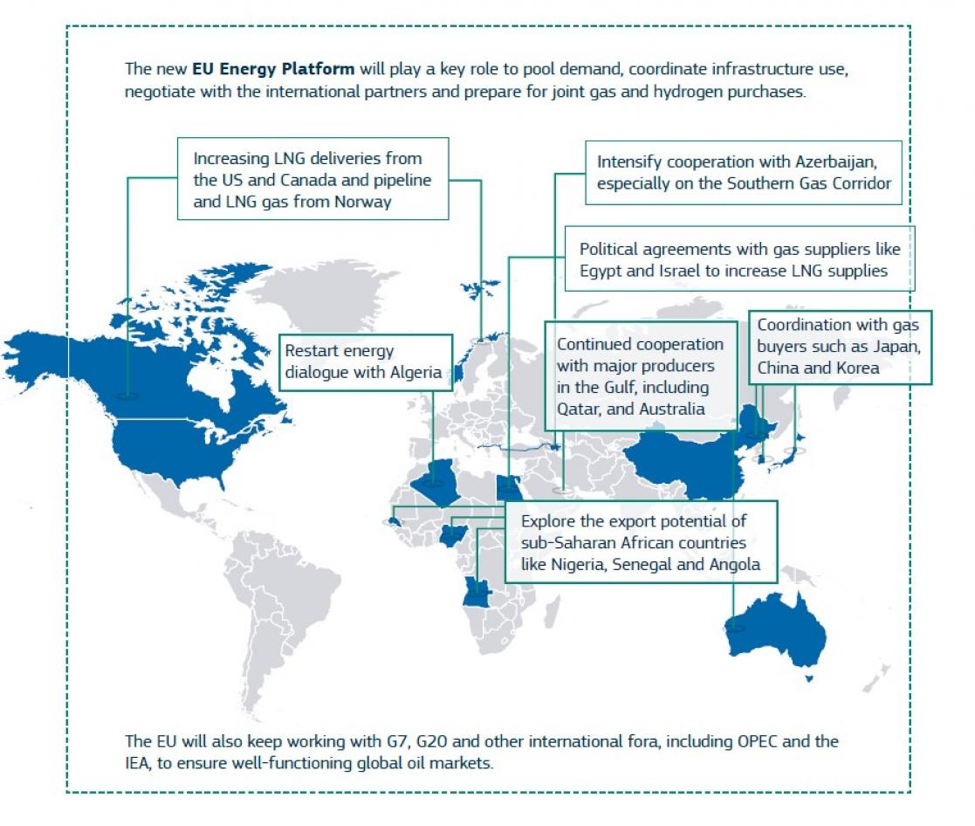
And so it seems that within Africa the opportunity is for existing producers, or those with projects on the cusp of production, that can supply gas before 2030. These could include Angola, Egypt and Nigeria insofar as they can quickly ramp up production. Senegal has already sold the LNG from its initial GTA project, due to start producing in 2023, to Asian buyers, but a final investment decision on a second phase is possible within the next year and production on that phase could start within the next few years.
More generally, expansion of projects with existing infrastructure would be particularly attractive to Europe for a few reasons. It could potentially avoid signing long-term commitments that trigger investments. European officials could also argue that expansions do not constitute development of “new oil and gas fields,” which the IEA has deemed incompatible with achieving net zero by 2050. European demand is unlikely to be much of an opportunity for other countries (or other projects in the above countries) that can only export in the longer-term (2030-2050); these would clearly constitute “new production.”
Europe’s identification of other potential sources of LNG may just be insurance against the possibility that EU-U.S. negotiations fail to result in the full supply of 50 bcm—or a tactic to increase European leverage in those negotiations. Like any insurance policy, this one may not be used, and ultimately significant European demand for additional African supply may not materialize even in the near term. And it may be that Europe wants the “insurance” but isn’t willing to pay the “premium”—or at least not a very high one—in the form of long-term gas purchase agreements necessary to secure financing for projects or funding new infrastructure. If the EU does not plan to make big, long-term investments in African LNG in that way, the responsible course would be to say so explicitly now, rather than leave prospective African suppliers to interpret ambiguities in the strategy.
Officials in producing countries should note these nuances and recognize that Europe and other importers generally prefer to have a diversity of producers, though Europe’s climate considerations may temper the EU’s preference. Many producing countries may never reach the “front of the queue.” Responsible engagement by officials in producing countries would mean avoiding significant risk when jostling for position—by entering a “race to the bottom” negotiation, investing significant public capital to de-risk projects for investors, or getting locked into oversized domestic gas infrastructure that may crowd out cheaper renewable energy alternatives.
EU energy strategy: Missed opportunity on just transition?
In its strategy the EU states that a “just and socially fair” transition is integral to its external energy policy. In practice, its plans around supplier diversification seem shortsightedly agnostic as to where supplies originate—essentially anywhere but Russia.
In a truly just transition, the EU would reduce rather than increase gas imports from countries such as the U.S. and Qatar, as these wealthier countries should be among the first to cut production in a just fossil fuel phaseout. As researchers and advocates for an equitable transition are increasingly recognizing, countries with more urgent development needs should have priority within the remaining carbon budget given their lower capacity to finance their own even more challenging energy transitions. In the absence of an agreed international framework for managed phaseout of fossil fuels, such priority access for developing producers is unlikely. But the EU should support the development of such a framework—or at least apply just principles where it can, as in its international energy strategy.
If consumer countries fail to adopt good governance criteria when selecting future energy suppliers, they risk repeating the mistakes of the past, when Western companies and governments served as key enablers of Putin’s catastrophic kleptocracy. The EU has laid important groundwork on this front, with democratic values and good governance/transparency as key principles for partnerships under its Global Gateway initiative. However, plans to intensify cooperation with authoritarian regimes as part of the EU’s gas diversification strategy raise concerns about its commitment to avoid enabling corrupt regimes.
As part of a responsible engagement the EU and its prospective African gas suppliers should account for the risk that citizens in these African countries may view gas export to the EU as coming at the expense of domestic energy plans.
Developing countries’ domestic energy needs, particularly in Africa where about 600 million people (around half of the population) lack access to electricity, are essential to a just transition. The EU should prioritize delivering on its stated support for increasing renewables in such countries. The strategy’s recognition that renewable energy exports to Europe (e.g., as green hydrogen) should not adversely impact a country’s domestic energy access is significant; the EU should develop this further. But the EU strategy is noticeably silent on the potential impact of increased gas exports to Europe on domestic energy needs in gas-producing countries. This is particularly relevant for discussions around sub-Saharan African gas producers, given the significance (rightly or wrongly) assigned to gas in strategies for addressing domestic energy needs. As part of a responsible engagement the EU and its prospective African gas suppliers should account for the risk that citizens in these African countries may view gas export to the EU as coming at the expense of domestic energy plans. This could accelerate resentment as Europe uses African gas while objecting to gas-supported electrification within Africa for climate reasons.
A way forward
More broadly, the EU should redouble its engagement around ensuring a just transition for developing countries that produce, or aim to produce, fossil fuels. The strategy’s reference to these countries’ interest in exporting green energy shows that the EU appreciates the importance of replacing revenue sources that lower-income countries will lose as part of the energy transition. The EU should support such long-term “revenue smoothing.” This could be part of an Africa-EU green energy initiative inclusive of partnerships of the type launched with South Africa at COP26.
The EU and producer countries should not over-rely on the idea included in the strategy that combining gas cooperation with long-term energy cooperation on hydrogen can “avoid stranded assets and ensure the green transition.” Avoiding stranded assets should be a priority, but not based on an overly broad assumption that fossil fuel infrastructure can be repurposed for other uses.
The EU should instead avoid stranded asset risk in the first place by being as clear as possible on likely future gas demand. With that clarity, African gas-producing countries can determine whether and how they can benefit in the short-term, while avoiding the temptation to sink billions of dollars in public capital in projects predicated on long-term European demand.
Podcast: Fossil Fuels and Climate Change, Featuring NRGI’s David Manley

In this episode of Sheila Khama’s Extractives podcast produced on 17 August, David Manley, a senior economic analyst with NRGI, discusses what the energy transition is, its drivers and responses, and its impact on regions like Africa.
In the recording, Manley highlights a technological revolution and a huge shift in the way we use technologies, such as solar or wind power generation, as well as the radical decline in the cost of these technologies.
“The Paris Agreement is also, to some extent, driving the energy transition," Manley says. It gives investors and businesses some certainty that over the next few decades there will be a market for renewable energy."
Regarding the impact of global energy transition on oil- and gas-producing countries in Africa, Manley points to a foreseeable decline in demand for their exports. However, as the African continent is particularly vulnerable to the severe effects of climate change, he also points to some of the benefits of global transition:
“By far these severe effects will outweigh most of the economic effects from reducing fossil fuel demand. So if the energy transition and the Paris Agreement can help limit that change, that is a great thing we should be aiming for.”
One significant upside for some countries is the increasing demand for metals and minerals, such as copper, cobalt and lithium, which are needed to develop green technologies. With demand for these metals expected to increase in the coming decades, many mining countries could benefit. Manley emphasizes that Africa has the most to gain from this boom.
Given the challenges and opportunities facing resource-rich developing countries, Manley stresses the importance of good governance for a successful transition.
He explains: “For oil- and gas-rich countries, the top priority is to manage these risks, be proactive and ensure that governments are not assuming high oil prices and that everything will be fine. We need to make a big change, using scenarios and thinking more pessimistically, for example, if there is a big drop in gas prices and collapse in production, what that means for countries’ economies and finances, and develop a plan to respond before it is too late.”
David Manley is a senior economic analyst at the Natural Resource Governance Institute (NRGI).
Supporting Just Transitions in the Oil and Gas Sector in Africa: The Role of External Actors

Because of the trade-offs required, and the diversity of objectives, views and pathways involved, there is growing recognition that achieving just transitions requires widespread, inclusive and democratic deliberation. Yet traditional models of participatory decision making and transition options often draw on experiences in wealthy liberal democracies. They rest on key assumptions that do not apply elsewhere: the existence of a strong and well-resourced state able to provide retraining and compensation, an engaged and responsive private sector, a well organized labor movement, and spaces where informed and capacitated civil society can meaningfully engage without fear of violence. Few resource-rich African countries meet such requirements. Yet the fundamental shift in their economic and development models implied by energy transitions will not be possible without an active and informed debate between citizens and policymakers: a reimagining of just transition through open and inclusive dialogue.

IDS and University of Sussex research on “Making Space for Dialogue on Just Transitions in Africa’s Oil and Gas Producing Regions” with partner organisations in Nigeria, Kenya and Mozambique explores how citizens are making their voices heard, despite challenges, through a variety of invited and claimed spaces of participation. These include participation in national strategies and visioning exercises such as “Which way Nigeria?”, combining engagement with transnational governance processes such as the Extractive Industries Transparency Initiative (EITI) with local protest strategies in Mozambique, and legal activism to resist particular energy infrastructures such as the Lamu coal plant in Kenya or to press demands for compensation from oil companies in Nigeria. Support by external actors such regional and multilateral development banks, donors, civil society organizations, and investors can play a key role in accelerating and amplifying these efforts. A webinar on March 9 explored the obstacles to and opportunities for doing so.
Breaking silos, avoiding duplication
As climate action is an increasingly hot topic for funders, there is a risk that efforts to support just transition focus on setting up new platforms and mechanisms, rather than leveraging what already exists. Funders can invest in pivoting and re-energizing existing platforms, mindful of the limited bandwidth of civil society actors. For example, in Ghana, the “Alliance of CSOs Working on Extractives, Anti-Corruption and Good Governance” has successfully evolved to work with the new National Energy Transition Committee, calling for more inclusive and open dialogue on Ghana’s energy transition journey.
Connecting local and global agendas
A key challenge is that elite policy makers are hatching initiatives with global implications in relatively closed spaces with little if any consultation or engagement with civil society at the national and local levels. Examples include announcements from the governments of Nigeria and South Africa at the last COP in Glasgow. In bridging this gap international CSOs and funders can play a helpful role in connecting partners at the national or local levels to regional institutions and international institutions and transnational coalitions (such as the Open Government Partnership Civic Space Learning Network and the OECD Civic Space Observatory). There are also new international efforts to define a viable pathway to a just transition, including the Beyond Oil and Gas Alliance, the Civil Society Equity Review, the OECD Equitable Framework and Finance for Extractive-based Countries in Transition (EFFECT), the Fossil Fuel Non-proliferation Treaty initiative and a recently released Tyndall Centre report. Leaders of these efforts should form strong connections to civil society actors from resource-rich countries to amplify—not replace—local voices and ensure that governance and participation are at the heart of these efforts.

Challenging power and vested interests
Just transitions are often inhibited by strong vested interests wanting to preserve the status quo and resist change, or those who seek to capture transition opportunities for their own benefit. A just transition must challenge incumbent actors’ control of decision-making. Funders can support work to identify and map vested interests and how to confront them, help local actors to improve representation on key committees and decision-making processes, and invest in initiatives to clean up political party donations and revolving doors between energy companies and state regulators.
The next major COP in Egypt later this year represents a huge opportunity for African countries and civil society—and those that support them—to advance a vision of just transition and a set of strategies for achieving it than ensures not only that no one is left behind, but that longstanding inequities are remedied. This means acknowledging and addressing historical injustices as well as supporting and financing future low carbon energy pathways for African countries currently reliant on fossil fuels.
Photo by Rod Waddington via Flickr (CC BY-SA 2.0)
Learn more about the outcomes of related interactive webinars exploring extractive industries and civic space.
Can African Oil and Gas Benefit From Europe’s Energy Crisis?

This commentary originally appeared in African Arguments on 29 March 2022 under the title "Will Africa Really Be ‘Europe’s Next Gas Station'’’?
These shifts, combined with Western oil and gas companies dumping their Russian interests, present an opportunity to other petroleum producing countries, albeit one tempered by actions to address the climate crisis. This has led governments and commentators to discuss African producers as potential beneficiaries of Europe’s supply gap, with talk of a “seismic shift” to Africa and of the continent as “Europe’s next gas station”.
Such headlines gloss over the complex reality. It is true that several established producers – such as Algeria, Angola, and Nigeria – are already reaping higher revenues from soaring oil and gas prices. Countries with projects due to start within the next year or so, such as Mauritania and Senegal, will likely also benefit from higher prices. However, most current producers have limited spare capacity to quickly ramp up supply and need to attract more investment before they can.
Investment decisions on key liquefied natural gas (LNG) projects in prospective producers, such as in Mozambique and Tanzania, are not likely until at least 2024 given security challenges in the former, and ongoing negotiations and outstanding project design processes in the latter. This means significant production is unlikely before 2030. Most of Mauritania and Senegal’s oil and gas reserves won’t be developed until later project phases. And any supply from prospects currently under exploration is likely even further off. It has historically taken sub-Saharan countries around 12 years to move from discovery to production – often longer than initially predicted by governments and companies.
While some African projects may come online more quickly, investors will make decisions based on an uncertain long-term outlook. The current spike in prices is a potent reminder of the fundamental unpredictability of oil and gas markets. Seven years on from the price spike in 1979, rates had fallen more than two-thirds from the peak of the crisis.
Three factors make the current outlook particularly uncertain. First is Russia’s role in the oil and gas market. Its supply to Europe will be affected by how its negotiations with Ukraine unfold, as highlighted by how prices have fluctuated in line with perceptions of how the talks are progressing. Russian supply earmarked for Europe could be diverted to Asian markets in the long term. This would reduce Asian demand for gas from elsewhere and offset the benefit of increased European demand for oil and gas from these producers.
The second factor is how much market share other non-African producers capture. Europe is not only looking to Africa to fill the gap. US LNG exports to Europe are surging, multiple additional large US LNG projects are ready for development, and European leaders are striking long-term deals in the Middle East. Many of these producers have more spare capacity and projects that can be greenlit more quickly than African producers.
Third, prospective suppliers must consider potential “demand destruction” and the pace of the energy transition. A lesson from the 1970s is that high prices and market turmoil often lead to a permanent reduction in demand through improvements in energy efficiency and development of alternative technologies. The current crisis could lead to even greater demand destruction given it appears to have reinforced Europe’s conviction to accelerate its energy transition away from fossil fuels. Beyond its goal to secure non-Russian supplies in the short-to-medium term, the EU also aims to leave fossil fuels behind for good.
What African and European officials can do?
Leaders in both Europe and Africa can take steps to make this moment more of an opportunity for Africa.
The EU could begin by clarifying its energy transition strategy for the benefit of African producer countries and potential private investors. Thus far, its pathway has been a minefield of mixed messages. For example, its plans announced in February 2022 to label some kinds of gas-fired power as “green” was seen by some producer countries as a signal to move ahead with gas projects. However, some European leaders seem to increasingly view renewables as not only necessary to tackle the climate crisis but also to improve energy security.
As Europe seeks to expand its use of clean energy, it should ensure that African producers of the critical mineral inputs to green tech receive good and fair deals.
To ensure a globally equitable transition, Europe should consider meeting any longer-term demand first with petroleum from African countries, given their pressing development needs. Europe could also champion the inclusion of incentives for good governance in the sequencing of the global phase out of fossil fuel production. In so doing, it should balance addressing European energy security with reducing African energy poverty as part of a broader strategy that also supports African countries’ own transitions to clean energy. Finally, as Europe seeks to expand its use of clean energy, it should ensure that African producers of the critical mineral inputs to green tech receive good and fair deals.
Irrespective of how Europe proceeds, officials in existing and prospective oil and gas producing Africa countries should soberly evaluate the longer-term uncertainties. While prices are soaring now, this unpredictability includes the possibility of fewer supply opportunities and lower prices over time.
Governments should ensure that strong revenue management frameworks are in place, including by directing any windfall revenue toward sustainable development and economic diversification. Diversifying economies remains crucial. Governments should also rigorously analyse their prospects across different scenarios, factoring in project timelines and potential market evolutions. They must remain cautious and avoid using public capital to make risky bets on oil and gas.
While some African producers may benefit from Europe’s scramble for non-Russian oil and gas, the reality is unlikely to match the hype.
Ending Nigeria’s Oil Dependency: Not If, But When…and How

The issues of “post-oil” and economic diversification received considerable attention in Nigeria after the 2014 commodity price crash, again during the 2016 economic crisis and more recently with the coronavirus pandemic influenced global crisis. Over that period, recognition of the dangers of Nigeria’s dependency on oil has led to several initiatives aimed at securing changes in government policy to address the problem. Here we examine Nigeria’s oil dependency within the context of emerging global and national imperatives to provide some initial recommendations to frame the Natural Resource Governance Institute’s (NRGI) newly constituted Nigeria program designed to focus on "Nigeria’s Oil Dependency: Imagining a Future Beyond Oil."
Nigeria’s oil dependency through the years
Nigeria’s dependence on oil is deep-rooted. The country continues to suffer from the effects of the Dutch disease which began when oil was discovered in the 1960s, having focused its efforts predominantly on its oil resources; the potential for greater returns from oil making other sectors less attractive. But, decades later, little has changed in Nigeria. Although the oil sector continues to deliver returns, these have depreciated over the years, hindering success of Nigeria’s development aspirations; Vision 20:20, the Economic Recovery and Growth Plan (ERGP), often just out of reach as they continue to rely on the performance of the global oil market.
How dependent is Nigeria on oil?
Nigeria’s federal and state governments remain heavily dependent on oil revenues, relying on it to deliver public goods and the use of oil dollars to service debt and bolster the national currency. The oil sector, however, has not significantly improved the well-being of Nigerians. Non-oil sectors lead to vastly more employment opportunities than the oil sector and their economic activities contributed approximately 93 percent of GDP in 2020.
Continued dependence on oil revenues threatens the lives and livelihoods of Nigerians and social cohesion in the country.
At the federal level, Nigeria’s dependence on oil almost crippled her economy catalyzing a negative GDP growth of 1.8 percent in 2020. The pandemic highlighted the potential losses to the Federation of the Federal government’s more than 50% revenue dependence on oil, as the shutdown of global economic activities, onslaught of the pandemic and sharp declines in oil demand in 2020 left the government unable to meet its 2020 revenue projections. The federal government had to slash its budget by a more realistic 20 percent, reducing its benchmark price and production projections from $57 per barrel to $30, and anticipated production volumes from 2.2 million barrels per day (mbpd) to 1.7 mbpd consecutively to accommodate new realities. Continued divestments by oil majors and their refocus to cleaner energy threatens Nigeria’s future ability to attain its revenue projections if they remain pegged against oil productions. Nigeria’s debt stock in 2020 stood at 31 percent of GDP and continues to grow as it tries to bridge the shortfalls in oil revenues. Despite this stark reality, the 2022 federal government budget still reflects 31 percent of expected federal government revenue generation from oil even as oil exports continues to supply 90 percent of Nigeria’s foreign exchange and half of federal government revenues. Continued dependence on oil revenues threatens the lives and livelihoods of Nigerians and social cohesion in the country.
Meanwhile, almost all of Nigeria’s states depend on oil revenues, channeled from the Federation Account and Allocation Committee (FAAC), for more than 50 percent of their fiscal needs. The most dependent are the oil-producing states, with Bayelsa state and Akwa Ibom state averaging 85 percent of their fiscal dependence on oil revenues. Only Ogun state and Lagos state draw less than half of their revenues from the FAAC consistently. Oil-producing states risk being fiscally unviable without oil. These states must urgently find alternative sources of revenue beyond FAAC to build their fiscal resilience before oil demand peeks. Those residing in those states must ask for diversification of their states’ revenues, with a greater focus on revenues generated internally beyond oil.
Ending dependency and preparing for a future beyond oil
Nigeria currently is at a pivotal point in its history where decisions made now will weigh heavily on its economic survival. After previous financial crises—the halving of Nigeria’s Stock Exchange All Share Index in 2008 and the 70 percent commodity price crash in 2014—Nigeria’s economy eventually rebounded as oil demand and price recovered. But this will no longer be the case if Organization of the Petroleum Exporting Countries (OPEC), the International Energy Agency (IEA) and others are correct when suggesting that we will soon reach peak demand for oil. So, ahead of that eventuality, the government must make plans to replace the huge shares of government revenue and foreign exchange earnings for which it presently relies upon oil.
The federal and state governments must make critical and strategic decisions carefully to position its economy for a future without oil. Oil will lose its value, so Nigeria must build its resilience in anticipation of that future, and take advantage of all the opportunities available in the African corridor, the growing green economy, technology, and non- sectors that speak to its unique advantages.
Gas takes a long time to bring profits and, if Nigeria is to transit using gas to industrialize and energize before attaining its COP 26 carbon neutrality plans by 2060, a clear plan and pathway for how it intends to transition to other energy options with trackable milestones is required.
Looking more closely at the federal government’s short-term plans to maximize its oil and gas endowments, there are obvious challenges. Firstly, investments in frontier explorations as provided for in the Petroleum Industry Act (PIA) may pose some risks in locking in revenue that may not yield the desired returns. Gas as a "transition fuel" requires significant capital investments and as a fossil fuel is likely to eventually lose out on investments to greener alternatives. Gas takes a long time to bring profits and, if Nigeria is to transit using gas to industrialize and energize before attaining its COP 26 carbon neutrality plans by 2060, a clear plan and pathway for how it intends to transition to other energy options with trackable milestones is required. In addition, if natural gas exports are expected to supplement foreign exchange earnings from oil in the short-term, lower longer-term investments may mean that those gains won’t last. Buffers need to be put in place to account for that or the growing investments made in cleaner fuels may put natural gas projects at risk of becoming “stranded assets”—with revenues sunk before realizing any value. It is critical that the Federal Government makes strategic spending decisions as oil’s role in meeting global energy demands continually declines over time.
The executive’s branch’s plan to dig deeper into fossil fuel investments by committing $1.5 billion to refurbishing historically unprofitable refineries, frontier exploration and sustaining fuel subsidies may put Nigeria’s future at risk if the alternative costs are not appropriately assessed. Even then, crude oil production to meet the government's ambition to ramp up production is threatened as majors like Shell, ExxonMobil, Chevron and Total rebrand as “green” to reflect investor appetite and the global energy transition. These international oil companies have been selling Nigerian assets, which will likely continue as the energy transition accelerates. Importers of Nigeria’s petroleum products are also seeking greener options. The top five export destinations for Nigeria’s petroleum products (India, Spain, Netherlands, United States and China) have committed to achieving carbon neutrality between 2030 and 2050. This puts further strain on Nigeria’s short- to medium-term capacity to generate and sustain its foreign exchange earnings as oil demand falls. Oil-producing regions will also be further strained as legacy environmental pollution and oil dependence induced economic and social challenges will remain if a ‘just transition’ is not prioritized.
Beyond oil, the federal government should accelerate revenue diversification through trade and domestic production, leveraging other sources of foreign exchange. Attracting foreign exchange earnings could be done by backing enablers that add greater value to local products, offering greater support to the manufacturing sector, developing Nigeria’s critical minerals in the mining sector to leverage the green economy, boosting regional trade through the African Continental Free Trade Agreement (AfCFTA) 2020 are other ways to improve and leverage domestic production diversification for more jobs and economic growth, key goals of the Nigerian government.
The Federal Ministry of Finance, Budget and National Planning should devise a comprehensive and inclusive plan with concrete and measurable milestones in collaboration with relevant Ministries, Departments and Agencies that speaks to Nigeria’s context, and accounts for both risks and opportunities to reduce oil dependence. That plan must then be implemented collaboratively. Nigerians’ opinions must be sought on the best approach to wean the country off its dependency on oil. They must agree on a timeline and pace for reform, and identify priority areas of focus. During the upcoming 2023 electoral campaigns, presidential and gubernatorial candidates; especially oil producing states must be required by citizens to outline plans to build fiscal resilience away from oil dependence. Civil society, accountability actors and the public must sustain dialogue and make economic diversification a major theme in the 2023 elections—on the campaign trail, in candidate commitments and party platforms.
Governing Africa’s Extractive Resources in Uncertain Times: Perspectives from Ghana, Kenya, Nigeria, Uganda and Zimbabwe

Critical decisions surrounding this transition were at the heart of discussions at the first Africa Regional Extractive Industries Knowledge Hub (AFREIKH) online course, Introduction to Extractive Industry Governance: Policy and Practice, hosted by the Extractive Industries Center (EIC) at Nairobi’s Strathmore University Law School, in partnership with NRGI.
After the course concluded, participants cited the Africa-specific content and the opportunity to learn from peers and mentors as key draws. I spoke with six of our distinguished learners to find out more about what the energy transition means for development in Africa, and how to achieve good governance. These were:
- Feyisayo Ayeni, from Nigeria, operations lead at NC Future Concepts
- Nelly Busingye, from Uganda, development expert, civil society activist and PWYP Africa’s membership engagement manager
- Bernard Kwofie, from Ghana, independent consultant
- Wanjiku Manyara, from Kenya, general manager of the Petroleum Institute of East Africa based in Nairobi
- Thandazile Moyo, from Zimbabwe, researcher at the Minerals to Metals Initiative, University of Cape Town
- Learnmore Nyamudzanga, from Zimbabwe, independent consultant

Clockwise from upper left: Manyara, Moyo, Feyisayo, Nyamudzanga, Busingye, Kwofie.
As you’ll see below, their perspectives were candid, providing insight into what future interventions in the sector should look like. The issues facing the extractive sector are global, but some of the challenges are context-specific. This raises a question regarding the response and whether an Afrocentric approach to addressing problems in extractive sector governance is needed.
As we plan AFREIKH’s next course, we will continue to explore the insights and focus on Africa’s position in this rapidly changing environment. As countries around the world come together to join their efforts to combat climate change, Africa’s policy actors and leaders are challenged to engage in this global discussion and reshape their actions on climate change, the energy transition and the future of extractive industries to avert misgovernance of the extractive sector, mitigate climate risks and seize the opportunities from the energy transition.
Moses Kulaba: What are your thoughts about the potential impact of the energy transition on your country’s development?
Moyo: I am concerned that my country may be too slow in implementing clean energy strategies. As a Zimbabwean living in South Africa, I am familiar with the challenges associated with the use of thermal power, as both countries rely on this energy source. In addition, coal mining creates employment opportunities and contributes to the economy. Given this, I worry that these two countries may fail to take advantage of the opportunities presented by the transition.
Kwofie: Ghana has always been a resource-dependent country, and the discovery of oil and gas in commercial quantities has further increased the country’s resource base. In 2019, oil revenues accounted for nearly 10 percent of non-aid fiscal revenues, and this share is expected to double by 2022. Most households depend on liquefied petroleum gas for domestic activities, such as cooking and, in cities, lighting. Even though energy tariffs, including for electricity, are expensive, moving away from the current system to a new energy economy may lead to a wider energy gap and resource poverty. This could widen inequality and deny citizens access to affordable energy. Both the government and the economy will face fiscal challenges in the form of lost revenues from extraction, and the country will have to look for alternative sources of revenue mobilization. This may eventually impact infrastructure development and growth. The government may miss fiscal targets due to budget constraints.
Nyamudzanga: The reality is that our world is moving from fossil fuels to renewable resources and that fossil fuels have serious negative impacts on our environment. In my country, Zimbabwe, we have good policies but are not “walking the talk.” The issues around energy transition are looked at from a political point of view, which sometimes leads the government to turn a blind eye to the concrete impacts of climate change. In our country, we are experiencing droughts, heatwaves, floods and cyclones as a result of climate change, but at the same time we are celebrating investments in fossil fuels, using electricity from coal, upgrading our thermal power plants and still taking pride in new coal mining.
What should your country do in response to the quickening energy transition?
Kofie: Ghana’s government needs to develop the capacity of its experts to engage effectively with other players in the extractive sector and review its investment plans in the energy sector to focus more on renewable energy. The government should also avoid investing in long-term oil and gas projects and reconsider the national oil company’s focus on its role as an operator. And the government needs to start mobilizing private sector investment in clean energy.
Nyamudzanga: The energy transition must be phased and well managed to reduce energy poverty. Zimbabwe must begin implementing plans to replace fossil fuels with green and renewable energy, because that is the way the world is going. Climate change is real. The younger generation must lobby for this transition because they are the most affected.
Busingye: Uganda needs to facilitate debates on the energy transition. The energy transition is here with us. The various stakeholders must therefore come together to address it politically, socially and economically, so that the transition to greener energy is inclusive and just. Having completed this course, I would like to mobilize other civil society organizations to discuss the energy transition, focusing on the context of emerging producers like Uganda.
Manyara: The breadth and depth of the energy transition haven’t taken root in Kenya. As far as I can perceive, we need to sit down and create a roadmap and action plan for the country’s energy transition, which should then be entrenched and effectively implemented across all ministries’ policies. Developing an objective, pragmatic and realistic roadmap for energy transition in Kenya is paramount, and should not be done as a reaction to the approaches and views of other jurisdictions in the world. We, Kenyans, should discuss and shape this roadmap based on our own capacities and ambitions regarding energy transition.
What does energy transition mean to you and what is one message you have for leaders and policymakers in your country on what they should prioritize?
Moyo: Africa should think of “energy access,” not energy transition. Africa will provide “just energy access.”
Nyamudzanga: [We should] move away from fossil fuels such as coal, crude oil and gas and begin to use renewable energy such as hydro, wind and solar. Let us have policies that promote the use of climate-friendly renewable energy.
Ayeni: The energy transition is an opportunity for developing countries to leapfrog some of the challenges associated with fossil-based resources. I hope that our leaders and policymakers will prioritize the development of public institutions that foster better and sustainable decision-making. For my part, having taken the course, I have gained included an understanding of the specific challenges such as extractive revenue management and energy transition in the context of long-term sustainable development in resource-rich countries and the leading governance and policy strategies used to achieve this.
Respondents’ statements have been edited for length and clarity.