
NRGI in 2022: Facing the Future

In 2022, NRGI will intensify its support to an equitable, sustainable and beneficial energy transition. We will push the global climate action dialogue to recognize the unique challenges faced by resource-rich developing countries, where we will grow a transition focus in our programs both longstanding and new.
To enable these strategic and programmatic pivots we must ensure that the organization is also fit for purpose. We will strengthen NRGI by further investing in strategic communications, and internal and external capacity development, and reinvigorating our approaches to grant-making and partnerships. Deepening diversity, equity and inclusion will be at the heart of our policies, practices and programming.
Focusing on an equitable and beneficial energy transition
NRGI will work to ensure that demand for critical minerals generates sustainable benefits for citizens in producing countries. We will advocate for increased focus on corruption and governance in global supply-chain and national reform efforts. We will identify the leading corruption risks facing the critical minerals sector, and prioritize associated anticorruption measures, leveraging our work on beneficial ownership screening, use of intermediaries and procurement guidelines. We will support dialogue and generate analysis with partners within producer countries to improve governance of cobalt, lithium, and other critical minerals. We will further develop and apply our expertise on economic linkages, value chain development, licensing, fiscal regimes and state-owned enterprise governance as they apply to the rapidly changing markets for these minerals, adapting cross-cutting research to live national policy debates.
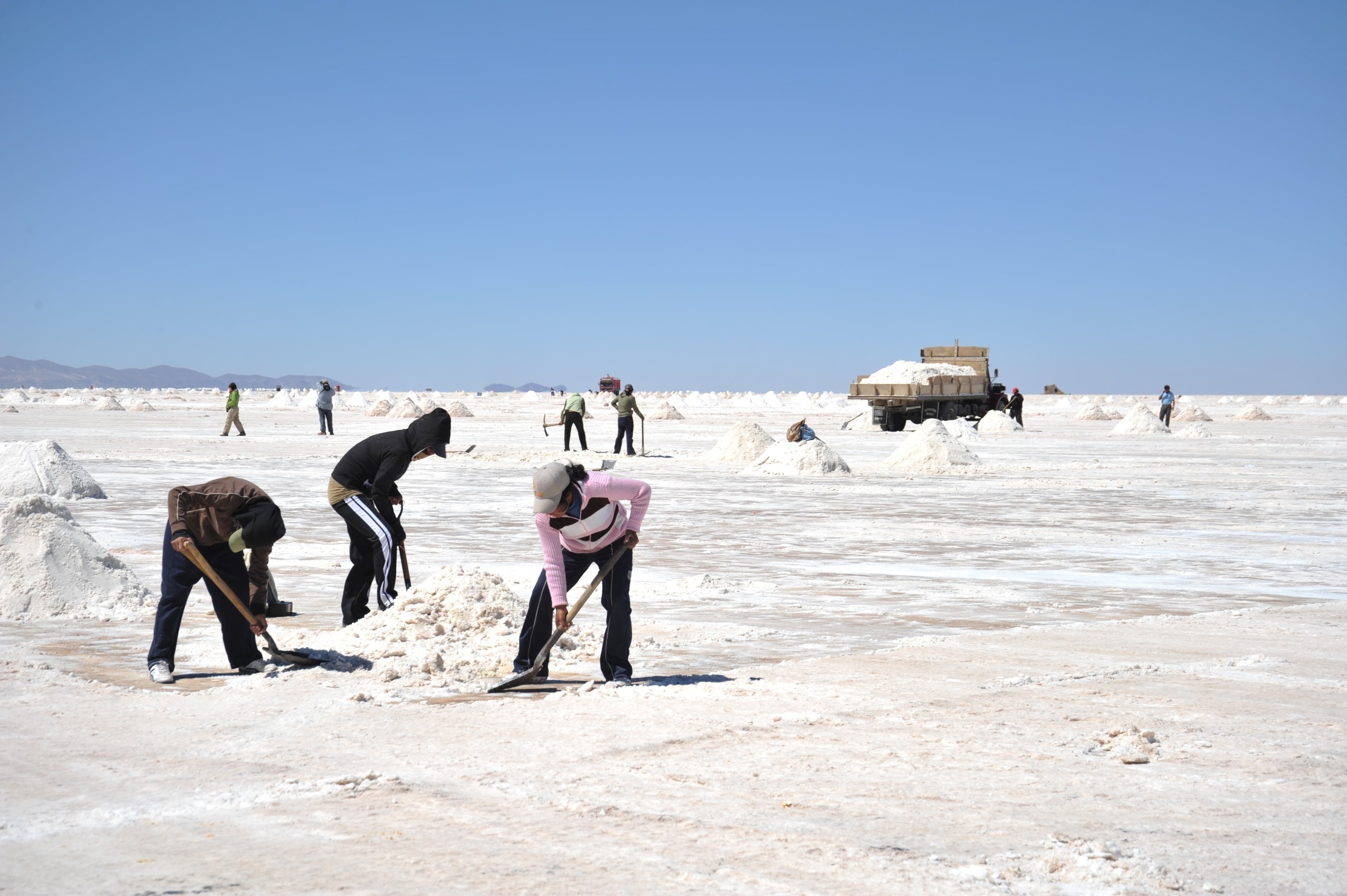
We will ensure that policy makers in fossil fuel-producing developing countries take decisions that reflect citizens’ long-term development needs and advance energy transition plans. Responding to demand, we will strengthen the movement for accountability amid the energy transition. As we did in the early years of the extractive industries governance movement, in 2022 NRGI will build a suite of capacity development tools to enhance the knowledge and strategic foundations of civil society actors and government officials contending with new realities of the climate crisis and economic impacts of the pandemic.
We will build on our field-leading work on the risks that national oil company (NOC) investments pose to their countries’ economic sustainability and their impact on global climate objectives. At the global level, we will work with climate and resource governance advocacy organizations to shape climate risk, environmental, social and Ggvernance factors (ESG), sustainability and transparency standards. In some countries, such as Ghana and Uganda, our support to analysis and advocacy by national actors to reduce NOC risk-taking will inform current policy decisions in 2022. In other countries, including Mexico and Tanzania, we will work with partners to begin to build constituencies for NOC reform over the longer term, conducting analysis to frame public debates around priorities and place the importance of NOC reform more centrally on domestic political agendas.
And we will leverage our analytical framework to help civil society and governments interrogate plans, policies, and investment choices around forward linkages from natural gas. In 2022, we will further hone the framework, and use it to spark dialogue around gas-to-power policies and ambitions in Senegal, Ghana, Peru and Nigeria, and around Lebanon’s domestic energy future.
We will also contribute to emerging areas of debate, building on past commentary and events, to advocate for a more equitable transition and to explore whether and how NRGI can support renewables governance.
Revamping our country programs
With NRGI’s prioritization of energy transition and Indonesia’s regional importance, we will re-engage in the country in 2022. Using the Resource Governance Index methodology, we will assess Indonesia’s extractive industries to prioritize issues for further research and engagement, including working with partners exploring just transition in the coal industry.
We are re-establishing our presence in Nigeria, shifting focus to the country’s economic future beyond oil. We are establishing new partnerships and have re-engaged with key partners from early incarnations of the program. We are focusing on select instruments of reform: national oil and gas policies, the Gas Master Plan, and the Petroleum Industry Act. We aim to build awareness and momentum by working with allies to ensure that support and planning for a post-oil economy is on the 2023 national election agenda.
NRGI has offered analysis and Resource Governance Index assessments, assisting state-owned companies in the improvement of their transparency and accountability practices, and supporting civil society organizations and oversight actors to monitor the sector.
Following the launch of our Senegal country program last year, we are supporting ongoing reforms of the country’s institutional and regulatory frameworks for the extractive sector, ranging from an overhaul of its participation in the EITI process, design of a new petroleum code and local content law, revision of its mining code, and the finalization of an oil and gas revenue management law. NRGI has offered analysis and Resource Governance Index assessments, assisting state-owned companies in the improvement of their transparency and accountability practices, and supporting civil society organizations and oversight actors to monitor the sector.
We will continue adapting and evolving our work in other NRGI countries of engagement, including Colombia, DRC, Mexico, Mongolia, Guinea, Peru, Tanzania, Tunisia, and Uganda.
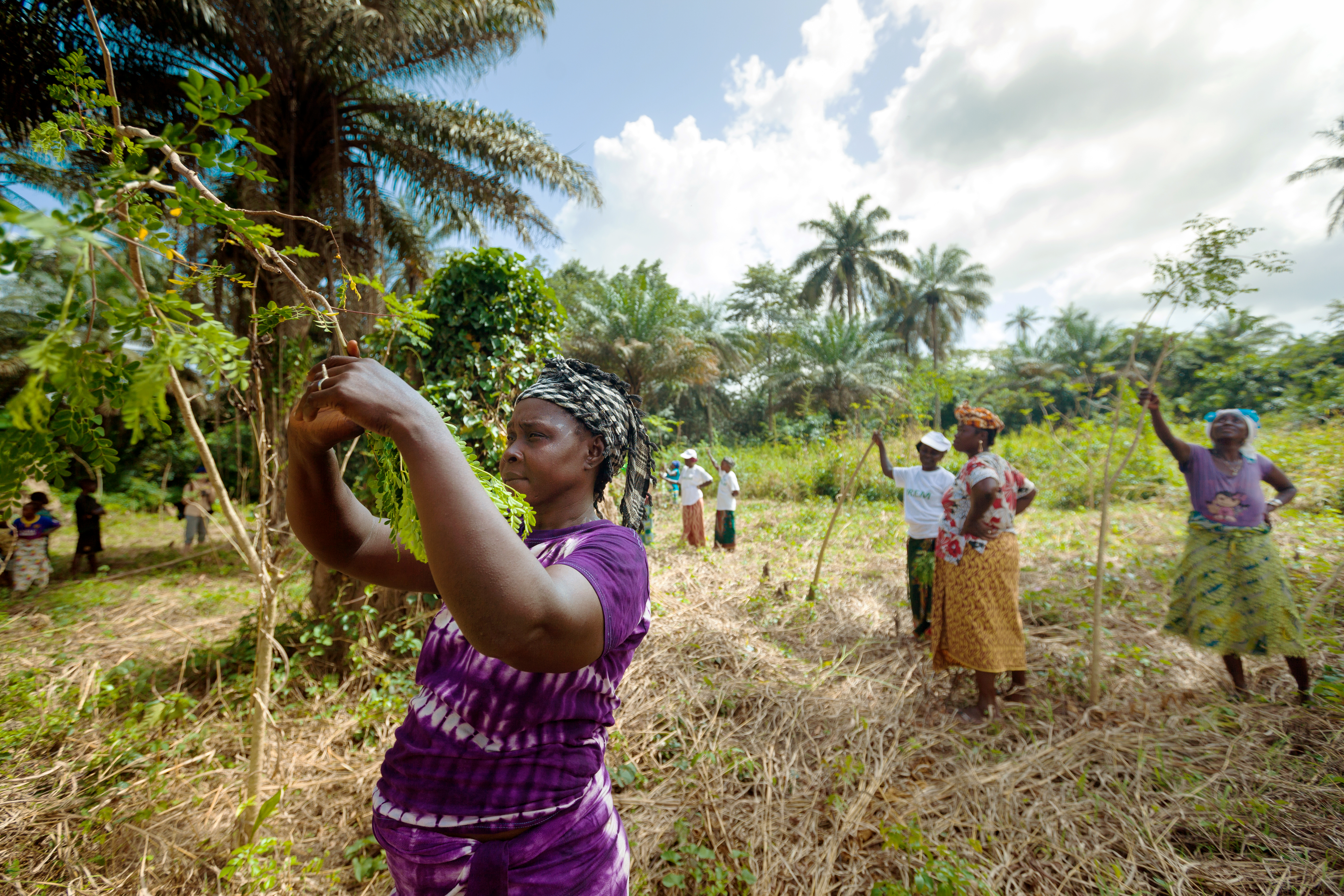
Expanding our frontiers
Responding to demands and evolutions in the field requires continual learning and evolution of our work.
In 2022, we will build on our recently concluded work in partnership with the World Resources Institute on gender and extractives. We will explore how NRGI can actively address the gender imbalances in the natural resource sector, aligning with NRGI’s commitment to diversity, equity and inclusion.
We are seeing growing demand on subnational resource revenue sharing, policy makers and civil society counterparts to support improvements in the design and monitoring of subnational revenue sharing systems. We will determine whether to deepen our engagement and renew our expertise in this area.
We will also explore the future of our work with investors and how we leverage corporate power to advance resource governance aims.
After two whirlwind couple years of adaptation, transition, and uncertainty, we now find ourselves grounded and ready to face the future. Though strategic evolutions remain, we have newfound clarity on our contribution to the energy transition and how to seize political openings. We are at the ready to help people in resource-rich countries to face the future.
Top photo by Axel Fassio/CIFOR for Flickr
Middle photo by Free Wind 2014 for Shutterstock
Bottom photo by Joe Saade/UN Women for Flickr
NRGI envisions a world where natural resources enable fair, prosperous and sustainable societies, instead of undermining them.
Oil and Gas Will Not Illuminate a Path Forward for Lebanon

As millions of Lebanese scramble to meet their basic needs and keep the lights on, Lebanon urgently needs a new, more realistic vision of what fossil fuels can do for the country. For years, politicians in Beirut swore that “entering the club of oil producers” would transform Lebanon’s failing economy and crumbling power sector. But that narrative has gone quiet over the last year, after a first offshore well came up dry, the ruling class became unable to operate a functioning government, the pandemic upended daily life and the economy imploded. Now, further drilling offshore is delayed, a second licensing round is on hold, and most people are focused on survival. In this harsh climate, what’s still possible?
In a new briefing, we warn that Lebanon should not stake its economic or energy future on oil and gas. For the last decade, politicians have made vastly differing claims about the size of Lebanon’s natural resource wealth, all based on limited information. The actual size of the country’s reserves remains in doubt, and unless further drilling finds something significant, no company will agree to extract.
Time is also of the essence, because even if there aren’t more delays, Lebanon would not produce any oil or gas until the 2030s—well into the era when extractives companies will be walking away from high-cost deepwater projects in “frontier countries”. In truth, Lebanon’s offshore was already a marginal destination for investment even before the pandemic caused a global slump and the energy transition started picking up speed—despite official claims to the contrary.
What if Lebanon does make a sizable discovery, though, and production starts while oil companies are still interested and foreign demand is solid? While no one can put a reliable price tag on such a scenario, there is no cause to think that oil and gas exports would be an economic “turning point” or a solution to the current miseries. In fact, the experiences of other countries show that becoming a producer could make some of the country’s economic governance problems worse—leading to, for instance, unrealistic budgets, more unsustainable debt and more endemic corruption. At worst, relying too much on fossil fuel exports would prolong the consumption- and rent-based economic model that underpins the current crisis, merely shifting dependence to a new sector.
As delays and obstacles to exporting fossil fuels have grown, the government in Beirut has reimagined its hypothetical gas as a new, cheaper fuel for the power plants owned by Électricité du Liban (EDL), the mismanaged, perennially insolvent state-owned utility. This focus on cost savings is understandable, given the dire need for cash. Yet it could be misleading, as there is no guarantee that burning gas for power will make for significant savings. Routine dysfunction and delays around new gas-to-power projects could even add costs, including big penalties, flaring and the need to fall back on gas imports. The risks that there won’t be domestic buyers for Lebanese gas are very real, considering that the government’s promises to build new gas-fired power plants go back to at least 2010.
Solar and wind, meanwhile, have received far less attention, despite their high potential. Gas versus renewables isn’t necessarily an “either-or” choice for Lebanon, as neither could close the huge power supply gap by themselves and both face serious (and overlapping) commercial and technical headwinds. Yet renewables could offer Lebanon bigger long-term cost savings than gas-fired power, along with other upsides like improved energy security, less exposure to world fossil fuel prices and less pressure on the local supply of U.S. dollars, the key foreign currency in Lebanon’s inflationary, import-driven economy. Political leaders also need to ask whether they will be able to finance an electricity system that depends heavily on gas in the longer term, especially as foreign capital for fossil fuel projects dries up.
This outlook, though disappointing, offer a chance to create a new energy strategy for when the country’s economic and political fortunes improve. To start, the new government should facilitate a multistakeholder risk assessment for oil and gas, to help adjust expectations. It should also set fresh goals and targets for the power sector, describe how gas and renewables will work together in the domestic energy mix, and clarify EDL’s role going forward. Officials should also reassess the investment barriers to utility-grade solar and wind projects and find ways to help lower them. New institutions and regulations may still be needed as well—for instance, a long-delayed power regulator and a distributed renewable energy law.
Leaders should start work on this new strategy now, rather than waiting for foreign donors and international financial institutions to write it for them. As aid negotiations go on, these outsiders will demand preconditions and reforms related to energy, some of which may not be in the country’s best interests. Consider the failed French-led roadmap of 2020, which pressured the government to fast-track arguably unworkable plans for new gas-fired power plants, among other things, in exchange for $11 billion in soft loans. The new IMF talks, however uncertain their prospects may be, should not become the latest chance for an outside actor to shape the story of Lebanon’s energy future.
Starting early, the Ministry of Energy and Water should also communicate, and solicit feedback on, any new direction it wants to take in the energy sector. Assessing needs and managing public expectations will be critical for the success of any new strategy, and no plans should be made without wide-ranging consultations and dialogue, a step that politicians often ignore.
By the end of all this outreach and stocktaking, Lebanon should have a new narrative for what oil and gas can and can’t do for its economy and its citizens. And unlike the old one, this should be based more on facts and hard trade-offs, and less on unrealistic hopes and empty promises.
Rethinking expectations around the future of oil and gas in Lebanon
Three Steps Toward an Equitable Energy Transition

When the curtain falls on COP26, a raft of action plans, pledges, compacts, coalitions and statements will have been announced. As “action-forcing moments,” these initiatives matter. But the choices made in countries around the world the other 50 weeks of the year, by actors ranging from national oil company officials and finance ministers to investors and activists, will equally determine the future for people and the planet.
Much of the spotlight in Glasgow is on promised cuts to fossil fuel consumption. Yet supply must also fall if we are to avoid catastrophe—the world needs to produce less oil, gas and coal starting now. Nearly two-thirds of already-discovered oil and gas would have to stay in the ground to keep within 1.5°C, and at current production levels, we’ll spend the global carbon budget by around 2030.
Each and every fossil fuel-producing country should support action on climate change for a simple reason: they are all vulnerable to it, and none more so than developing countries in the tropics. Yet an abrupt end to production would upend economic and political life in many of these countries, especially where leaders and citizens have staked their aspirations on getting more out of the ground.
At NRGI we believe that, at a minimum, wealthier, higher-emitting producers that have benefitted the most from extraction should wind down first and fastest. They should also make the deepest production cuts. Most lower-income producers have small carbon footprints, as well as pressing development and energy challenges. Pressuring them to wind down faster is economically unfair and morally unjustifiable.
The world cannot wait for wealthy nations to “lead” on fossil fuel production cuts. Many haven’t even acknowledged the limits of their moral authority on the topic, especially when toxic politics are stalling their own energy sector clean-ups. While the U.S., U.K., Canada and others just pledged to end financing for fossil fuel projects in low-income countries, G20 countries have poured $300 billion in new public money into fossil fuels since the pandemic started. Some countries—like the U.S., Canada and Australia—take the stage at events like COP to preach hard choices they won’t make for themselves. This sows mistrust and division, and complicates progress toward consensus.
In this tough political climate, we need solutions that don’t require a grand bargain. G20 countries must first honor their climate finance promises; supporting lower-income, fossil-dependent producing countries to transition to a post-oil, -gas or -coal economy is a critical complement. This includes investing in natural resource governance, which offers a road map to support quicker, fairer energy transitions for fossil fuel and mineral producers.
Here are three priorities that policy makers, activists and the international community must advance:
Increase dialogue and transparency around emissions and national economic risks from fossil fuel projects.
With a billion people already living in poverty in resource-rich developing countries, the stakes for adaptation and transition are high; yet fossil fuels represent one of the few avenues for much needed revenues for recovery and sustainable development. As a result, as demand wanes, some leaders will support costly, questionable handouts to extractives companies. Others with less altruistic aims will push through polluting, corrupt, possibly loss-making projects to keep their pockets lined.
Whatever their agendas, few politicians, in countries wealthy or poor, are likely to engineer fast, fair transitions by themselves. They will have to engage with—and be pushed by—activists, climate defenders, frontline communities, media, civic and trade organizations and research institutions, among others. If those actors are to play their critical roles, governments must first protect civic space and disclose more information on their energy transition plans. They should detail their future production goals, including what they’ll spend on subsidies and infrastructure. They should publish realistic scenarios for how transition could affect the health of their economies and the economics of particular fossil fuel projects. And they should be honest about the carbon-intensity of their production and reserves. This will help citizens hold leaders accountable, engage in more meaningful dialogue and shape new pathways for development.
International actors should also establish and implement strong and consistent standards. Extractives companies, for their part, must disclose more than the high-level information found now in most of their current climate risk disclosures, ESG metrics and sustainability reports. The data they publish should not just be for investors. Data should help stakeholders where the companies operate to understand how the companies’ transition plans—including divestment from specific projects—will impact national economic and development prospects. More broadly, fossil fuel companies can exacerbate governance and resource dependence risks in producing countries; climate disclosure standards must better and in a more nuanced fashion shed light on such risks. For this reason, norm-setting bodies must pay more attention to developing sector-specific standards, like the approach taken in the new Global Reporting Initiative Oil and Gas Standard.
Confront the risky bets that national oil companies are making.
The debate about how to cut supply cannot ignore national oil companies (NOCs), which produce over half of all oil and gas. Plans made by this “hidden half” of the industry matter at least as much as those of international oil companies, especially now that developing any new oil or gas fields conflicts with Paris goals. Leaders in resource-rich countries face a stark choice regarding new fossil fuel projects: investing public money in these projects will either undermine climate goals, or potentially cost their countries billions if climate goals are met.
Going forward, finance ministers and other economic decision-makers in countries with NOCs must reconsider whether letting NOCs grow is worth the risk. NOCs making risky bets in the oil and gas sector often do so by incurring largely hidden debt ultimately backed by government, meaning countries could be left responsible. Private oil and gas companies, for their part, should not try to pawn their risky assets onto state companies from poor countries; nor should they ask for tax breaks or other handouts.
Strategies to push NOCs to produce less must recognize that NOCs vary greatly in their openness to change, their vulnerability to the energy transition, and what they add to their economies and world emissions. Campaigners need context-specific, pragmatic strategies that don’t require NOC bosses to care about climate change—for example, pushing an NOC (or its financial backers) to recognize when its ambitions don’t make economic sense. Success along those lines would be a boon for the climate fight since countries with more risk-averse views on new extraction would produce less. It would also give fossil fuel-producing countries a better shot at building diversified, resilient economies as demand for what they currently produce wanes.
Fight corruption and promote good governance in critical mineral supply chains.
Thus far, COP has largely overlooked the flip side of fossil fuels’ decline: the projected quadrupling of the demand for clean technology minerals such as cobalt, lithium and copper that are needed for transition. As demand spikes, expectations in the countries producing them have surged, as prospects for a new mineral boom raise hopes for revenues to boost development. But mineral booms have often disappointed in the past, and these countries could also face rampant corruption—which, in turn, could disrupt supply.
Production surges could also feed an ugly, unjust “race to the bottom” that benefits rich consumer nations and producer-country elites while leaving citizens in host countries to pay the costs with their ecosystems, living standards and lives. Many countries with sizeable reserves of critical minerals have already suffered instability and destruction from poorly governed mining—these include the Democratic Republic of the Congo (home to half of known cobalt reserves), Myanmar (large deposits of rare earth minerals) and Bolivia (some of the world’s largest undeveloped lithium deposits). The energy transition should offer citizens in places like these something other than fresh disappointment.
Schemes to track and certify mineral supplies, while important, won’t alone promote a mineral boom that’s both fast and fair. The governments, companies and investors leading supply chain initiatives must also support forward-looking anticorruption and governance standards—for instance, by publishing all payments and mining contracts, avoiding corruption-prone agents and intermediaries, and disclosing companies’ true owners. They should also help producer countries strengthen their laws and institutions and encourage them to take important steps like auditing their state-owned mining companies or opening license awards to outside scrutiny.
These three actions can help governments and citizens in producing countries make more informed choices about their energy futures that protect the planet, strengthen their economies, and create fairer societies. The global energy transition should offer such chances to all, not just to those who have already excessively benefitted at the expense of others.
Suneeta Kaimal is president and chief executive officer of the Natural Resource Governance Institute (NRGI). Aaron Sayne is a senior governance officer at NRGI.
How Mozambique Could Strengthen its Proposed Sovereign Wealth Fund

The Mozambique government expects the country’s large gas reserves to generate revenues of around USD 96 billion over 25 years (based on a 2019 estimate). With offshore production due to start in 2022, the country is at a critical moment.
In October 2020, Mozambique’s central bank published a proposal for establishing a new sovereign wealth fund. The decisions made now about the structure and rules of the fund will have major ramifications on the country’s economic future and the wellbeing of its citizens.
Under the plan, 50 percent of annual oil, gas and mining revenues would be deposited in the fund until its twentieth year, and 80 percent thereafter. The fund would then, in theory, use these deposits to meet two objectives: accumulation of savings to balance the needs of present and future generations, and fiscal stabilization.
The proposal incorporates many of the key elements of effective, accountable and transparent sovereign wealth fund frameworks. Among the strongest of these are clear fund objectives, clear deposit rules, the channeling of domestic spending through the state budget and a comprehensive governance structure accompanied by a robust auditing framework.
Nevertheless, as officials work to finalize the sovereign wealth fund framework, they might consider improving it in several important areas:
1. Manage public expectations given gas revenue uncertainty
Government revenues could come in lower and later than expected. The government took the important step of publishing downside scenarios in 2018, but these have not grabbed headlines in the same manner as optimistic projections. The government could publish updated scenarios regularly and refer to the downside scenarios in its public statements about the fund. Using several means of communication, especially social media, would also help manage public and political expectations.
Mozambique’s hopes rest on Total’s Area 1 and Exxon and Eni’s Area 4 liquefied natural gas (LNG) projects. Area 1’s first phase and Area 4’s Coral floating project are under development, but the larger Area 4 onshore project is yet to reach a final investment decision. With Rystad Energy estimating a breakeven LNG price of nearly USD 7 per million British thermal units (mmBtu), it is not guaranteed that the Area 4 onshore project will be developed at all. The Asian benchmark price has averaged around USD 9 per mmBtu over the past five years. But if the world acts to limit global warming to less than 2˚C by 2050, Wood Mackenzie suggests that the Asian price could be lower, possibly less than USD 5 per mmBtu by 2040. Under this scenario, Area 4’s onshore project is likely unviable. These low prices would also reduce government revenues from the other projects. As previous government projections and the experience of some of sub-Saharan Africa’s other new producers highlight, another risk is cost overruns, which would further lower government revenues.
2. Beware saving for future generations when borrowing at high interest rates
The government could revise the proposed deposit and withdrawal rules to reflect that saving revenues may sometimes hinder rather than help achieve intergenerational equity. While a reasonable rate of return for most sovereign wealth funds is around 4 percent, Mozambique is borrowing at high interest rates, such as 9 percent on a Eurobond. A simple illustration highlights the implication: If a person has $100 in debt and is paying 9 percent interest on this debt, but is earning 4 percent interest on their savings in the bank, then for every $100 saved rather than used to pay down debt, the person loses $5.
Intergenerational equity is not just about money though; the government can help future generations by investing in healthcare, education and productive infrastructure today. In Mozambique, the benefits from domestic spending are greater than the likely return on fund savings, and likely to remain so until poverty is drastically reduced. While the government should consider “absorptive capacity” constraints to effective public investments, we recommend it prioritizes good public investments.
The proposed deposit and withdrawal rules together act as a revenue-based fiscal rule based on arbitrary saving-spending thresholds. The government should consider only making fund deposits if debt servicing costs become manageable or once extractives revenues reach a certain threshold, like solutions implemented in Mexico and Tanzania. Alternatively, the state could adopt a general fiscal expenditure rule or structural balanced budget rule.
3. Ensure all government spending is smoothed rather than just focused on gas revenue volatility
We recommend a different approach to managing volatility. The proposed deposit and withdrawal rules are “pro-cyclical” in that they allow for more spending when extractives revenues are high and require spending cuts when revenues are low. The stabilization component of the fund—which can channel up to 4 percent of the previous year’s gas revenue to the state budget when actual revenues fall short of projected revenues—may not fully mitigate this effect.
To even out year-to-year spending, we recommend an expenditure smoothing rule that allows for additional spending on infrastructure and human capital development projects (provided these generate an adequate social rate of return). For instance, in Peru, rules only permit real current expenditure to increase by 4 percent a year. Though if the congress declares an emergency, an exception can be made: like the escape clause suggested in Mozambique’s proposal, which we support.
4. Clarify ENH dividend policy and cost controls
The proposal suggests that all taxes, royalties and other fees paid by the national oil company, Empresa Nacional de Hidrocarbonetos (ENH), would be deposited into the fund, as would its dividends. International experience indicates that national oil companies tend to increase expenses as production increases, reducing the revenues available for dividend payments and therefore to the national treasury. While the dividend policy for CMH, a partially privatized subsidiary of ENH, was recently clarified, we recommend clarifying the dividend policy for ENH as a whole. We also recommend strong cost control measures at ENH and its subsidiaries, such as limits on their mandates, more comprehensive and regular cost audits, greater transparency and publication of independent external audits.
5. Enhance investment rules
While sovereign wealth fund investment guidelines generally contain detailed asset management policies—such as target asset allocation, benchmarks, lists of eligible and prohibited asset classes and diversification requirements—the government might consider a stronger approach by legislating these measures, as in Ghana, Uganda and Timor-Leste.
6. Enhance transparency and external accountability
The proposal requires public disclosure of quarterly and annual reports, but what information these must contain requires further clarification. For instance, the reports could include fund balances, returns by asset class or by asset, and external managers and their fees. The government could also publish online independent external audits and Administrative Court reports.
Finally, the government could consider tasking an independent, multi-stakeholder body oversight of the management of extractives revenues, potentially reporting to the parliament and the public. Such bodies, instituted by countries including Ghana and Timor-Leste, have improved fund management and strengthened public trust in the management of natural resources.
It’s Time to Talk: Sonatrach and the Energy Transition in Algeria

العربية »
This post is part of the "Resource Governance and the Energy Transition" series.
Last week Algerian football supporters attacked the headquarters of Algeria’s national oil company, Sonatrach. They were angry at the company, accusing it of not paying the salaries at Mouloudia d'Alger, the football club it owns. The attackers blamed this state of affairs for the average results of the club in the Algerian league.
If Algerians can be so angered by poor football performance, imagine their wrath when Sonatrach’s revenues decrease because of the global changes affecting the oil and gas sector. Such a downturn could mean that the company will be unable to continue to play a pivotal role in the economy of Algeria. We are entering an era of energy transition where resource-dependent countries, their state-owned companies and their populations need to prepare, get fit and build a strategy that will help them win the competition.
The coronavirus pandemic accelerated many trends that were already underway, including the energy transition away from fossil fuels toward renewables. The faster this transition, the more it threatens national oil companies and governments reliant on oil revenues—unless they prepare well.
Governments of Middle Eastern and North African (MENA) countries that rely on oil and gas for revenues cannot ignore the global march toward clean energy; they must react and secure a stable future for their citizens. To that end, we at NRGI have produced a new briefing, “National Oil Companies and Energy Transition in the Middle East and North Africa” (a companion piece to the report Risky Bet: National Oil Companies in the Energy Transition). Algeria’s Sonatrach is one of three MENA NOCs that we examine, along with Qatar Petroleum and Saudi Aramco. And it appears to be most vulnerable to the accelerating energy transition.
Algeria, the largest oil and gas producer in North Africa, is heavily dependent on hydrocarbons for exports and government revenues, with oil and gas accounting for 60 percent of government revenues. Sonatrach controls over 75 percent of the country’s hydrocarbon production; it is the cornerstone of the economy, which makes it crucial that Sonatrach management and government officials heed global shifts.
A new corporate strategy?
National oil companies with dwindling proven reserves and a heavy share of high-cost geological assets among their potential future portfolios face serious possibilities of “stranded investments,” and could struggle to maintain expected production volumes, revenues and transfers to state treasuries. NRGI analysis shows that national oil companies in the MENA region could invest more than $66 billion in oil and gas projects that would not break even if the world keeps to its climate commitments. Sonatrach’s portfolio is the most vulnerable in this regard, with $12 billion in project spending (more than 25 percent of the company’s budgeted capital expenditure) slated for projects with a break-even price between $40 and $70.
Alongside the prospect of investing in high-cost projects, Sonatrach must continue to supply the ever-growing domestic demand for natural gas, which is sold to citizens at subsidized prices, thereby reducing the share available for revenue-generating exports. These challenges reverberate through the company’s portfolio, limiting access to finance and partnerships that would aid its diversification.
Sonatrach’s current approach to mitigate this uncertainty largely revolves around a shift to liquefied natural gas (LNG). This includes investing in existing and new LNG projects to diversify its gas export portfolio. The success of this approach hinges on the availability of domestic reserves and technology to unlock gas at a competitive cost—and on whether the demand for gas holds up or yields to increasingly cheaper renewable energy. In addition, Sonatrach must demonstrate commercial abilities to become an LNG trader (not just a supplier), expand internationally to secure a flexible and diverse portfolio, and harness financial resources to take positions in the gas value chain. However, we know that Sonatrach had to halve its spending in 2020 due to the collapse in the oil price, at the time limiting its capacity to expand into growth markets such as chemicals and plastics.
State of the government-Sonatrach relationship
Alongside the Algerian government, Sonatrach, like many national oil companies, shoulders significant financial responsibility for the wellbeing of citizens. Reduction in oil and gas revenues increases this pressure. So beyond the company’s business and investment strategies, the government of Algeria must reexamine the fiscal relationship between Sonatrach and the state, as long-held expectations about available fiscal transfers (of taxes, dividends and other payments by the company to the government) may be unmet. The International Monetary Fund (IMF) estimates Algeria’s fiscal break-even price—the oil price necessary in order to meet expected spending while balancing the national budget—at $92 per barrel. That figure increases monthly, and more so amid the pandemic. Based on the new budget, Sonatrach seems likely to set the price of oil at $135 for the barrel to break even fiscally—a price which is unlikely to materialize anytime soon (or possibly ever). This contrasts with many oil companies and analysts assuming the oil price for the next few decades will average $60 a barrel. Even as the pandemic abates, low oil prices are likely to prevail and price spikes will be the exception. Therefore, the government end its dependency on Sonatrach and seek new sources of cash.

Let’s talk energy transition
Sonatrach lacks funds and low-cost reserves and therefore will be less resilient to declining prices than the regional giants Saudi Aramco or Qatar Petroleum. It is therefore imperative for Sonatrach to conduct rigorous risk analysis around capital allocation decisions. Ultimately, both the government and Sonatrach must re-examine the company’s conventional assumptions about public expenditures, and the government must clearly define and explain to citizens the institution’s role in the country’s energy transition.
As profit margins shrink across the industry there is less margin for error, and so efficiency and integrity are more important than ever. Sonatrach should redouble its investments in transparency and corporate governance reform.
Already, Sonatrach has recently taken steps to improve its governance and transparency. In the 2017 edition of the Resource Governance Index (RGI), which assessed performance using 2015-2016 data, Sonatrach scored 47 out of 100 possible points, ranking 31st out of 52 assessed state-owned enterprises, a performance considered “weak” by the RGI. In a 2020 interim RGI assessment, Sonatrach scored 65 points out of a possible 100, which indicates an increase of 18 points and a transition from the weak to satisfactory performance band. That is a positive evolution that should continue.
Finally, the Algerian government and Sonatrach should create an inclusive space for the public to engage with government officials and company staff on the impact of energy transition on the country’s oil and gas sector. Together all stakeholders should debate solutions to the challenge presented by the shift to clean energy—citizen-oriented solutions.
New Oil- and Gas-Producing Countries Now Have an Online Home

Oil and gas extraction has often failed to benefit citizens in producing countries, and in many cases has exacerbated corruption and environmental damage. The New Producers Group is a network of officials from countries newly producing oil and gas or exploring production, that aims to change that by sharing resources and expertise on how to better manage the sector.
The group—coordinated by NRGI, Chatham House, the Commonwealth Secretariat and more than 30 member countries—has launched a new website that assembles research, videos, and other tools to support governments to develop strong policies, oversight and accountability around oil and gas production.
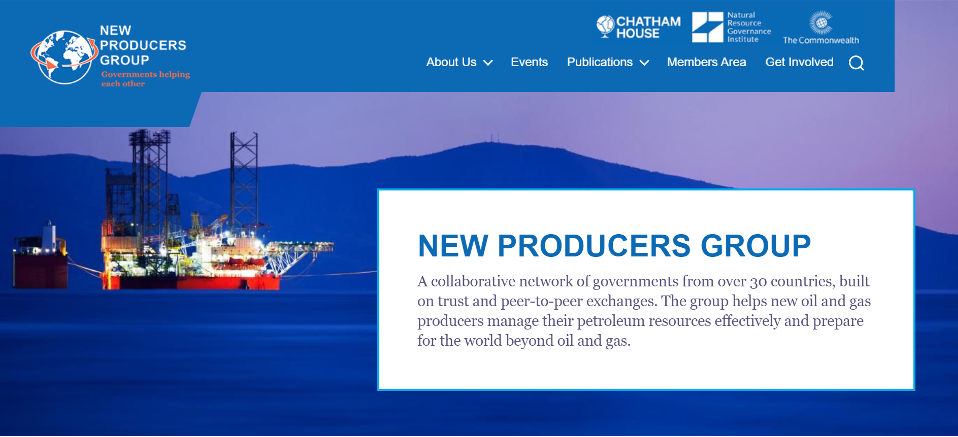
Climate change has amplified the urgency of establishing responsible and effective management of oil and gas. Developing countries face new challenges in marrying their economic and climate ambitions, and the global commitment to shift away from fossil fuels. Excessive expectations about the benefits of oil and gas production can also lead new producers to take on outsized debt and stifle investment in renewable energy, which could hold more sustainable benefits for the country.
The website hosts publications on topics ranging from the energy transition to building accountability, a roadmap for the group’s plans, and a members’ area where participants can share information and connect with each other. The group is currently focusing its efforts on understanding how oil and gas producers can best prepare for the global energy transition, which was the theme of the group’s 2020 annual meeting.
I encourage you explore the site and share it with others working in this space.
Clean Energy and Fossil Fuels in the Middle East: A Virtuous Cycle?

This post is part of the "Resource Governance and the Energy Transition" series.
Key messages:
- An energy transition in the Middle East requires financing. Governments heavily rely on selling hydrocarbons for this money.
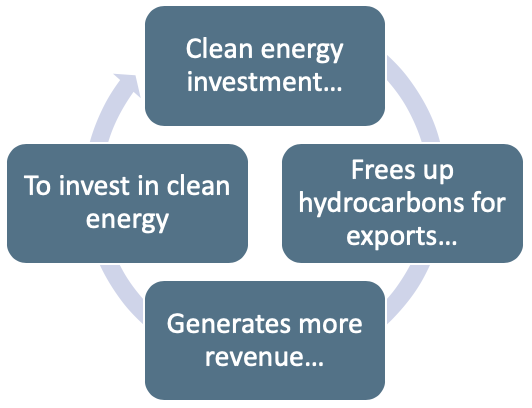
- Governments can create a virtuous circle: invest in clean energy, to free up hydrocarbons for export, which can finance more clean energy.
- As hydrocarbon prices decline, the low-cost producers of the Middle East have an advantage and should be the last to leave the market. The world will demand proportionally more of the region’s oil and gas.
- However, the Achilles heel of the Middle East remains its undiversified economy, and the need for high prices to sustain governments’ spending.
- Diversification will ensure that Middle Eastern oil producers can sustain exports at lower prices, with less economic pain.
The coronavirus pandemic has overshadowed several issues that pre-crisis were top priorities for many governments and organizations around the world. One such agenda item is the energy transition, which refers to the transformation of our energy system from one that heavily relies on carbon-dioxide-emitting fossil fuels – coal, gas and oil – to one which is dominated by green and clean sources of energy. Although no one knows how long and how deep the current crisis is going to be, or what the shape of recovery will be, it is only a matter of time before the push for the energy transition will regain its pre-crisis fervor.
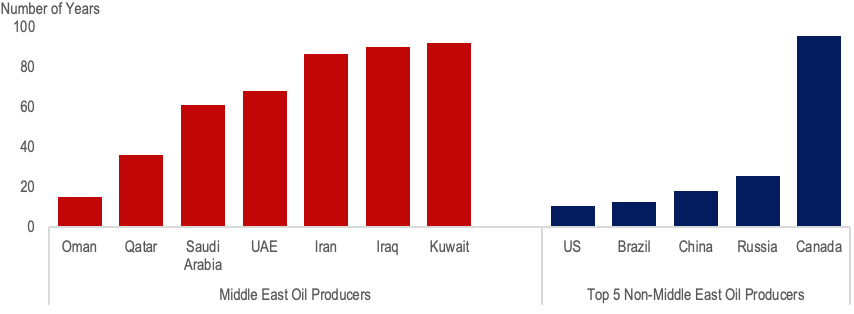
The world’s determination to fight climate change and green the energy mix is a concern for any oil and gas producer, and the more so for the large Middle Eastern oil exporters which sit on massive proven hydrocarbon reserves, expected to easily last another 60 years. (See figure below.) The risk of such assets becoming stranded and losing value is high, with dire consequences for these poorly diversified economies. This prospect is probably the most apparent and often discussed impact of the energy transition on Middle Eastern oil producers.
In reality, however, the picture is more complicated. The limited diversification of Middle Eastern oil exporters with regard to both their primary energy mix and their economies will conspire to increase – not decrease – cheap oil and gas exports from the region as the energy transition gets underway.
Reserves to production ratios
 Click to enlarge
Source: BP. Statistical Review of World Energy, 2019
The domestic energy transition: Increasing oil and gas exports from the Middle East
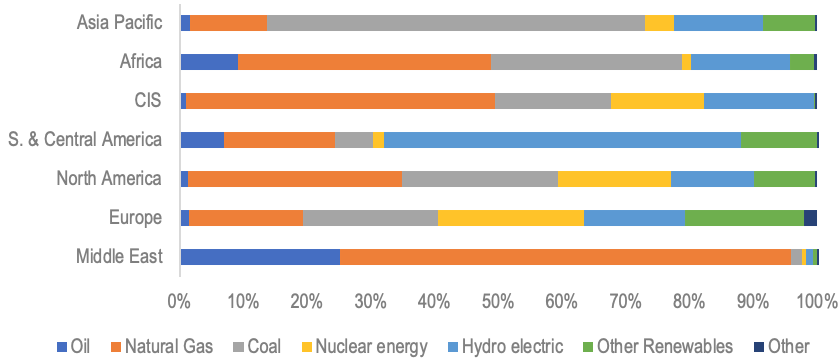
The Middle East is truly a unique region with respect to its limited energy diversification, regardless of whether countries are net importers or exporters of oil and gas. The dominance of these two hydrocarbons in the region’s primary energy and electricity mix is remarkable. In countries like Kuwait and Saudi Arabia their contribution is nearly 100 percent. Outside the region, the mix is much more colourful as countries meet their energy needs from a greater variety of sources of energy, from fossil fuels to renewable and nuclear energy. Overall, the Middle East is the least diversified in the world with respect to the primary energy mix:
Electricity generation by fuel, 2018
 Click to enlarge
Source: BP. Statistical Review of World Energy, 2019
The region’s oil and gas exporters have set ambitious targets to diversify their energy and electricity mix. The United Arab Emirates (UAE), for instance, aims to obtain half of its primary energy from clean sources by 2050, from less than 2 percent in 2018. This should be a welcome move, from an environmental perspective, especially since the region encompasses some of the biggest carbon emitters (on a per capita basis) in the world. Also, economically speaking, greater use of green energy would free more oil and gas for exports.
The transition of a petroleum-based to a green economy, however, differs from elsewhere. Everywhere, the energy transition does not come cheap. Despite impressive falls in the operating costs of solar and wind power technologies, green energy still requires government support, oftentimes including financial support. For renewable energy, one has to count investment and the full system costs in power generation, not just the generation costs when the sun is shining and the wind is blowing, to take into account the problems of intermittency and lack of storage. For nuclear, the investment costs are substantial, thus making financing on purely commercial terms difficult to obtain and often requiring heavy government support.
In the Middle East, the public sector dominates the economy, especially as far as energy infrastructure is concerned, and the participation of the private sector remains modest. In addition, in many countries, governments have hardly any source of revenues independent from oil and gas. In Iraq, for instance, that dependence exceeds 90 percent. As long as government revenues in the region are dominated by hydrocarbons, hydrocarbon revenues will have to finance the new, clean energy infrastructure.
Once oil and gas have been replaced domestically with cleaner sources for power generation, a virtuous cycle will result: the more clean energy replaces oil and gas in producing countries, the more oil and gas will be available for them to export, and in this way to finance their own domestic energy transition. This reward can be substantial: Saudi Arabia, for example, on a hot day burns more than one million barrels of oil to produce power for cooling. The Middle East in this respect stands out from any other region around the world: here, clean energy substitutes fuels which can actually be sold at a profit. On the one hand, this ultimately provides an incentive to engage in the energy transition. On the other hand, this incentive is inextricably linked to exporting more oil and gas. Progressing the energy transition in the Middle East thus means incentivizing more oil and gas exports to the rest of the world.
A virtuous cycle
The global energy transition: Increasing oil and gas exports from the Middle East
When analysts discuss stranded assets, they typically take a long-term view of the post-oil and -gas age. However, there will be a considerable period when these energy sources will remain in demand throughout the energy transition, which may span decades. The market for oil and gas during this period will shrink and prices will decline accordingly. The low-cost producers, such as those in the Middle East, will clearly have an advantage and should be the last to leave the market. High-cost producers will be squeezed out first, as they find it hard to sustain production as oil prices decline.
In this respect, the more successful the global energy transition is, the more reliant the world’s economies will be on the Middle East, with significant implications for energy security and geopolitics. Here too, the energy transition will lead to more – not less – oil and gas exports from the Middle East.
No wonder the region’s national oil companies have been pursuing aggressive strategies to expand their production capacity throughout the oil and gas supply chain. In 2018, for instance, Saudi Aramco announced it would invest USD 500 billion over the next 10 years and the UAE’s national champion, ADNOC, announced an investment of $130 billion by 2023, both in oil and gas capacity expansion.
However, to capitalize on such a strategic position, economic diversification is fundamental. As it stands, despite cheap extraction costs for oil and gas, the cost of maintaining inefficient large economies is overwhelming. The Achilles heel of the Middle Eastern oil producers remains their lack of economic diversification and their need for higher prices to sustain their spending. One illustration of the scale of the challenge is the high fiscal breakeven oil prices that these countries require to balance their budget and which has constantly been above market prices in recent years, resulting in substantial budget deficits. Such a structural weakness easily spoils the region’s competitive advantage of being the low-cost producer.
Fiscal breakeven oil prices among Middle East and North Africa oil exporters (USD per barrel)
| 2017 | 2018 | 2019 | 2020* | 2021* | |
|---|---|---|---|---|---|
| Algeria | 91 | 101 | 105 | 157 | 109 |
| Bahrain | 113 | 118 | 106 | 96 | 84 |
| Iran, I.R. of | 65 | 68 | 244 | 389 | 320 |
| Kuwait | 46 | 54 | 53 | 61 | 60 |
| Libya | 103 | 69 | 49 | 58 | 70 |
| Oman | 97 | 97 | 93 | 87 | 80 |
| Qatar | 51 | 48 | 45 | 40 | 37 |
| Saudi Arabia | 84 | 89 | 83 | 76 | 66 |
| UAE | 62 | 64 | 67 | 69 | 61 |
* denotes projections by the IMF
Source: IMF. Regional Economic Outlook: Middle East and Central Asia (2019)
If Middle East oil and gas exporters diligently and successfully pursue economic diversification, they will be able to sustain exports at lower prices, with little economic pain.
What follows next, once the global energy transition progresses significantly, largely depends on whether the region’s oil and gas producers have wisely reinvested their hydrocarbon revenues, so that future income from financial investments will exceed that from hydrocarbon exports. If they do pursue that path, the wealth created from oil and gas will stay with those countries long after these resources’ importance to the economy has faded.