
New Challenges, Enduring Lessons: The Future of NOCs in Sub-Saharan Africa


Nicolas Lippolis is Founder and Executive Director of the Centre for Energy, Finance and Development (CEFD) and contributed this piece as part of NRGI's 20th anniversary thought piece series on the future of resource governance.
The accelerating global energy transition has placed national oil companies (NOCs) under growing scrutiny. NRGI, among other civil society organizations, has extensively documented NOCs’ exposure to transition risks, including potentially stranded assets, long-term demand contraction, and tightening access to external finance. At the same time, it is increasingly acknowledged that NOCs can also play a constructive role in the energy transition by leveraging their capabilities to support decarbonization and broader economic transformation.
To unlock their potential to deliver both economic transformation and just energy transitions, African NOCs require tailored, nuanced analysis. Unlike in many other regions, NOCs in Sub-Saharan Africa function primarily as sector regulators rather than integrated operators. Their historical mandate has been to maximize state revenues and ensure domestic energy supply, including through the development of mid- and downstream sectors—but not necessarily to lead technological innovation efforts. This difference is essential for understanding how these companies have responded to the sector’s transformations and what paths lie open before them.
Today, African NOCs find themselves at the intersection of several powerful trends. Governments across the continent continue to face urgent development priorities, including expanding energy access, supporting industrialization, and generating fiscal revenues. These pressures help explain why many governments continue to view hydrocarbons as part of their development pathway, even as the global energy transition accelerates and questions are raised regarding the long-term viability of hydrocarbon-based development strategies.
At the same time, many international oil companies (IOCs) have been retreating from African upstream assets due to declining basin attractiveness, portfolio reassessments, and, in some cases, challenging operating environments. This changing landscape makes the strategic choices facing African NOCs more consequential than ever.
Financing choices in reaction to a changing global energy landscape
Recent IOC divestments from mature hydrocarbon assets in Sub-Saharan Africa have produced two broadly distinct classes of response, depending on the size and institutional maturity of producer countries.
In smaller producers, NOCs have been mobilized to take over oil blocks vacated by IOCs. The risks here are considerable and, in some cases, already materializing. A notable case is that of the Gabon Oil Company’s (GOC) US$1 billion acquisition of six oil blocks from Assala Energy. The deal was financed through an oil-backed loan from commodity trader Gunvor that granted the trader unusual latitude over pricing and cost calculations, and has added further financial stress to a state already allocating over half its expenditures to debt service.
In a smaller but structurally similar arrangement, in the Republic of Congo, the SNPC (National Petroleum Company of Congo) has reportedly contracted a US$200–300 million loan from Geneva-based trader Mercuria to acquire Eni’s rights over the M’Boundi oil field. The transaction has attracted criticism—observers argue that SNPC is assuming control of a mature and potentially declining asset despite lacking the technical and financial capabilities needed, meaning the acquisition could prove more burdensome than profitable.
An even more brazen transaction was avoided in Ghana in July 2021, when a coalition of civil society organizations successfully opposed the Ghana National Petroleum Corporation’s proposed US$1.65 billion acquisition of Aker Energy’s offshore assets after uncovering a Bank of America appraisal valuing the oil field at just US$300 million. The asset was eventually reverted to Ghana at no cost, further underscoring the potential harm of the proposed deal.
Senegal, a new producer, has so far not replicated this approach, despite some signs of increased NOC ambition. Following the exit of BP and Kosmos Energy from the Yakaar-Teranga gas field, Petrosen has expressed interest in taking over the project. However, the financial commitments and technical requirements involved appear to exceed the Senegalese state’s current capabilities, particularly considering its worsening sovereign debt crisis. Its delicate financial situation has, however, not held it back from announcing ambitions to engage in onshore exploration or to build a new refinery. Supporters of a greater role for Petrosen argue that increased national participation could help secure domestic gas supplies, support gas-to-power ambitions, and capture a larger share of future project revenues.
Responses in mature oil economies: Nigeria and Angola
Responses differ in Sub-Saharan Africa’s two largest producers, which possess the region’s most mature oil sectors. While some companies are pursuing corporatization and commercial restructuring, others remain primarily regulatory entities with limited operational responsibilities and very different reform priorities.
In response to declining production and subdued IOC investment, the Angolan and Nigerian governments introduced legislative reforms—in 2019 and 2021, respectively—that established more arm’s-length relationships between NOCs and oil sector policymaking. This was a deliberate effort to reduce the conflation of regulatory and commercial functions that had historically characterized both Sonangol and NNPC (formerly “Nigerian National Petroleum Corporation”). Besides improving the credibility of oil sector reforms, the “corporatization” of the two NOCs is intended as a first step toward eventual access to domestic stock markets and international private capital.
The results have been uneven. In Nigeria, the NNPC was restructured into a limited liability company (“Nigerian National Petroleum Company Limited”) in 2022, though it remains entirely government-owned, with no set date for the proposed stock market listing. NNPC’s corporatization has nonetheless been accompanied by improvements in corporate disclosures and the creation of a new Sustainability Department, which, together with a strengthened NNPC New Energy Limited (NNEL) subsidiary, is leading efforts to respond to the decarbonization of the global economy.
In Nigeria, natural gas sits at the center of energy transition policy. Accordingly, NNPC has recently published a Gas Master Plan intended to support the government’s Decade of Gas agenda through gas commercialization, infrastructure development, power generation, gas-based industrialization, liquefied petroleum gas (LPG) expansion, and the elimination of routine gas flaring. However, upstream hydrocarbon production has been disappointing, leading to a wholesale change in the company’s leadership and board in 2025.
The corporatization of Angola’s Sonangol, largely considered the region’s most competent NOC, has also faced some hiccups. Sonangol’s role in Angola’s oil economy was significantly downsized following the creation of a new regulatory agency in 2019 and the divestment of most of its assets in non-core areas of activity, allowing the company to focus on obtaining better value from core commercial operations. Yet while Sonangol’s profitability has improved, the promised domestic listing of 30 percent of its shares has been repeatedly postponed, with the latest date set for 2027. The listing process has been complicated by the challenges of advancing corporate governance reforms, rationalizing an oversized workforce, and reconciling commercial objectives with Sonangol’s continued involvement in strategic public investment projects such as refineries and oil storage terminals. Together, these activities underscore the company’s enduring role as a central instrument of state policy (Heller, 2011).
Sonangol’s strategic role is also reflected in its growing involvement in the new “green economy.” The company has built two solar power plants, in partnership with Azule Energy (a BP–Eni joint venture) and TotalEnergies, respectively. It has also acquired licenses to explore for critical minerals, reflecting Angola’s growing ambitions for the sector. These initiatives reflect a broader trend among some African NOCs to explore opportunities beyond traditional oil and gas activities, although the commercial viability and strategic coherence of such diversification efforts remain uncertain.
The Way Forward for African NOCs
Variations in the recent trajectories of African NOCs suggest that the way forward is not uniform, but is best conceived as a gradient that tracks the institutional development of each company. Any assessment of African NOCs should recognize that the continent faces a dual challenge: managing transition-related risks and opportunities while simultaneously addressing persistent energy poverty and infrastructure deficits. Effective reform strategies will therefore need to balance long-term climate considerations with near-term development and energy security objectives.
As shown by questionable investments in Gabon, Ghana, and Congo, the classic transparency agenda promoted by NRGI remains essential for less institutionally consolidated NOCs, where companies must increase the transparency of their oil sales, improve oversight of their activities, and strengthen corporate governance.
Tackling the NOC-commodity trader nexus could also go a long way toward preventing some of the most harmful transactions. Reform programs could address areas such as procurement, contract management, and revenue administration. In particular, it is important to strengthen regulatory and legal frameworks related to the selection of buyers, terms of sale negotiations, and contract awards for the sale of host states’ equity oil and the oil allocated to them in production sharing agreements. Rather than aspiring to wide-ranging governance reform, such targeted interventions would directly tackle sources of fiscal and illicit financial flow risk.
The challenges look quite different in the larger oil economies such as Angola and Nigeria, where IOC divestments have been relatively limited in the former or mostly taken over by domestic private operators in the latter. For both Sonangol and NNPC, the main challenge is to deliver on the mandates set by oil sector reforms and advance in their corporatization. This will entail introducing rigorous reporting standards, enhancing transparency and disclosure requirements, strengthening corporate governance mechanisms, and securing greater operational autonomy from political authorities, while reducing the influence of patronage structures that have historically shaped both companies. Here, African NOCs can draw valuable lessons from other NOCs that have undergone partial stock market listings, including Brazil’s Petrobras, Colombia’s Ecopetrol, and Norway’s Equinor.
At the same time, Sonangol and NNPC face the unique challenge of advancing their corporatization while still playing limited roles as operators and, in the case of Angola, facing projected declines in oil and gas production. Moreover, they are reforming at a time of heightened awareness of the risks posed by climate change and the global energy transition, which threaten their core business while also creating new opportunities for diversification.
In conclusion, there is no “one-size-fits-all” path to harness the full potential of African NOCs. Further nuanced research is essential, and could deepen comparative analysis across African producers, identifying lessons from both successful and unsuccessful reform experiences and examining how different institutional models affect transparency, financial performance, and resilience to energy transition risks.
Beyond research, the continued engagement between policymakers and civil society groups at national, regional, and global levels will be critical for progress. With its 20-year track record of combining robust analysis with trusted engagement, NRGI will no doubt remain an important source of comparative knowledge and a model for other civil society organizations seeking to promote the management of natural resources in the service of shared and sustainable prosperity.
Colombia: Inclusion and Upgraded Governance Are the Keys to Petro’s Energy Transition Ambition

This is a shortened translation of a longer Spanish-language post.
On 7 August, Colombia turned a new page in its history. For the first time South America’s second-most populous country will be governed by a left-wing president and an Afro-Colombian vice-president who is a seasoned leader of social movements. More than 11 million citizens (50.44 percent of those voting) gave President Gustavo Petro and Vice President Francia Márquez Mina their mandate.
Petro boldly stated in his inaugural address that “we are willing to move to an economy without coal and without oil.” But how can the government and Colombians translate these green ambitions into concrete results?
In addition to addressing fiscal and energy supply challenges, the government must commit to good governance of the energy transition away from fossil fuels. The transition must include diverse voices and be transparent. Authorities must define clear policy frameworks for managing the progressive decline in production of fossil fuels, the need for economic diversification and the new governance challenges of renewable energies and transition minerals.
Petro's energy transition agenda
President Petro’s proposal to limit oil extraction has positioned him as a changemaker in the global energy transition. During his campaign, he invited other leaders in the region to form an “anti-oil bloc” to move economies away from fossil fuels and create a Latin American front to fight climate change. A few days ago, he received a letter signed by more than 80 parliamentarians from 30 countries that are part of the movement called “Call of Parliamentarians for a Future Free of Fossil Fuels” expressing their support to his proposal. Indeed, as an oil-producing and oil-dependent country, Colombia could become a laboratory for the innovation of transition policies, with much to contribute to other producing countries and global efforts to mitigate warming.
In line with Colombia’s updated commitments to the Paris Agreement—51 percent reduction in greenhouse gas emissions by 2030 and zero net emissions by 2050—during the campaign, Petro argued that Colombia should cease licensing for new hydrocarbon exploration and for large-scale open pit mines; ban the exploration and exploitation of offshore and non-conventional hydrocarbon deposits; and stop fracking pilot projects.
Petro also proposed promoting non-conventional renewable energy sources and earmarking the exploitation of fossil fuel reserves for domestic consumption, given their low levels (7.6 years’ worth of oil and 8 years’ worth of gas). In addition, he pointed out that Ecopetrol (which is majority state-owned), should play a fundamental role in the transition by redirecting part of its exploration budget toward a new energy transition fund.
After winning the election, Petro moderated some of these proposals. In his inaugural speech, he pointed out that although his commitment to decarbonization remains, Colombia is not a major contributor to global emissions. He also placed a greater focus on the role of international cooperation. The newly appointed finance minister, José Antonio Ocampo, has indicated that gas exploration will probably continue and that oil exports should continue in the short term. In a recent interview, the new mining minister, Irene Vélez, also commented that this process would take more than a decade and that the government would discuss the extraction of minerals necessary for technologies needed for the energy transition.
Top-down decision-making, general exclusion of affected communities and negative project impacts have generated a high level of socio-environmental conflict in the territories where extraction takes place.
Former president Iván Duque took important steps toward the energy transition by promoting investments in renewable energies, some green hydrogen pilot projects and transition minerals. But his administration also prioritized the expansion of fossil fuel extraction. He supported the coal industry to increase its competitiveness in the Asian market, promoted offshore hydrocarbon exploration projects, and encouraged pilot fracking projects to increase gas supply. Top-down decision-making, general exclusion of affected communities and negative project impacts have generated a high level of socio-environmental conflict in the territories where extraction takes place. This perpetuated a trend that began in the early 2000s.
Four challenges to Colombia’s energy transition
If Colombia does not initiate a broad discussion and take steps toward a just transition, in a few years it could end up with stranded assets and investments with low economic, social and environmental returns that could increase inequality. However, President Petro will have to lead this process in a scenario of great economic uncertainty linked to inflation and the risks of a global recession—in addition to the difficult fiscal situation resulting from the coronavirus pandemic.
Fiscal policy
In the past, as much as 25 percent of government income has come from hydrocarbons. Managing the progressive decline in hydrocarbon production means replacing taxes on oil and gas with new sources of revenue.
The new government has proposed imminent tax reform with the aim of raising COP 25 trillion (approximately USD 5.5 billion). The success of this proposal will be a key indicator of how and when the government might cover the gap that would be left by an eventual reduction in oil and gas taxes and royalties.
The redefinition of Ecopetrol’s role will be of great significance since its profits are an important contributor to the state budget. It is an efficient company that has achieved good financial results in recent years despite the pandemic and its profits will help to cover this year’s fiscal deficit.
The energy crunch resulting from the war in Ukraine will likely sustain the recent increase in hydrocarbon prices for some time to come.
Government officials will also need to decide whether or not to maintain the commitment to the promotion of the exploitation of minerals, which have contributed less to government coffers than oil and gas. The new government has announced a mining moratorium during its first 100 days so that officials can review compliance with regulations, but in other declarations has opened the door to further exploitation of transition minerals such as nickel and copper. Should authorities further pursue those commodities, they should also develop a modern taxation framework as well as enforceable socio-environmental standards adapted to the new importance of these metals.
Finally, the pace of the global energy transition is a key consideration for Colombia’s revenues in the short term. It is likely that in the long-term oil and coal prices will decrease. But the energy crunch resulting from the war in Ukraine will likely sustain the recent increase in hydrocarbon prices for some time to come. Petro has shown a willingness to take advantage of the boom in the short term.
Trade deficit
Another economic challenge to consider relates to the current account deficit. In 2021, the oil industry represented 33 percent of the total value of Colombian exports. Along with coal and other minerals, oil and its derivatives account for about 56 percent of the total value of the country’s foreign sales and generate annual foreign exchange earnings of about USD 20 billion. Likewise, oil license bid rounds and mining investments are a main source of foreign direct investment (USD 7.6 billion in 2020). In this context, the new minister of finance has suggested the need to continue exporting oil to avoid a problem in the balance of payments.
Energy supply
In 2018, 70 percent of Colombia’s energy supply derived from fossil fuels (40 percent on oil and derivatives, 21 percent on natural gas and 9 percent on coal.) Liquid fuels derived from oil are especially important in the transport sector (96 percent of consumption) while gas is key for industry and households. In this context, the government must define a path for its progressive reduction at the same time as it ensures energy access for the most vulnerable communities. Renewables energies will play a key role.
Clean energy governance
In order to multiply investments in renewable energy, the government should establish clearer governance frameworks. The development of clean energy projects has generated strong criticism and opposition from local communities due to the absence of free, prior and informed consultation, environmental and social impacts, and a lack of understanding of the relationship between communities and their lands. This is especially relevant in La Guajira, a multicultural and multilingual department of Colombia with a 42 percent indigenous population, high levels of poverty and limited access to electricity, but with enormous potential for wind and solar energy (wind speeds exceed 9.8 meters per second, twice the world average, and solar radiation is between 6 and 7 kilowatt hours per square meter per day, 60 percent higher than the global average). It is essential that the government, elected with the support of ethnic minorities, resolves these tensions and ensures that local populations receive the benefits of the transition.
The way forward
In general, the new government has the challenge of building adequate governance for the transition, keeping in tune with social expectations, while meeting the needs of an economy recovering from the pandemic. Implementing policies to move away from fossil fuels will be complex from a political and economic point of view, so it is very important to guarantee a democratic process and avoid the influence of undue interests in the process.
The eyes of the world are on how Colombia, a country dependent on oil production, can make its own just energy transition.
Among other elements, officials planning for the transition should:
- disclose the possible impacts of the different transition scenarios and disseminate this information to different stakeholders.
- ensure broad and territorial participation in defining and implementing the transition, including the most vulnerable groups.
- articulate clear measures for the diversification of the economy and compensation that will allow those most affected by the transition to benefit.
Robust governance will also require a high degree of interinstitutional coordination, especially between public institutions, including at the local level, to avoid contradictory messages about the transition process and the future of extractive industries. The energy transition requires policies at all these levels and necessitates an interdisciplinary perspective. It may also require additional regulatory frameworks in new areas such as transition minerals or renewable energies as officials and citizens come to better understand the conditions of these markets and global trends, as well as the implications for communities.
The eyes of the world are on how Colombia, a country dependent on oil production, can make its own just energy transition. There is a huge potential to generate lessons useful to other countries. The challenges are vast, both fiscally and in terms of energy access. But the Petro administration can meet these and other challenges by establishing adequate governance of the transition. For this, Petro will need to cultivate a broad national consensus that includes the territories and a diversity of voices. The support of allies at the international level will also be essential.
Europe’s Demand for Africa’s Gas: Toward More Responsible Engagement in a Just Energy Transition

Through the publication on 18 May of its external energy strategy, the EU somewhat clarified its approach to diversifying gas supplies. The strategy is of course written from a European perspective; its implications for African producer countries require a bit of dissection. These implications are important given live debates around the role of gas in Africa’s future and more broadly, including at the G7 level.
The EU strategy (and the broader “REPowerEU” package in which it sits) indicates that Europe is seeking a short-term injection of additional gas—but also that it is accelerating its transition to cleaner energy sources. The EU is therefore unlikely to seek longer-term (post-2030) sources of gas. Current and prospective African gas producers ought to take note and adapt accordingly. If European interest in African gas is indeed primarily short-term, responsible EU-Africa engagement would require European officials to clarify their intentions and needs, and relevant African policymakers to ensure that related expectations in their countries are realistic given likely future scenarios.
With such clarity, the handful of African countries ready now (or soon) to start or increase gas production can seize a short-term opportunity to increase public revenues. But given major uncertainties around the future of gas, officials in these and other countries should focus primarily on building more sustainable economies and domestic energy systems, not investing billions of dollars of public capital in long-term gas projects that face tough obstacles and risk carbon lock-in.
There is a bigger opportunity in Europe’s energy rethink for African countries: they can use it to push the EU to follow through on its promises of financing and technology for renewable energy growth in Africa. Europe could couple the realization of these commitments with near-term gas procurement from certain African countries, contributing to long-term partnerships in service of a just energy transition.
Implications for African gas: Timing is everything
Some of the main reactions to the EU strategy have focused on important areas of climate-related concern. The strategy also brings mixed messages for policymakers in countries evaluating opportunities to export gas.
Europe’s main tool for reducing Russian gas imports will be reducing gas consumption.
The REPowerEU plan details how Europe will expedite its energy transition in the wake of the Russian invasion of Ukraine. Europe’s main tool for reducing Russian gas imports will be reducing gas consumption. The plan doubles down on a previous objective to lower consumption by 30 percent by 2030 (around 100 billion cubic meters (bcm)); it details European aims to reduce consumption by a further 11 percent (35 bcm) by 2030 through a combination of energy efficiency and clean energy substitution.
Alongside the reduction in consumption, the EU envisions an increase in gas imports from non-Russian sources: mostly of liquefied natural gas (LNG) (an additional 50 bcm), but also pipeline gas (an additional 10 bcm or more).
So, for whom is this an opportunity, and for how long? On this, the strategy is less clear.
One point of ambiguity concerns the timeframe for increased non-Russian gas imports. The strategy references the need “over the coming years” but omits further detail. Nevertheless, this will likely sync with the strengthened plans around reduced gas consumption by 2030, meaning that if the EU sticks to its decarbonization objectives it is unlikely to need much additional longer-term supply (i.e., for 2030-2050) given its 2050 net-zero target.
A second point of ambiguity relates to the prospective sources of additional supply. The EU has already advanced some deals for short-term supply, including a political agreement with the U.S. for additional LNG imports of at least 15 bcm in 2022 and approximately 50 bcm annually until at least 2030. The 50 bcm would cover all of the EU’s planned increase in LNG supply, meaning there may not be any opportunities for other producers. And yet the strategy also references separate efforts to source gas (e.g., LNG from Egypt and Israel, and piped gas from Algeria and Azerbaijan) and specifically mentions the “untapped LNG potential” of countries in sub-Saharan Africa.
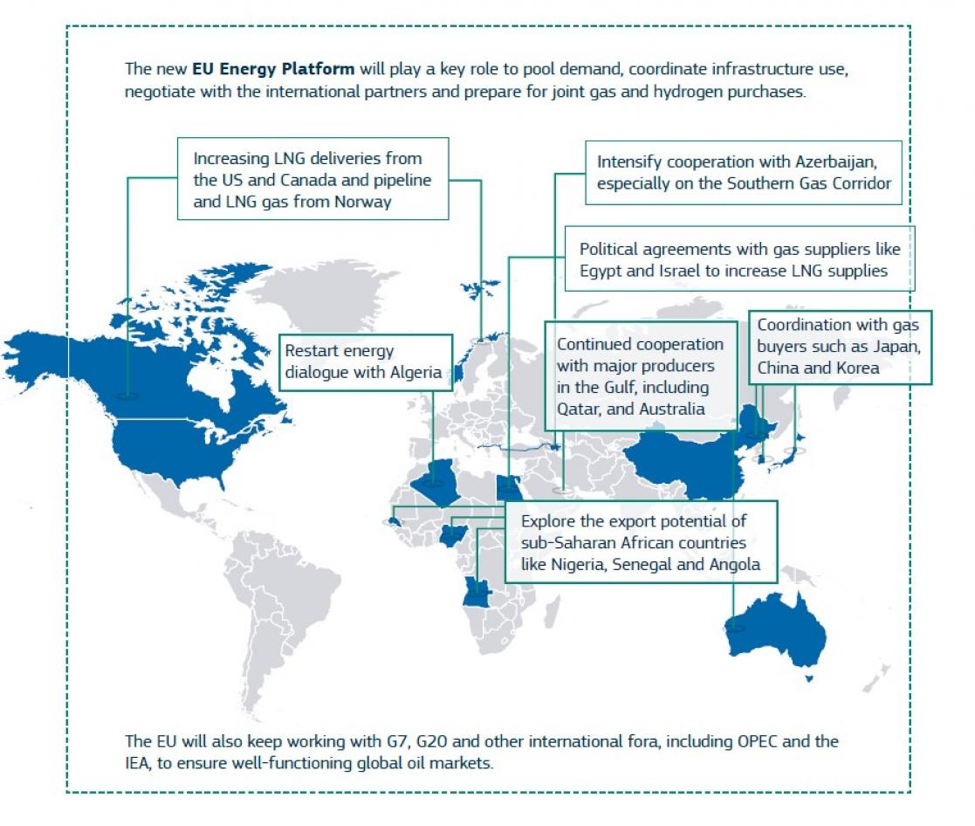
And so it seems that within Africa the opportunity is for existing producers, or those with projects on the cusp of production, that can supply gas before 2030. These could include Angola, Egypt and Nigeria insofar as they can quickly ramp up production. Senegal has already sold the LNG from its initial GTA project, due to start producing in 2023, to Asian buyers, but a final investment decision on a second phase is possible within the next year and production on that phase could start within the next few years.
More generally, expansion of projects with existing infrastructure would be particularly attractive to Europe for a few reasons. It could potentially avoid signing long-term commitments that trigger investments. European officials could also argue that expansions do not constitute development of “new oil and gas fields,” which the IEA has deemed incompatible with achieving net zero by 2050. European demand is unlikely to be much of an opportunity for other countries (or other projects in the above countries) that can only export in the longer-term (2030-2050); these would clearly constitute “new production.”
Europe’s identification of other potential sources of LNG may just be insurance against the possibility that EU-U.S. negotiations fail to result in the full supply of 50 bcm—or a tactic to increase European leverage in those negotiations. Like any insurance policy, this one may not be used, and ultimately significant European demand for additional African supply may not materialize even in the near term. And it may be that Europe wants the “insurance” but isn’t willing to pay the “premium”—or at least not a very high one—in the form of long-term gas purchase agreements necessary to secure financing for projects or funding new infrastructure. If the EU does not plan to make big, long-term investments in African LNG in that way, the responsible course would be to say so explicitly now, rather than leave prospective African suppliers to interpret ambiguities in the strategy.
Officials in producing countries should note these nuances and recognize that Europe and other importers generally prefer to have a diversity of producers, though Europe’s climate considerations may temper the EU’s preference. Many producing countries may never reach the “front of the queue.” Responsible engagement by officials in producing countries would mean avoiding significant risk when jostling for position—by entering a “race to the bottom” negotiation, investing significant public capital to de-risk projects for investors, or getting locked into oversized domestic gas infrastructure that may crowd out cheaper renewable energy alternatives.
EU energy strategy: Missed opportunity on just transition?
In its strategy the EU states that a “just and socially fair” transition is integral to its external energy policy. In practice, its plans around supplier diversification seem shortsightedly agnostic as to where supplies originate—essentially anywhere but Russia.
In a truly just transition, the EU would reduce rather than increase gas imports from countries such as the U.S. and Qatar, as these wealthier countries should be among the first to cut production in a just fossil fuel phaseout. As researchers and advocates for an equitable transition are increasingly recognizing, countries with more urgent development needs should have priority within the remaining carbon budget given their lower capacity to finance their own even more challenging energy transitions. In the absence of an agreed international framework for managed phaseout of fossil fuels, such priority access for developing producers is unlikely. But the EU should support the development of such a framework—or at least apply just principles where it can, as in its international energy strategy.
If consumer countries fail to adopt good governance criteria when selecting future energy suppliers, they risk repeating the mistakes of the past, when Western companies and governments served as key enablers of Putin’s catastrophic kleptocracy. The EU has laid important groundwork on this front, with democratic values and good governance/transparency as key principles for partnerships under its Global Gateway initiative. However, plans to intensify cooperation with authoritarian regimes as part of the EU’s gas diversification strategy raise concerns about its commitment to avoid enabling corrupt regimes.
As part of a responsible engagement the EU and its prospective African gas suppliers should account for the risk that citizens in these African countries may view gas export to the EU as coming at the expense of domestic energy plans.
Developing countries’ domestic energy needs, particularly in Africa where about 600 million people (around half of the population) lack access to electricity, are essential to a just transition. The EU should prioritize delivering on its stated support for increasing renewables in such countries. The strategy’s recognition that renewable energy exports to Europe (e.g., as green hydrogen) should not adversely impact a country’s domestic energy access is significant; the EU should develop this further. But the EU strategy is noticeably silent on the potential impact of increased gas exports to Europe on domestic energy needs in gas-producing countries. This is particularly relevant for discussions around sub-Saharan African gas producers, given the significance (rightly or wrongly) assigned to gas in strategies for addressing domestic energy needs. As part of a responsible engagement the EU and its prospective African gas suppliers should account for the risk that citizens in these African countries may view gas export to the EU as coming at the expense of domestic energy plans. This could accelerate resentment as Europe uses African gas while objecting to gas-supported electrification within Africa for climate reasons.
A way forward
More broadly, the EU should redouble its engagement around ensuring a just transition for developing countries that produce, or aim to produce, fossil fuels. The strategy’s reference to these countries’ interest in exporting green energy shows that the EU appreciates the importance of replacing revenue sources that lower-income countries will lose as part of the energy transition. The EU should support such long-term “revenue smoothing.” This could be part of an Africa-EU green energy initiative inclusive of partnerships of the type launched with South Africa at COP26.
The EU and producer countries should not over-rely on the idea included in the strategy that combining gas cooperation with long-term energy cooperation on hydrogen can “avoid stranded assets and ensure the green transition.” Avoiding stranded assets should be a priority, but not based on an overly broad assumption that fossil fuel infrastructure can be repurposed for other uses.
The EU should instead avoid stranded asset risk in the first place by being as clear as possible on likely future gas demand. With that clarity, African gas-producing countries can determine whether and how they can benefit in the short-term, while avoiding the temptation to sink billions of dollars in public capital in projects predicated on long-term European demand.
Podcast: Fossil Fuels and Climate Change, Featuring NRGI’s David Manley

In this episode of Sheila Khama’s Extractives podcast produced on 17 August, David Manley, a senior economic analyst with NRGI, discusses what the energy transition is, its drivers and responses, and its impact on regions like Africa.
In the recording, Manley highlights a technological revolution and a huge shift in the way we use technologies, such as solar or wind power generation, as well as the radical decline in the cost of these technologies.
“The Paris Agreement is also, to some extent, driving the energy transition," Manley says. It gives investors and businesses some certainty that over the next few decades there will be a market for renewable energy."
Regarding the impact of global energy transition on oil- and gas-producing countries in Africa, Manley points to a foreseeable decline in demand for their exports. However, as the African continent is particularly vulnerable to the severe effects of climate change, he also points to some of the benefits of global transition:
“By far these severe effects will outweigh most of the economic effects from reducing fossil fuel demand. So if the energy transition and the Paris Agreement can help limit that change, that is a great thing we should be aiming for.”
One significant upside for some countries is the increasing demand for metals and minerals, such as copper, cobalt and lithium, which are needed to develop green technologies. With demand for these metals expected to increase in the coming decades, many mining countries could benefit. Manley emphasizes that Africa has the most to gain from this boom.
Given the challenges and opportunities facing resource-rich developing countries, Manley stresses the importance of good governance for a successful transition.
He explains: “For oil- and gas-rich countries, the top priority is to manage these risks, be proactive and ensure that governments are not assuming high oil prices and that everything will be fine. We need to make a big change, using scenarios and thinking more pessimistically, for example, if there is a big drop in gas prices and collapse in production, what that means for countries’ economies and finances, and develop a plan to respond before it is too late.”
David Manley is a senior economic analyst at the Natural Resource Governance Institute (NRGI).
How Ghana Can Map Its Energy Transition Journey

At the COP26 climate conference last year, governments reaffirmed their commitment to the goal of limiting global warming to 1.5°C. Achieving this will require a colossal and unprecedented shift away from fossil fuels to renewable energy sources like wind and solar—as well as provision of clean, affordable and reliable energy for the nearly one billion people currently living without it.
The wealthiest countries that have polluted the most should hold the primary responsibility for tackling climate change, both in cutting their emissions first and fastest, and in providing climate finance and support to countries like Ghana. Ghana’s President Nana Akufo-Addo emphasized this responsibility during COP26 when he called for a fair and equitable solution that “recognizes the historical imbalances between the high emitters and low emitters.”
To date, however, wealthy countries have under-promised and underdelivered. They have yet to reduce emissions to the extent necessary to avoid warming beyond 2°C, let alone 1.5°C. And, as President Akufo-Addo also mentioned, they have failed to honor their 2010 promise of USD100 billion per year to support developing countries’ responses to climate change. Tragically, the consequences will be felt by all for decades to come.
Ghana’s agency in the energy transition
Despite this compound injustice and these broken promises, Ghana’s future ultimately depends on its own leadership and effective planning. Ghana is still a resource-dependent country, with more than a quarter of its export earnings coming from oil and gas alone. Over the past decade, the oil sector has contributed around $6.5 billion of direct revenue to Ghana’s budget. Without a plan to respond to the global energy transition, a significant decline in oil revenues could plunge Ghana into a deep crisis.
Globally, oil and gas projects currently in the pipeline worth an estimated $400 billion run the risk of not breaking even. Against the backdrop of the global energy transition, GNPC’s ambitions of becoming an operator are risky.
At a minimum, the government should avoid making bad decisions—those that threaten the country's economic and fiscal outlook. But Ghana’s record does not inspire confidence. In the last decade, the government has allocated $2 billion to the Ghana National Petroleum Corporation (GNPC). These investments have financed equity stakes in exploration, development and general operations in oil-producing fields. NRGI’s Risky Bet report shows that, globally, oil and gas projects currently in the pipeline worth an estimated $400 billion run the risk of not breaking even. Against the backdrop of the global energy transition, GNPC’s ambitions of becoming an operator are risky.
In July 2021, Ghana’s Ministry of Energy and GNPC declared their intention to sink an additional $1.65 billion of public money into shares of Aker Energy's oil project—yet another “risky bet” given the increasing pace of the global energy transition, which would result in poor returns on such a large-scale investment. Furthermore, such a decision would divert precious capital that the government could invest in more socially beneficial programs such as education or cheaper and more diverse energy sources that could power development in Ghana. Thankfully, after severe criticism from civil society organizations, the public and industry oversight bodies in Ghana, the government paused its investment plans in the Aker shares.
No doubt, Ghana’s economic and fiscal outlook is uncertain. The 2018/19 oil licensing round remains unconcluded and oil production is projected to decline. International companies are redirecting their investments, and projects have been delayed. State oil revenues peaked in 2018, at 10 percent of total government revenue, and dropped to seven percent in 2020 due to the coronavirus pandemic. The ongoing war between Russia and Ukraine and the related global energy crisis now present huge uncertainties for the oil sector, including the prospect of a global recession.
The good news is that Ghana now has a golden opportunity to develop a comprehensive and context-specific plan for navigating the global energy transition. In response to COP26 and Ghanaian CSOs’ demands for a national energy transition policy, the government launched the National Energy Transition Committee (NETC) in December 2021. The committee is tasked with developing a national policy document on steps the country can take to successfully navigate global energy transition. The NETC is also tasked with conducting a nationwide consultation on Ghana’s energy transition. At the first regional forum organized by the Ministry of Energy on behalf of the NETC, Vice President Dr. Mahamudu Bawumia said the NETC’s nationwide consultations are key to success: “We need to develop plans and implement options that people can relate to.” He also stressed the importance of equal opportunities for all citizens to enjoy the benefits of the energy transition and ensure social justice in the process.
Essential elements for Ghana’s approach
The establishment of the NETC is an important and valuable first step. The following recommendations, if adopted, would put the committee on track to deliver a successful energy transition plan:
- Include all voices. Ghana’s plan should be inclusive and leave no citizen behind. The plan should address how government will support local economies with relevant training, technology and finances to take advantage of the new opportunities in the transition.
- Enlist experts. The NETC should engage sector experts working on the energy transition to help ensure that the plan is informed by data and technical analysis.
- Promote open dialogue. Open and honest engagement between all relevant stakeholders will help build consensus and ownership around a transition pathway that is widely considered by citizens as viable and necessary. A shared understanding of the risks and opportunities of the energy transition is critical to agree on a shared strategy.
- Plan in harmony and coordination with existing policies. The energy transition plan should harmonize existing policy objectives and remedy the systemic inefficiencies in existing policy implementation.
- Improve governance of climate finance. The Ministry of Finance should spell out the role of international climate finance in energy transition planning and interrelate the energy transition plan with Ghana’s (conditional) nationally determined contributions under the Paris Agreement. Across the board, this requires building the state’s capacity to receive and deploy international climate finance.
- Take a critical and dynamic approach to energy options. The transition plans must address Ghana’s growing energy needs. Decisions about energy sources and related services should be based on analyzing different solutions over the long term, mindful of the likelihood that many factors (such as the competitiveness of renewables and gas) may change quickly over the coming decade. Accordingly, the NETC should review the role of fossil gas over the course of the transition—not assume from the outset that gas will be a constant.
- Assess implications for existing institutions. Ghana’s energy transition plan should consider the role of existing institutions such as GNPC in light of the long-term, macro pathway, rather than starting with assumptions about their purpose and role. Making the right investment decisions will require transparency and robust risk assessment.
The energy transition brings risks for national oil companies and governments reliant on oil revenues.
Ending Nigeria’s Oil Dependency: Not If, But When…and How

The issues of “post-oil” and economic diversification received considerable attention in Nigeria after the 2014 commodity price crash, again during the 2016 economic crisis and more recently with the coronavirus pandemic influenced global crisis. Over that period, recognition of the dangers of Nigeria’s dependency on oil has led to several initiatives aimed at securing changes in government policy to address the problem. Here we examine Nigeria’s oil dependency within the context of emerging global and national imperatives to provide some initial recommendations to frame the Natural Resource Governance Institute’s (NRGI) newly constituted Nigeria program designed to focus on "Nigeria’s Oil Dependency: Imagining a Future Beyond Oil."
Nigeria’s oil dependency through the years
Nigeria’s dependence on oil is deep-rooted. The country continues to suffer from the effects of the Dutch disease which began when oil was discovered in the 1960s, having focused its efforts predominantly on its oil resources; the potential for greater returns from oil making other sectors less attractive. But, decades later, little has changed in Nigeria. Although the oil sector continues to deliver returns, these have depreciated over the years, hindering success of Nigeria’s development aspirations; Vision 20:20, the Economic Recovery and Growth Plan (ERGP), often just out of reach as they continue to rely on the performance of the global oil market.
How dependent is Nigeria on oil?
Nigeria’s federal and state governments remain heavily dependent on oil revenues, relying on it to deliver public goods and the use of oil dollars to service debt and bolster the national currency. The oil sector, however, has not significantly improved the well-being of Nigerians. Non-oil sectors lead to vastly more employment opportunities than the oil sector and their economic activities contributed approximately 93 percent of GDP in 2020.
Continued dependence on oil revenues threatens the lives and livelihoods of Nigerians and social cohesion in the country.
At the federal level, Nigeria’s dependence on oil almost crippled her economy catalyzing a negative GDP growth of 1.8 percent in 2020. The pandemic highlighted the potential losses to the Federation of the Federal government’s more than 50% revenue dependence on oil, as the shutdown of global economic activities, onslaught of the pandemic and sharp declines in oil demand in 2020 left the government unable to meet its 2020 revenue projections. The federal government had to slash its budget by a more realistic 20 percent, reducing its benchmark price and production projections from $57 per barrel to $30, and anticipated production volumes from 2.2 million barrels per day (mbpd) to 1.7 mbpd consecutively to accommodate new realities. Continued divestments by oil majors and their refocus to cleaner energy threatens Nigeria’s future ability to attain its revenue projections if they remain pegged against oil productions. Nigeria’s debt stock in 2020 stood at 31 percent of GDP and continues to grow as it tries to bridge the shortfalls in oil revenues. Despite this stark reality, the 2022 federal government budget still reflects 31 percent of expected federal government revenue generation from oil even as oil exports continues to supply 90 percent of Nigeria’s foreign exchange and half of federal government revenues. Continued dependence on oil revenues threatens the lives and livelihoods of Nigerians and social cohesion in the country.
Meanwhile, almost all of Nigeria’s states depend on oil revenues, channeled from the Federation Account and Allocation Committee (FAAC), for more than 50 percent of their fiscal needs. The most dependent are the oil-producing states, with Bayelsa state and Akwa Ibom state averaging 85 percent of their fiscal dependence on oil revenues. Only Ogun state and Lagos state draw less than half of their revenues from the FAAC consistently. Oil-producing states risk being fiscally unviable without oil. These states must urgently find alternative sources of revenue beyond FAAC to build their fiscal resilience before oil demand peeks. Those residing in those states must ask for diversification of their states’ revenues, with a greater focus on revenues generated internally beyond oil.
Ending dependency and preparing for a future beyond oil
Nigeria currently is at a pivotal point in its history where decisions made now will weigh heavily on its economic survival. After previous financial crises—the halving of Nigeria’s Stock Exchange All Share Index in 2008 and the 70 percent commodity price crash in 2014—Nigeria’s economy eventually rebounded as oil demand and price recovered. But this will no longer be the case if Organization of the Petroleum Exporting Countries (OPEC), the International Energy Agency (IEA) and others are correct when suggesting that we will soon reach peak demand for oil. So, ahead of that eventuality, the government must make plans to replace the huge shares of government revenue and foreign exchange earnings for which it presently relies upon oil.
The federal and state governments must make critical and strategic decisions carefully to position its economy for a future without oil. Oil will lose its value, so Nigeria must build its resilience in anticipation of that future, and take advantage of all the opportunities available in the African corridor, the growing green economy, technology, and non- sectors that speak to its unique advantages.
Gas takes a long time to bring profits and, if Nigeria is to transit using gas to industrialize and energize before attaining its COP 26 carbon neutrality plans by 2060, a clear plan and pathway for how it intends to transition to other energy options with trackable milestones is required.
Looking more closely at the federal government’s short-term plans to maximize its oil and gas endowments, there are obvious challenges. Firstly, investments in frontier explorations as provided for in the Petroleum Industry Act (PIA) may pose some risks in locking in revenue that may not yield the desired returns. Gas as a "transition fuel" requires significant capital investments and as a fossil fuel is likely to eventually lose out on investments to greener alternatives. Gas takes a long time to bring profits and, if Nigeria is to transit using gas to industrialize and energize before attaining its COP 26 carbon neutrality plans by 2060, a clear plan and pathway for how it intends to transition to other energy options with trackable milestones is required. In addition, if natural gas exports are expected to supplement foreign exchange earnings from oil in the short-term, lower longer-term investments may mean that those gains won’t last. Buffers need to be put in place to account for that or the growing investments made in cleaner fuels may put natural gas projects at risk of becoming “stranded assets”—with revenues sunk before realizing any value. It is critical that the Federal Government makes strategic spending decisions as oil’s role in meeting global energy demands continually declines over time.
The executive’s branch’s plan to dig deeper into fossil fuel investments by committing $1.5 billion to refurbishing historically unprofitable refineries, frontier exploration and sustaining fuel subsidies may put Nigeria’s future at risk if the alternative costs are not appropriately assessed. Even then, crude oil production to meet the government's ambition to ramp up production is threatened as majors like Shell, ExxonMobil, Chevron and Total rebrand as “green” to reflect investor appetite and the global energy transition. These international oil companies have been selling Nigerian assets, which will likely continue as the energy transition accelerates. Importers of Nigeria’s petroleum products are also seeking greener options. The top five export destinations for Nigeria’s petroleum products (India, Spain, Netherlands, United States and China) have committed to achieving carbon neutrality between 2030 and 2050. This puts further strain on Nigeria’s short- to medium-term capacity to generate and sustain its foreign exchange earnings as oil demand falls. Oil-producing regions will also be further strained as legacy environmental pollution and oil dependence induced economic and social challenges will remain if a ‘just transition’ is not prioritized.
Beyond oil, the federal government should accelerate revenue diversification through trade and domestic production, leveraging other sources of foreign exchange. Attracting foreign exchange earnings could be done by backing enablers that add greater value to local products, offering greater support to the manufacturing sector, developing Nigeria’s critical minerals in the mining sector to leverage the green economy, boosting regional trade through the African Continental Free Trade Agreement (AfCFTA) 2020 are other ways to improve and leverage domestic production diversification for more jobs and economic growth, key goals of the Nigerian government.
The Federal Ministry of Finance, Budget and National Planning should devise a comprehensive and inclusive plan with concrete and measurable milestones in collaboration with relevant Ministries, Departments and Agencies that speaks to Nigeria’s context, and accounts for both risks and opportunities to reduce oil dependence. That plan must then be implemented collaboratively. Nigerians’ opinions must be sought on the best approach to wean the country off its dependency on oil. They must agree on a timeline and pace for reform, and identify priority areas of focus. During the upcoming 2023 electoral campaigns, presidential and gubernatorial candidates; especially oil producing states must be required by citizens to outline plans to build fiscal resilience away from oil dependence. Civil society, accountability actors and the public must sustain dialogue and make economic diversification a major theme in the 2023 elections—on the campaign trail, in candidate commitments and party platforms.
Uganda’s Oil: Seven Recommendations After the Final Investment Decision

On Tuesday 1 February 2022, the project’s joint venture partners, TotalEnergies, China National Offshore Oil Corporation (CNOOC) and Uganda National Oil Company (UNOC), announced that a final investment decision (FID) for Uganda’s Lake Albert development project was reached, a major step in the country’s oil sector. The project covers two upstream blocks and the development of an export oil pipeline, the East African Crude Oil Pipeline (EACOP), which will transport most of the oil through Tanzania to then be shipped overseas. The deal will see investments of about US$10 billion in the development of crude oil production in East Africa, with first oil expected in 2025.
With the FID now announced, Uganda’s government has a few pending critical issues it will need to take into consideration if oil resources are to benefit current and future generations of citizens.
Getting the oil project financed
While FID has been announced, financing is yet to be secured for the development of EACOP, whose estimated cost has jumped from $3.5 billion to $5 billion due to increased costs as a result of production and transport disruptions caused by the COVID-19 pandemic, as well as an estimated additional $4 billion needed for the refinery and refined products pipeline.
For this reason, the joint venture partners in the Lake Albert project and the pipeline have turned to financing institutions. However, most institutions, including the International Finance Corporation (IFC), are hesitant to invest in the project due to the risks associated with the energy transition, as well as environmental and social concerns. The Ugandan government may instead have to turn to non-concessionary loans to finance their share in the joint venture, which could turn out to be expensive in the long run and may affect the returns from the project.
Uganda’s 15 percent equity in the upstream will be financed by the production share, but the Ugandan government needs to secure resources for the 15 percent shares in EACOP as well as the planned 40 percent equity in the refinery. Uganda’s government has fortunately already considered the size of the stake in the refinery it will take and is also already weighing options for allocating some of the shares to East Africa Community (EAC) partners and other institutional investors.
Taking into account investments in renewable energy
At the same time, a Memorandum of Understanding (MoU) was signed between TotalEnergies E&P and the Ministry of Energy and Mineral Development of Uganda for the development of large-scale renewable energy projects, confirmation of the reality of the energy transition, which may affect future oil prices. If the government invests substantial resources in the oil sector, lower returns caused by the risks associated with the energy transition may prevent these investments from delivering a viable return in the long term. The consequence is that some of the investments are likely to become stranded. If the resources are borrowed, it will be difficult for Uganda to repay these loans and this may result in default.
Ensuring long-term benefits from the oil sector
To reach the FID, the Ugandan government had to grant generous exemptions to the international oil companies and to key contractors involved in the project under the EACOP Act (2021). The government also facilitated the sale of Tullow Oil’s stake in Uganda’s oil sector. These compromises will have implications for the optimal design of the revenue management framework and may affect the amount of revenue that would accrue to the government from oil operations.
In addition, the government granted UNOC legal and beneficial ownership of the resources from crude oil operations to enable the company to meet the government’s financial obligations for the oil sector. While this is not inherently a challenge, an NRGI study on national oil companies (NOCs) underlined the importance of accountability mechanisms to ensure that resources under the control of NOCs are managed effectively.
The risks linked to the energy transition may impact how much revenue the project will make as prices are expected to fall over the lifetime of the project.
While oil prices can be volatile, with the FID reached and a break-even price of around $49, the project is now very likely to go ahead. However, the risks linked to the energy transition may impact how much revenue the project will make as prices are expected to fall over the lifetime of the project. If the world meets the Paris Agreement, the Climate Policy Initiative estimated that the Lake Albert project may produce only 81 percent of its reserves, resulting in lower revenues and an early end to production.
Uganda is also due to receive royalties from oil operations. NRGI estimates that royalties of 12.5 percent on average will amount to about $10.5 billion, based on crude oil price of $60 per barrel, with designated oil-producing local governments expected to receive about $630 million over the 25-year lifetime of the project, based on the same crude oil prices of $60 per barrel.
However, the government is yet to designate the local governments that will benefit from royalties. This may likely affect their preparedness to finalize development strategies and benefit from accrued oil revenues.
In order to translate the aspirations of the country into concrete revenues and long-term benefits for the country and its people from oil production, NRGI makes the following seven policy recommendations:
- Strengthen transparency and reporting provisions in the Public Finance Management Act (2015) to ensure that UNOC is managed in a transparent and efficient manner.
- In addition to the fiscal rules set out in the Charter of Fiscal Responsibility (CFR), develop a longer-term strategy to manage oil revenues, particularly in light of the long-term shift away from fossil fuels.
- Undertake periodic reviews of tax exemptions and incentives that may reduce government revenues from taxation of the oil and gas sector.
- Support the capacity of the private sector to engage in the oil sector to enhance backward linkages.
- Publish the list of local governments that will benefit from royalties and support the finalization of development strategies to ensure that local governments benefit from revenues accrued to them from oil production.
- Review the level of stake equity and consider using less risky support to the refinery, such as sovereign guarantees.
- Manage public and political expectations as the oil project may take longer than expected for substantive oil money to flow into government coffers and before local community benefits can be realized.
New Strategic Minerals Videos: Supply Chains and Governance Challenges in Andean Countries

Español »
The urgency of the global transition to clean energy sources and the need to implement the Paris climate agreement, coupled with economic recovery from the coronavirus pandemic, have significant implications for the extractive industries. This means new challenges and opportunities along the supply chains of minerals such as lithium and copper, demand for which continues to grow because of their use in green energy generation technologies. In parallel, polluting minerals such as coal face the possibility of becoming “stranded assets,” resources that have lost their value due to changes in global energy consumption.
In this context, the Natural Resource Governance Institute (NRGI), with the support of the German Cooperation (GIZ), has produced videos on three topics: coal in Colombia, lithium in Bolivia and Chile, and copper in Peru. These videos explore perspectives on critical minerals and governance challenges in South America’s Andean countries and can serve as a starting point for much-needed dialogue.
Bolivia and Chile: Challenges and gaps for the industrialization of lithium and its inclusion in global chains
There are high expectations around lithium due to the projected growth in demand for batteries for electric vehicles, in which lithium is a key component. However, enthusiasts must better understand projections of the lithium market and the battery industry in a context of greater dynamism in the global energy transition.
Changes in the energy matrix will lead to a greater demand for lithium, so countries with significant lithium reserves must consider the feasibility of adding value to its production to participate in the global market. In addition, to strengthen the governance of the sector, governments must plan how to manage the social and environmental impacts. The growth in demand for lithium is an opportunity to discuss the energy transition, mining governance, as well as the increase in electromobility in producing countries such as Bolivia and Chile.
Peru: Environmental and social impacts around the copper supply chain
Copper is the main export of Peru, the second-largest exporter of copper concentrate in the world. As an important source of foreign exchange and revenue, copper contributes significantly to Peru’s national economy.
In the context of energy transition and the use of new technologies for the mineral-intensive generation of renewable energy, demand for copper (needed in most green technology) will grow. However, Peru has a series of governance problems, such as mining conflicts related to water and land access, as well as poor citizen participation. The government, with the support of different actors, must urgently strengthen mining governance so that the sector contributes to economic recovery, respecting the rights of the populations and with policies that promote the development of economic linkages, following criteria of sustainability and inclusive employment.
Colombia: Coal supply chain in a context of energy transition
Thermal coal is Colombia's second-largest export, after oil, and is an important source of economic activity and tax revenue. However, despite the abundance and quality of reserves, Colombia’s thermal coal industry faces a difficult future likely characterized by a long-term structural decline in demand, influenced by the increase in electricity generation from renewable sources versus fossil fuels, of which coal is the dirtiest.
The International Energy Agency forecasts that coal prices will ultimately decline, in all scenarios, and coal is at risk of becoming a stranded asset — hence the urgency for the transition to other forms of energy generation and the search for alternative economic activities for the regions dependent on this mineral. The transition to other forms and sources of energy opens the door to new governance models for natural resources. To reap those benefits, governments and other actors involved must therefore agree on a just transition plan that strengthens productive capacity, promotes new economic sectors and solves environmental liabilities.
Video: National Oil Companies and the Energy Transition

NRGI has published a new report, Risky Bet: National Oil Companies and the Energy Transition, contrasting the investment plans of national oil companies (NOCs) with global commitments to climate action.
The report finds that NOCs are set to invest $400 billion in costly oil and gas projects that will only break even if we fail to take the action necessary to keep global warming within 2°C.
Watch the video to learn more.
Read the report.