
National Oil Company Transformation: Strategic Choices for an Uncertain Energy Future

National oil companies (NOCs) are among the most important actors in the global energy system. They already produce the majority of the world's oil and gas—54 percent of global oil and 50 percent of gas in 2025—and their combined share is projected to rise to around 62 percent by 2050. Significant amounts of public money flow to NOCs1 —in 2025, NOC capital expenditure (US$240 billion) was more than three times that of the oil majors (US$73 billion)2 , and well over a trillion dollars of new investment is expected before 2033.
Beyond these metrics lies another important truth—in many countries, NOCs are deeply entwined in national identity and are often anchor employers for entire communities and regions. They help fund public services, shape national budgets, and support jobs and local economies. In some cases, their decisions affect everything from energy access to infrastructure investments.
Against today’s backdrop of geopolitical turbulence, volatile oil prices and the energy transition, governments face difficult decisions: how to balance near-term revenues with long-term risks, and how to align NOC strategies with broader development goals. (See here for a more detailed exploration of the strategic context facing NOCs). The right choices could see NOCs become engines for inclusive, prosperous societies and critical players in a just energy transition. Conversely, strategic missteps could see NOCs become drivers of waste, corruption, inequality and environmental harm.
Today, NRGI is publishing National Oil Company Transformation: Strategic Choices for an Uncertain Energy Future—a new report that lays out a clear, five-step framework that governments, NOC leaders, civil society and other stakeholders can use to seize new opportunities, minimize risks and define credible transformation pathways. The report is published as NRGI marks its 20th anniversary under the theme “Transforming resource governance for a new era”. We are committed to using the anniversary as a milestone to take stock of what has been learned and to put that knowledge to work on the challenges that will define the coming decades. Few are more consequential than the question of how NOCs navigate the current uncertain environment and the energy transition.
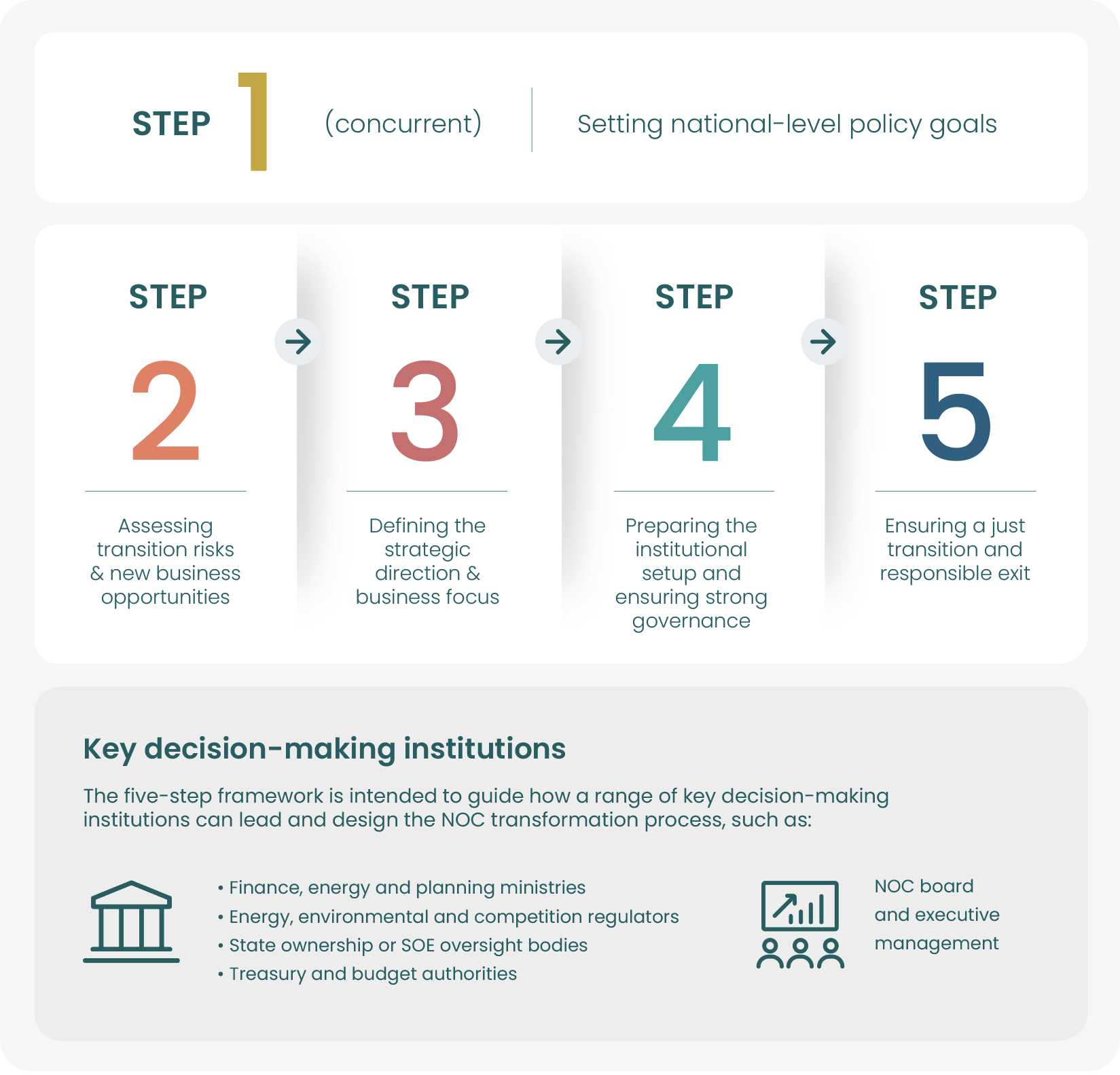
To meet the needs of policymakers, National Oil Company Transformation: Strategic Choices for an Uncertain Energy Future includes country examples and guiding questions to aid the strategic process. The report also pays particular attention to two areas that are often underexplored: assessing transition risk and new business opportunities, and ensuring a just transition and responsible exit.
On transition risk, the report shares striking analysis from NRGI’s earlier Riskier Bets report. NOCs face sharply different levels of exposure—from Uganda's UNOC and Cameroon's SNH, where more than 80 percent of planned investments may not break even under plausible transition scenarios, to lower-risk NOCs with more resilient, lower-cost portfolios. The report also challenges the assumption that a pivot to gas automatically reduces risk, examining how price volatility, contract structures and rapidly falling renewables costs complicate that picture.
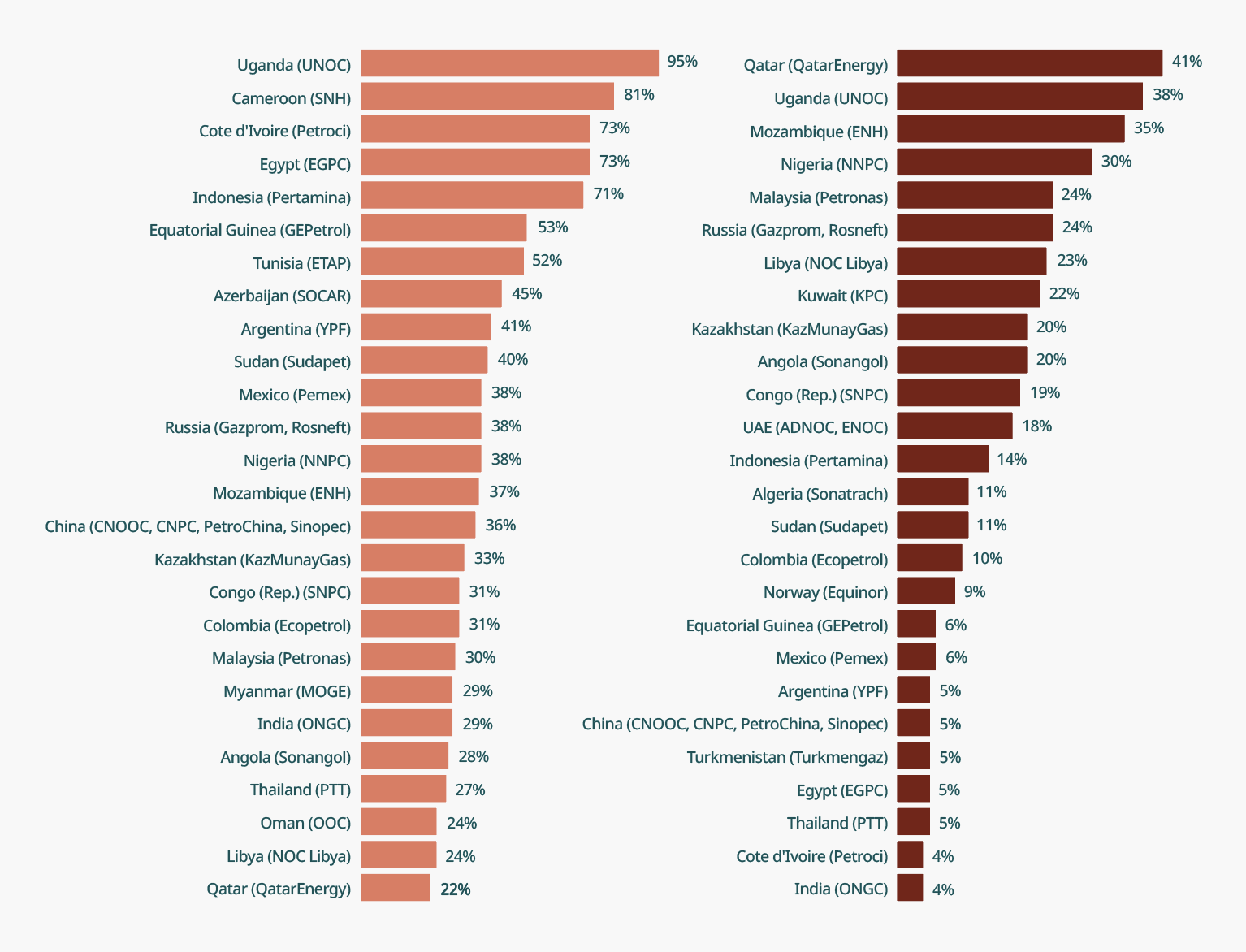
break even under APS (left) and as a percentage of annual government expenditure (right)1
On just transition, the report is equally substantive. NOCs are not only commercial entities—in many producing regions they are anchor employers and service providers, and their transformation carries real consequences for workers and communities. The report draws on emerging practice from NOCs including Petronas, Petrobras and PetroSA to set out concrete strategies for workforce transition, subnational economic diversification and community engagement.
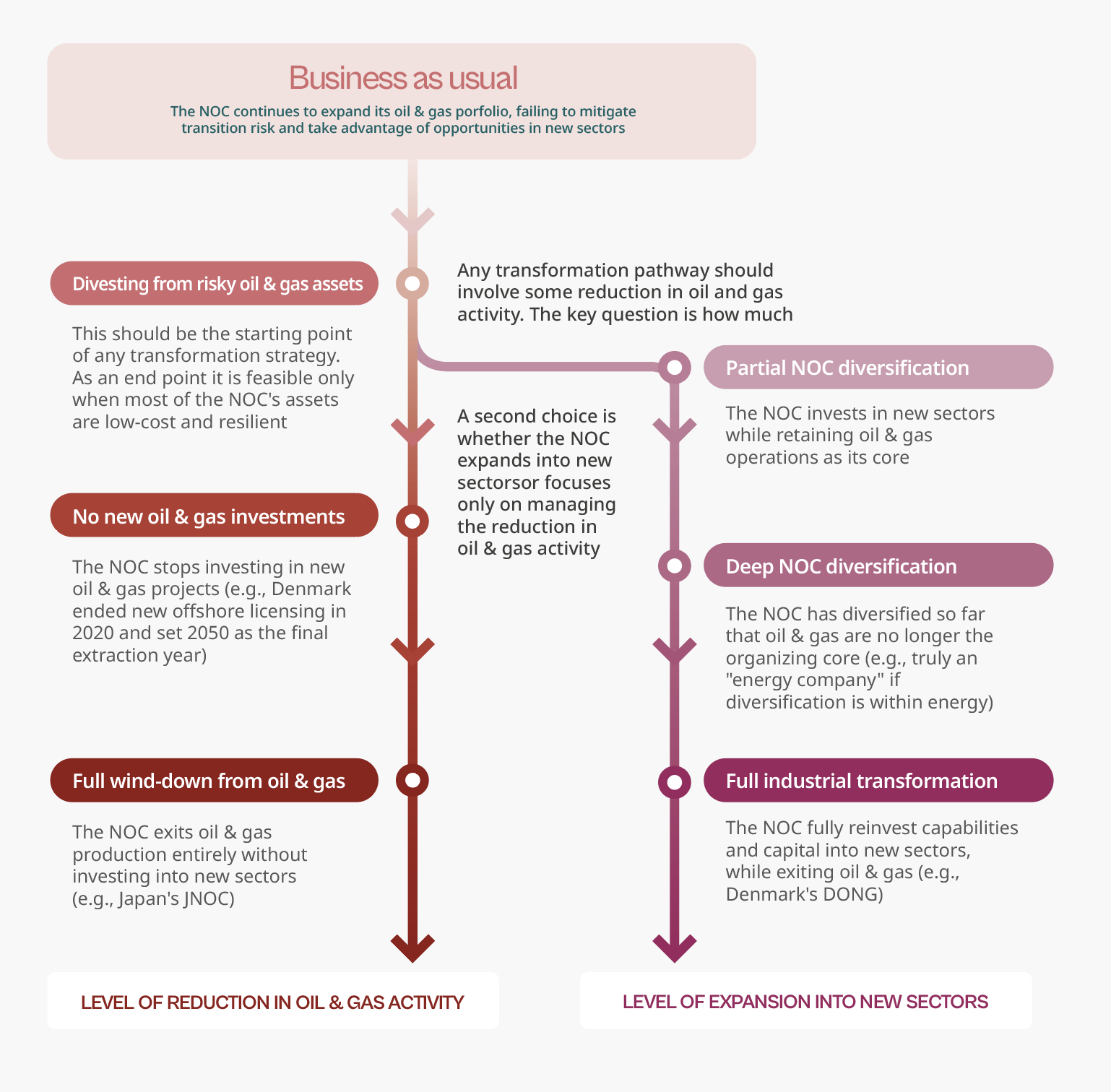
The report is clear that there can be no "one-size-fits-all" model. Policymakers must make difficult trade-offs with the well-being of all of a country’s citizens in mind, and the framework is designed as an entry point for structured dialogue rather than a prescriptive blueprint.
The report is equally clear that business-as-usual is not a neutral option. Amid structural shifts in energy markets, inaction will expose countries to rising fiscal, social and political risks. NRGI’s Riskier Bets analysis showed that under a scenario in which governments meet their existing climate pledges and global oil demand falls accordingly, around 25 percent of planned 2023–2032 upstream investments across NOCs may fail to break even—with significant consequences for governments and their citizens. Governments and NOCs must act now, proactively reviewing and refining their strategies in response to energy transition pressures and opportunities. We hope that this report is both a spur to action and a practical tool for change.
Download the report today, and register for a webinar on 21 April during which we will unpack the report in more detail, and hear directly from policymakers and NOC executives on how they are meeting this moment.
If you want to connect with NRGI to learn more about our work on NOCs, you can reach out to Andrea Furnaro
Authors

Andrea Furnaro
Senior Policy Analyst

Giovanni Tagliani
Contributor

Patrick Heller
Chief Program Officer

Ana Carolina González Espinosa
Senior Director for Programs and Latin America Director

Tengi George-Ikoli
Nigeria Country Manager

Fernanda Ballesteros
Mexico Country Manager

Nicola Woodroffe
Lead Legal Analyst